7 best educational PC games for kids in 2026 (all ages 7+): Noun Town Language Learning (vocabulary, 12 languages, $19.99), Minecraft Education Edition (coding and creativity), Scribblenauts Unlimited (vocabulary and creative thinking), Zoombinis Logical Journey (logic and maths), Prodigy Math Game (curriculum maths, free), The Oregon Trail (history and decisions), and Poly Bridge 2 (physics and engineering). Each one teaches real skills through gameplay, not quizzes.
Finding games that are genuinely educational and fun at the same time is harder than the marketing suggests. There are plenty of games labelled "educational" that are little more than worksheets dressed up with animations. The ones in this list are different. Children play them because they want to. The learning is built into the gameplay, not bolted on top of it.
Every game here is suitable for children aged 7 and up, runs on PC (most also on Mac), and has a track record of producing real learning outcomes. Below each entry you will find an embedded trailer so you can get a feel for the game before spending anything.
Noun Town drops children into a colourful 3D town where every object has a name in the language they are learning. They explore, interact with characters, hear words spoken by native speakers, and get gentle prompts to say words back using the microphone. The game covers 12 languages: Japanese, Korean, Chinese (Mandarin), Spanish (Spain and Mexico), French, German, Italian, Russian, Greek, Egyptian Arabic and English.
What sets it apart from flashcard apps is the spatial context. Words are encountered in a believable environment, attached to physical objects, which is how children naturally absorb vocabulary in real immersion. A built-in spaced repetition system then schedules words to come back at the right intervals to keep them from fading. Speech recognition gives children real-time feedback on their pronunciation, which is something very few tools at this price point offer.
The Noun Town language learning game has 590+ reviews on Steam with an 87% positive rating and has been played by over 200,000 people across the series. There is a free demo on Steam if you want to let your child try it before buying. At $19.99 for a one-time purchase covering all 12 languages, it is good value by any measure.
Free demo, no sign-up needed
Minecraft needs no introduction, but the Education Edition is worth explaining on its own terms. It is a separate product built on the same engine as the standard game, with structured lesson plans, classroom tools, coding challenges (using block-based programming and Python), and curated worlds covering topics from marine biology to historical architecture. Schools in more than 115 countries use it.
Even without the curriculum content, the core Minecraft experience is genuinely educational. Building in a 3D environment develops spatial reasoning and planning. Working within material constraints builds resource management skills. Collaborative projects teach communication and negotiation. The difference with the Education Edition is that all of this is channelled toward specific learning objectives with content that teachers and parents can navigate and assign.
For children who already play regular Minecraft, the Education Edition feels familiar but with more direction. For children new to Minecraft, the Education Edition is an excellent entry point because the structured content gives them something to work toward rather than an open world with no obvious place to start.
Scribblenauts is built on a simple premise: type any word, and that object appears in the game world. Solve the puzzle using whatever you can think of. The game recognises a huge vocabulary and accepts creative, unexpected solutions, which means children are directly rewarded for knowing more words and for thinking laterally.
In practice, children playing Scribblenauts quickly exhaust the obvious answers and start experimenting with stranger, more obscure vocabulary. They look up words they have heard but are not sure about. They test the edges of the game's knowledge because it feels like a challenge rather than a lesson. This kind of active, curiosity-driven engagement with language is hard to engineer deliberately, and Scribblenauts manages it almost by accident as a consequence of its core mechanic.
It also develops flexible thinking. Because there is rarely a single right answer, children get practice at generating multiple possible solutions and evaluating which might work. That is a habit of mind that transfers well beyond the game.
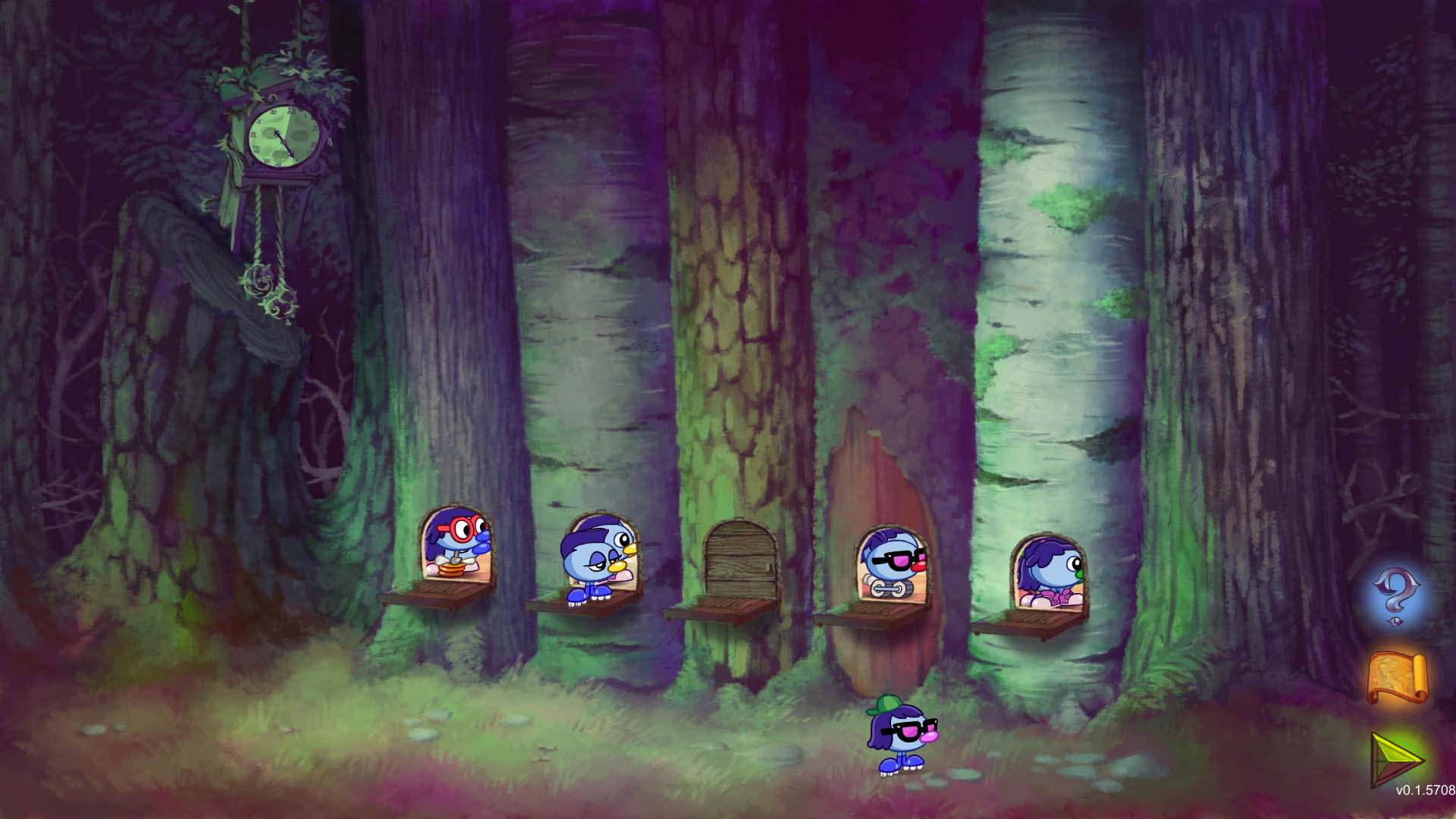
Zoombinis has been around since 1996 and it has been through several revivals because the core design is genuinely outstanding. You guide a group of small creatures (Zoombinis, each with unique physical attributes) through a series of puzzles that require you to infer hidden sorting rules through observation and trial. The game teaches logical reasoning, pattern recognition, set theory, and systematic thinking without ever using those words or any mathematical notation.
Originally developed by education researchers at TERC in collaboration with The Learning Company, Zoombinis was built around the idea that children could engage with sophisticated mathematical thinking if the context was engaging and the feedback was immediate. Thirty years later, the research holds up. Children who play Zoombinis regularly show measurable improvements in logical reasoning tasks that have nothing to do with the game.
The 2015 and 2025 PC releases are the most accessible versions, with improved visuals but the same puzzle design. It is one of the few educational games where the pedagogy is as sophisticated as the entertainment.
Still deciding? If your child is learning (or could learn) a language, Noun Town is our top pick from this list.
Try the free demo on SteamProdigy Math is a browser-based maths RPG for children in grades 1 to 8. The setup is straightforward: you play a wizard exploring a fantasy world, and you battle creatures by answering maths questions. Get the answer right, your spell works. Get it wrong, you take damage. The maths curriculum is drawn from Common Core and other major national standards, and the game adapts question difficulty based on each child's performance over time.
The core game is genuinely free. A paid membership unlocks cosmetic in-game items but is not required to access any of the maths content. For parents, there is a parent dashboard that shows which topics your child has been working on and how they are performing, which makes it easy to align Prodigy sessions with whatever their school is currently covering.
Children who find maths anxiety-inducing often respond well to Prodigy because the pressure shifts away from "getting it right" and toward "keeping your character alive," which turns out to be a meaningfully different emotional context. The questions themselves are identical to what they would encounter on a worksheet, but the framing changes how they feel about attempting them.
The Oregon Trail has been an educational institution since its first version in 1971. The 2021 Gameloft revival, available on Steam, brings it into the modern era with pixel art visuals and updated mechanics while keeping the core experience intact: you lead a party of settlers on the 2,000-mile journey from Missouri to Oregon, managing resources, making decisions, and dealing with the consequences of both.
The history embedded in the game is grounded in real accounts of the journey. Children who play it encounter the actual geography of the trail, the kinds of diseases that killed settlers in the 1840s, the economics of the journey, and the tension between speed and safety. The game opens conversations that a textbook rarely manages to start, because the decisions feel consequential rather than hypothetical.
The decision-making element is the strongest educational component. Children have to weigh short-term and long-term trade-offs, manage uncertainty, and live with the outcomes of their choices. These are transferable skills, and they are genuinely more effectively taught through experience than through instruction.
Poly Bridge 2 is a bridge-building puzzle game where you design structures that must hold specified loads using limited materials and a set budget. When a bridge fails, the game shows you exactly where the stress broke it. You rebuild and try again. The whole loop is a practical lesson in iterative engineering: observe failure, infer the cause, modify the design, test again.
The physics engine is close enough to real structural behaviour that children develop a genuine intuitive feel for load distribution, tension, compression, and material properties. These are abstract concepts when written on a page. After an hour of watching bridges collapse in Poly Bridge, they are concrete and memorable. Many players who go on to study engineering credit games like this with giving them a feel for structural mechanics before they ever encountered the formal theory.
The budget mechanic adds a layer of real-world constraint that most physics games ignore. Building a bridge that works is one challenge. Building one that works within the budget is another. The interplay between these two requirements produces the kind of creative problem-solving that engineering education consistently tries and often fails to teach through conventional methods.
A note on AI in educational games
Every game on this list was built before the major integration of generative AI into educational software. That is worth knowing. AI-generated content in children's tools, particularly AI speech synthesis and AI-produced learning material, is an area where quality control and factual accuracy are not yet reliably established. Parents considering newer products should check whether voice acting and curriculum content has been produced and verified by humans.
Noun Town specifically uses professional human voice actors, qualified language teachers for curriculum review, and native-speaker translators and checkers for all 12 supported languages. There is no AI-generated audio in the game. For a language learning product used by children, where accurate pronunciation is critical to forming good habits, this is not a minor distinction. Children who learn incorrect pronunciation early develop patterns that are genuinely difficult to correct. Noun Town's use of real humans at every step removes that risk entirely.
I have two young children. I know exactly what it feels like to spend 20 minutes cajoling a seven-year-old to sit down with their reading or their maths. And I know the contrast when they find something that makes them want to learn: the nagging disappears, the clock disappears, and you end up having to pull them away.
That is what the best educational games do. They do not replace traditional study, and I want to be clear about that. Games will not prepare your child for a specific test, build their handwriting, or develop the sustained attention that comes from reading a chapter book. They are a supplement, not a substitute. But for motivation, for building enthusiasm around subjects that might otherwise feel dry, and for getting children to engage with learning on their own initiative, the right game is worth a great deal. The ones above are the ones I would actually recommend to another parent.
Callan Ratcliffe, Noun Town
Most educational games fail for one of two reasons. Either the learning is not embedded in the gameplay (it is a quiz in a game costume), or the gameplay is not good enough to keep children returning (it is learning software pretending to be a game). The ones that work do both things properly. The education is structural. The gameplay is genuinely engaging on its own terms.
A few questions worth asking before buying any educational game:
The British Council's research on games in language learning and the broader literature on game-based learning from Educational Psychology Review both point in the same direction: engagement is the mechanism. Children learn more from activities they find genuinely compelling. The quality of the activity matters, but so does whether they want to show up for it.
The Royal College of Paediatrics and Child Health has moved away from strict hourly limits in favour of a more nuanced question: is screen time displacing sleep, physical activity, face-to-face interaction, or other important activities? If it is not, the concern is much lower than the "two hours a day" rules many parents have heard.
Educational games sit at the more actively beneficial end of the screen time spectrum. Children playing Zoombinis or building bridges in Poly Bridge are thinking, making decisions, and often talking to a parent or sibling about what they are doing. That is meaningfully different from passive video consumption. It does not mean unlimited play is fine, but the conversation is more nuanced than a single number.
As the personal note at the top of this article says: games are a supplement, not a substitute. The best use of educational games is alongside reading, physical play, and face-to-face learning, not instead of them. Used that way, they are one of the more effective tools available for keeping children genuinely motivated about learning.
Most of what is on this list works well from around age seven upward, but "best game for my child" really depends on the specific age. Here is how the seven picks land across primary school years, plus where each one starts to feel too easy or too hard.
| Age | Best fits from this list | Why |
|---|---|---|
| 5 to 6 | Prodigy Math Game | Free, browser-based, and built for early primary maths. Younger children usually need a parent nearby for reading support, since the game is text-heavy in places. |
| 7 to 8 | Noun Town, Zoombinis Logical Journey, Scribblenauts Unlimited | This is the sweet spot for all three. The 3D exploration in Noun Town, the puzzle logic in Zoombinis, and the vocabulary play in Scribblenauts assume a child who can follow on-screen prompts fairly independently, which lines up with this age band. |
| 9 to 10 | Minecraft Education Edition, The Oregon Trail, Poly Bridge 2 | Children at this age handle the longer decision chains in The Oregon Trail and the more demanding physics puzzles in Poly Bridge comfortably, and get more out of Minecraft's coding challenges. |
| 11 to 12 | Poly Bridge 2, Minecraft Education Edition, Zoombinis (later levels) | Older children tend to want more challenge. Poly Bridge's harder levels and Minecraft's Python coding option both scale up well, and Zoombinis' late puzzles hold up for this age too. |
If your child is younger than five, the section below covers what actually works at that age, since most of the list above assumes a reader working somewhat independently.
Every pick on this page is built for children who can read on-screen prompts and handle a keyboard or mouse fairly independently, which in practice means most of them work best from around age seven, even where a game's own age rating is lower. If your child is younger than that, a couple of adjustments make this list more useful rather than less relevant.
Prodigy Math Game is the most workable option below age seven. Kindergarten and Year 1 children can play it with a parent reading questions aloud, and the RPG framing tends to hold attention better than a straightforward maths app. Noun Town's exploration and word-to-object matching is simple enough that some five and six year olds manage it with light adult support in the room, even though the official guidance starts at seven. Regular Minecraft, played in creative mode alongside a parent, is a reasonable way to build early spatial and planning skills before a child is ready for Minecraft Education Edition's structured content.
None of this is a strong recommendation to buy something built for a different age bracket. If your child is three or four, the honest answer is that most PC games, educational or not, are not designed with them in mind, and time is usually better spent on non-screen activities or apps built specifically for that age.
Prodigy Math Game turns up in search under a lot of different names, including Prodigy Math, Prodigy Game, Prodigy App, and sometimes just "Prodigy." It is all the same product, built by Prodigy Education, and it is the only entirely free pick on this list, which is worth covering in more detail given how often parents look it up directly.
The game covers grades 1 through 8, roughly ages 6 to 14 depending on curriculum pace. Children create an avatar, explore a fantasy world, and answer maths questions to battle in-game creatures. Every question is tied to a real curriculum standard (Common Core in the US, and equivalents elsewhere), and the difficulty adjusts automatically based on performance, so two children on the same account can be working through genuinely different material.
The core maths content is free with no expiring trial. A paid membership, Prodigy Premium, sits alongside it but only unlocks cosmetic extras such as pets, outfits, and in-game currency, not additional maths questions or features. Parents sometimes assume the free version is a stripped-down demo; it is not. The membership upsell inside the game can be fairly persistent, so it is worth sitting with your child for the first few sessions to see how it is presented before deciding whether to opt in.
For oversight, Prodigy offers a separate parent account, also free, that links to your child's login and shows which topics they have covered, how long they have played, and where they are getting stuck. It is the closest thing on this list to a proper progress report, which makes it a reasonable tool to run alongside school maths rather than instead of it.
One limitation worth flagging: Prodigy is entirely browser-based, so it needs an internet connection and works better on a laptop or desktop screen than a phone. There is no downloadable PC client to install.
A fair number of the people who land on this page are looking for something to play during school hours, on a Chromebook or a locked-down school PC rather than a home computer. That is worth answering directly, since most of the picks above need a proper install and admin rights that school devices usually restrict.
Prodigy Math Game is the exception. It runs entirely in a browser, needs no download or install, and works on Chromebooks, school PCs, and most tablets without special permissions. If a school network allows access to outside websites at all, Prodigy is very likely to work.
The rest of the list, including Noun Town, Minecraft Education Edition, Scribblenauts, Zoombinis, The Oregon Trail, and Poly Bridge 2, are installed PC games distributed through Steam or Microsoft, and school IT policies almost always block software installation and Steam access on shared devices. Minecraft Education Edition is the closest thing to an exception, since some schools license it directly and install it centrally through Microsoft 365 Education. Check with your child's school rather than assuming it is available.
For home use after school, all seven picks are fair game, and that is really where they are designed to be played.
| Game | What it teaches | Ages | Price |
|---|---|---|---|
| Noun Town | Language, vocabulary, pronunciation | 7+ | $19.99 |
| Minecraft Education | Creativity, coding, problem-solving | 7+ | Via M365 / ~$5/yr |
| Scribblenauts Unlimited | Vocabulary, lateral thinking | 7+ | ~$29.99 |
| Zoombinis Logical Journey | Logic, pattern recognition, maths | 7+ | ~$9.99 |
| Prodigy Math Game | Curriculum maths (grades 1-8) | 6+ | Free |
| The Oregon Trail | History, decision-making | 7+ | ~$9.99 |
| Poly Bridge 2 | Physics, engineering, iterative thinking | 7+ | ~$14.99 |
Noun Town has a free demo on Steam. No sign-up needed.
Try Noun Town on SteamThe seven best picks, all suitable for ages 7+, are Noun Town Language Learning (language and vocabulary, 12 languages, $19.99), Minecraft Education Edition (coding and creativity), Scribblenauts Unlimited (vocabulary and creative thinking, ~$29.99), Zoombinis Logical Journey (logic and maths, ~$9.99), Prodigy Math Game (curriculum maths, free), The Oregon Trail (history and decisions, ~$9.99), and Poly Bridge 2 (physics and engineering, ~$14.99).
Noun Town is suitable from age 7. The 3D world is designed to be accessible to younger learners, and the vocabulary focus means children do not need to understand grammar rules to progress. They explore, hear native speaker audio, and try speaking words back through the microphone. All 12 supported languages are included in the $19.99 purchase, with a free demo on Steam to try first.
They share the same core engine but Education Edition is a separate product with structured lesson plans, classroom management tools, coding challenges in block-based and Python programming, and purpose-built worlds covering science, history, maths and citizenship. Regular Minecraft still develops spatial reasoning and creative problem-solving, but Education Edition channels that into curriculum-aligned content that parents and teachers can assign and track.
The research is consistently positive. A 2019 meta-analysis in Educational Psychology Review found game-based learning produced significantly better outcomes than traditional instruction across language, maths, and science. The mechanism is engagement: children who find an activity genuinely enjoyable spend more time on it and encode information more durably. Games that embed learning in meaningful gameplay, rather than adding quizzes on top of entertainment, consistently outperform worksheet-style digital tools.
Yes, particularly vocabulary. Words encountered in contextual, game-based environments are retained at higher rates than those learned through drills or flashcards. The British Council has noted that spatial and contextual vocabulary acquisition produces stronger retention in younger learners than list-based study. Noun Town is designed around this: words appear in a 3D world with native speaker audio and spaced repetition, which makes vocabulary stick even for children who have never studied a language formally.
The Royal College of Paediatrics and Child Health has moved away from rigid time limits toward asking whether screen time is displacing sleep, physical activity, or face-to-face interaction. Educational games sit at the more beneficial end of the spectrum because children are actively thinking and problem-solving. As a rough guide, 30 to 60 minutes of active educational gameplay works well as a daily supplement alongside traditional study, reading, and physical activity.
Prodigy Math is a browser-based maths RPG for grades 1 to 8. Children answer curriculum-aligned maths questions to battle enemies and progress through a fantasy world. The core game is entirely free. A paid membership unlocks cosmetic items only and is not required to access any maths content. There is also a parent dashboard showing which topics your child has covered and how they are performing.
The 2021 Gameloft version draws on real accounts of the 1840s westward migration in the United States. The geography, diseases, challenges, and economics of the journey are grounded in documented history. It is not an academic simulation, but children who play it come away with a genuine feel for the period and its hardships, and it opens conversations about history that textbooks rarely manage to start.
Poly Bridge 2 teaches physics intuition, structural engineering principles, iterative problem-solving, and budget management. When a bridge fails, the game shows exactly where and why. Children learn to read failure as information rather than an endpoint. The physics engine is close enough to real structural behaviour that players develop a genuine intuitive feel for load distribution, tension, compression, and material properties before they encounter those concepts formally.
Zoombinis teaches logical reasoning, pattern recognition, set theory, data classification, and systematic thinking through puzzles that require children to infer hidden sorting rules by observation. The game covers sophisticated mathematical thinking without using any formal notation, which makes it accessible to children who would find the same concepts dry on paper. It was originally designed by education researchers at TERC and the pedagogy is more rigorous than most educational games claim to be.
Scribblenauts rewards children for knowing more words and thinking creatively. You solve puzzles by typing objects into existence, and the game accepts an enormous vocabulary. Children quickly exhaust obvious solutions and start experimenting with obscure or unexpected words, which functions as active, curiosity-driven vocabulary exploration. The game also develops flexible thinking because there is rarely a single right answer to any puzzle.
No. Educational games are a supplement, not a substitute. They are effective for building motivation, grounding abstract concepts, and making practice feel less like practice. But they do not cover curriculum comprehensively, prepare children for specific assessments, or develop sustained reading and writing skills. The strongest approach uses both: games for engagement and enthusiasm, traditional study for coverage and formal skill development.
Most of them do. Noun Town, Minecraft Education Edition, Scribblenauts Unlimited, Zoombinis, Poly Bridge 2, and The Oregon Trail all have Mac-compatible versions. Prodigy Math runs in a browser and works on any computer. Check each game's Steam or product page for current system requirements before buying, as Mac compatibility can vary between macOS versions.
All of the games listed here predate the major integration of generative AI into educational software. That matters because AI-generated content in children's games, particularly AI speech synthesis and AI-produced curriculum material, is an area where accuracy and quality control are not yet reliably established. Parents considering newer products should check whether voice acting and learning content has been produced and reviewed by qualified humans rather than generated by AI.
Noun Town uses professional human voice actors, qualified language teachers for curriculum design, and native-speaker translators and checkers across all 12 supported languages. Pronunciation accuracy is critical in language learning: children who learn incorrect pronunciation early develop habits that are very difficult to correct later. AI-generated speech, even at current quality levels, can introduce subtle phonological errors that a trained native speaker would not make. Using real humans throughout removes that risk for children learning through the game.