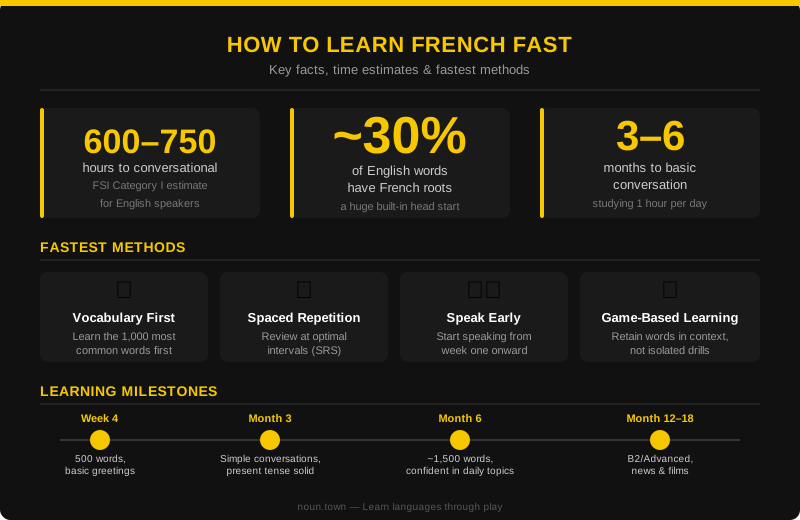
Short answer: French takes around 600 to 750 hours to reach B2 (professional working proficiency) for English speakers, making it one of the faster major languages to learn. The fastest path focuses on vocabulary first, uses spaced repetition for retention, and gets you speaking with native audio as soon as possible. You already know thousands of French words through English, which gives you a real head start.
French has a reputation for being difficult, particularly for its pronunciation. That reputation is partly earned. But on the whole, French is one of the more accessible languages for English speakers, and the 600-hour estimate from the US Foreign Service Institute puts it firmly in the "achievable" category for anyone willing to put in consistent work.
The problem most learners have is not the language itself. It is the method. A lot of people spend months on grammar rules, pronunciation guides, and vocabulary lists that do not stick, and then wonder why they still cannot hold a conversation. This guide covers what actually works.
About 30% of English vocabulary comes directly from French or Norman French, brought over after 1066. Words like "liberty," "restaurant," "ballet," "justice," "genre," "facade," and thousands more are either identical to French or close enough that the meaning is immediately obvious. Before you have studied a single lesson, you already have a working vocabulary of several thousand French words.
This matters more than it sounds. Vocabulary size is the single strongest predictor of how well you understand a language when you read or listen to it. Going into French with a head start of several thousand words is a real advantage, and it means your early study can compound quickly.
French grammar is also more regular than many learners expect. Yes, there are gendered nouns (every noun is either masculine or feminine). Yes, verbs conjugate differently depending on the subject. But the patterns are learnable, they repeat reliably, and they follow logical rules far more often than, say, English spelling does.
The standard approach for many classroom learners is to begin with grammar: learn the rules for verb conjugation, understand how adjective agreement works, memorise the table of irregular verbs. This is not wrong, but it is slow.
Research on second language acquisition consistently shows that vocabulary breadth predicts comprehension far better than grammatical knowledge does. If you know 2,000 high-frequency French words, you can understand roughly 90% of everyday speech and most written text. If you know the grammar rules but not the words, you cannot say or understand much at all.
The practical implication is this: spend your first few months learning words aggressively, and let grammar knowledge develop naturally through exposure. Research published in the journal Studies in Second Language Acquisition consistently supports vocabulary breadth as the dominant predictor of reading and listening comprehension. When you hear a sentence and something sounds wrong, your brain will start to notice patterns. Explicit grammar study becomes much faster once you already have a mental model of what French sounds and reads like.
Which words first? Focus on the top 1,000 most common French words. These cover a disproportionate amount of everyday conversation. After that, branch into topic-specific vocabulary based on what you actually want to talk about.
French pronunciation is genuinely difficult for English speakers, and there is no point pretending otherwise. Silent letters are everywhere. The letter "e" at the end of a word is usually not pronounced. Liaison, where the final consonant of one word links to the start of the next, changes how sentences sound entirely. Nasal vowels, sounds like "an," "on," and "in," have no real equivalent in English.
The fastest way to improve is through listening and repetition with native audio, not through studying pronunciation rules in isolation. When you hear a word spoken naturally by a native speaker, over and over, your ear begins to calibrate. Your brain adjusts its sense of what the language sounds like. Shadowing, where you listen to native audio and try to mimic it in real time, is one of the most effective techniques.
Speech recognition practice also helps. When you speak French and receive immediate feedback on whether what you said was understood, you get a very direct signal about where your pronunciation is off. It is uncomfortable at first, but it accelerates progress significantly compared to practicing in private with no feedback.
Total immersion, living in France and speaking French all day every day, is obviously the fastest environment for learning. But most people cannot do that, at least not right away. The question is how to replicate some of those benefits from wherever you are.
The key is surrounding yourself with French input consistently. That means watching French TV with French subtitles (not English), listening to French podcasts even when you only catch a few words, reading simple French content daily, and switching the language on your phone or browser to French. None of these things alone will teach you the language. All of them together reshape your relationship with it.
The biggest risk with home immersion is that it becomes passive. Watching French TV with the sound on while you scroll your phone is not immersion. You need to be actively engaged, even if that just means pausing every few minutes and trying to recall what you just heard. Active listening is a skill that improves with practice, and it is worth building deliberately.
Spaced repetition is the most efficient known method for memorising vocabulary. The idea is simple: you review a word just before you are about to forget it. Easy words get reviewed less frequently. Harder words come back sooner. Over time, words move into long-term memory with far less repetition than brute-force drilling would require.
The catch is that spaced repetition works best when words are encountered in context rather than in isolation. If you are drilling "chien = dog" as a translation pair, you are building a weak memory link. If you learn "chien" by seeing a dog in a scene and hearing a native speaker say the word, your brain encodes it through multiple channels at once: visual, auditory, and contextual. That kind of encoding is much more durable.
This is one reason why the Noun Town language learning game has become popular for vocabulary building. Rather than presenting words as flashcard pairs, it puts you in a 3D world where you encounter words attached to the things they describe, spoken by native speakers, with spaced repetition built into the system. The retention rates are notably better than translation-based drilling.
Most learners wait too long before they start speaking. They want to feel ready. They want to avoid embarrassment. But the speaking skill develops differently from reading or listening, and the only way to build it is by doing it.
You do not need to be fluent to start practicing speaking. You need about 500 to 1,000 words and a willingness to make mistakes. A conversation partner who is patient and corrects you naturally, rather than stopping you at every error, is ideal. Tutors on platforms like italki are affordable and flexible, and even a 30-minute conversation session once a week produces measurable improvements over time.
The discomfort of early speaking practice fades quickly. After a few sessions, the anxiety drops and you start noticing which words and structures you reach for most often. That tells you exactly where to focus your next round of vocabulary study.
If you have one hour per day available, here is a reasonable distribution for an early-intermediate French learner:
Adjust this as you progress. At intermediate level, listening and speaking time should increase significantly. Grammar study can reduce once the core patterns are solid. The important thing is showing up consistently, not obsessing over the perfect distribution.
At one hour per day of focused study, 600 hours works out to just under two years. At two hours per day, it is closer to twelve months. The FSI estimate assumes high-quality study time, not passive exposure, so be honest with yourself about whether your daily hour is genuinely focused or not.
Most learners reach a useful conversational level, enough to navigate travel and hold basic conversations, around the 200 to 300 hour mark. That is six to nine months at one hour per day. Full fluency, where you can discuss complex topics without significant effort, takes longer. But by that point, the process becomes more enjoyable because you can do things in French that are inherently interesting to you.
The US Foreign Service Institute estimates 600 to 750 hours to reach professional working proficiency. At one hour per day of focused study, that is roughly 18 months to two years. Most learners reach basic conversational ability in 6 to 9 months.
It is one of the easier major languages, classified as Category I by the FSI. Around 30% of English vocabulary has French or Norman French roots, so you already know thousands of French words. The main difficulties are pronunciation and verb conjugation, not the overall structure of the language.
Prioritise the top 1,000 most common French words, use spaced repetition to lock them in, and encounter them in context rather than as isolated translation pairs. Contextual learning through immersive games, French media, and conversation produces stronger long-term retention than flashcard drilling alone.
Vocabulary first. A vocabulary of 2,000 high-frequency words unlocks around 90% of everyday French speech. Grammar knowledge helps you build sentences correctly, but without the words, the rules have nothing to work with. Learn words aggressively early on and let grammar fill in around them.
Yes. Games that present vocabulary in spatial context with native speaker audio and spaced repetition have been shown to produce strong retention. Noun Town covers French and 11 other languages, using a 3D open world with native audio and speech recognition built in. There is a free demo on Steam if you want to try it.
Want to build French vocabulary through play? Try Noun Town free on Steam.
Try Noun Town on Steam ← Back to blog