
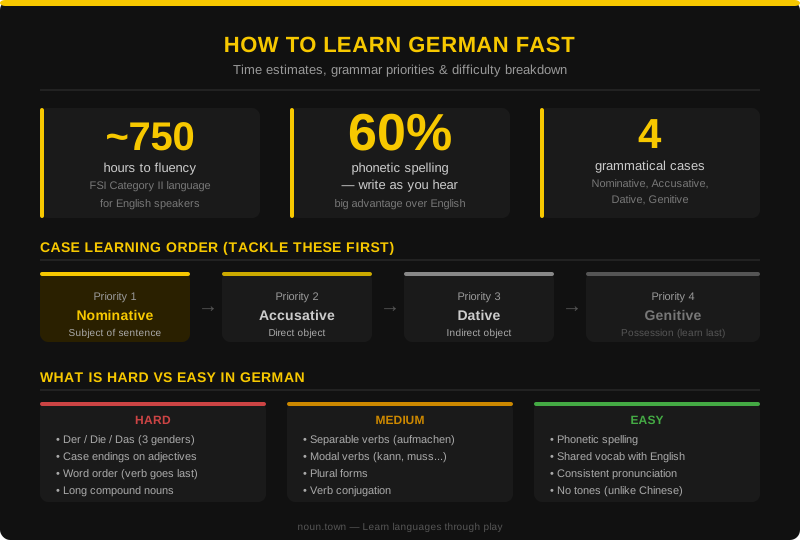
Short answer: German takes around 750 hours to reach B2 (professional working proficiency) for English speakers, putting it in the FSI's Category II languages. It is harder than French or Spanish but far more accessible than Japanese or Arabic. The fastest path involves learning high-frequency vocabulary first, treating the case system as a pattern-recognition problem rather than a rules-memorisation exercise, and using native audio from day one.
German has a complicated reputation. Mark Twain wrote a famous essay about its difficulty in 1880. Compound words like "Rindfleischetikettierungsuberwachungsaufgabenubertragungsgesetz" get shared online as jokes. The case system trips people up for months. And yet around 750,000 people pass the Goethe Institut's B2 exam every year, which suggests the language is very much learnable for those who go about it the right way.
The trick is understanding which parts of German are genuinely hard and which parts are easier than their reputation suggests. They are not the same list.
There are three things in German that genuinely require sustained effort from English speakers. Knowing what they are lets you plan your study time accordingly.
The first is grammatical gender. German has three: masculine (der), feminine (die), and neuter (das). Unlike French, where gender is somewhat predictable from word endings, German gender is often arbitrary. The word for "girl" (das Madchen) is neuter, not feminine. You have to learn the gender of each noun as you learn the noun itself. There is no shortcut. The fastest approach is to always learn a noun together with its article (so "der Tisch" not just "Tisch") and treat them as a single unit from the start.
The second is the case system. German has four grammatical cases (nominative, accusative, dative, and genitive) and the articles, adjectives, and pronouns attached to a noun change depending on its role in the sentence. This is genuinely unfamiliar to English speakers, who use word order to convey the same information. It takes time to internalise, and the fastest way is through extensive reading and listening rather than drilling tables in isolation.
The third is word order. German verb placement follows rules that feel counterintuitive at first: the verb goes to the end of a clause in certain constructions, subordinate clauses have a different order from main clauses, and modal verbs split from the main verb in ways that can take a while to feel natural.
Grammatical gender (3 genders, mostly unpredictable), case system, complex word order
Verb conjugation, separable verbs, adjective endings, compound nouns
Pronunciation, spelling (almost fully phonetic), shared vocabulary with English
German pronunciation is one of the most underrated advantages of learning the language. Unlike French, where the gap between spelling and pronunciation is enormous, German is almost entirely phonetic. You read it as it is written. Once you learn the sounds that correspond to each letter or letter combination (the "ch" sound, the umlauts, the way "w" sounds like "v"), you can read any German word aloud and be understood. That is a genuine relief compared to the guesswork involved in English or French pronunciation.
German and English also share a substantial amount of vocabulary, because both are Germanic languages. Words like "Hand," "Finger," "Arm," "Haus," "Garten," "Wind," "Sand," "bitter," "blind," "gold," and hundreds more are immediately recognisable to English speakers. Cognates and near-cognates give beginners a meaningful head start on vocabulary, particularly for concrete nouns.
German compound words, though they look intimidating, are actually a vocabulary superpower once you understand how they work. A compound word is built from smaller words that you already know. "Handschuh" (glove) is literally "hand-shoe." "Fernseher" (television) is "far-seer." "Krankenhaus" (hospital) is "sick-house." Once you have a few hundred root words, you can often decode compound words you have never seen before.
The most common mistake German learners make is spending too long on grammar tables before they have a meaningful vocabulary. Grammar rules are far easier to absorb when you already have words to apply them to. The case system feels abstract when you are working with hypothetical sentences. It starts to make intuitive sense once you have heard the same nouns in different contexts hundreds of times.
Aim for 1,000 high-frequency German words before you spend significant time on the dative case or adjective endings. At that point, your listening comprehension will be solid enough that patterns start to feel natural rather than arbitrary. You will catch errors by ear rather than by consulting a rule.
Vocabulary learning works best when words are encountered in context. Hearing a German noun spoken by a native speaker while you associate it with the object it describes is significantly more effective than learning it as an English translation pair. This is why games and immersive content produce better retention than flashcard apps for many learners, particularly for concrete nouns. The Noun Town language learning game covers German and uses exactly this approach: words are presented in a 3D spatial context with native speaker audio, and spaced repetition handles the review schedule automatically.
The case system is the part that most learners dread. Here is a more realistic way to think about it.
In practice, the nominative and accusative cases cover the vast majority of everyday sentences. Nominative marks the subject of a sentence (who is doing the action). Accusative marks the direct object (what is being acted upon). Between these two, you can construct and understand most basic German. The dative, used for indirect objects and after certain prepositions, is the third priority. The genitive case appears relatively infrequently in spoken German and can be learned much later without significantly impeding communication.
The practical order, then, is: nominative first, accusative second, common prepositions third, dative fourth. Do not let the full four-case table intimidate you into learning everything at once. Build up in stages, and give yourself time to hear each case used naturally before moving to the next.
Listening to native German from day one is non-negotiable. The rhythm, sounds, and flow of the language need to become familiar before your brain will process it without significant effort. Good early resources include slow-German podcasts like "Slow German mit Annik Rubens," YouTube channels aimed at beginners, and children's content, which is grammatically simpler but often uses the same vocabulary you are building.
Speaking practice should start around the 100 to 200 hour mark, or whenever you can reliably produce basic sentences. German speakers are generally very encouraging to learners who make an effort, and the worst that happens is that someone switches to English. Do not let that possibility stop you. The faster you develop a habit of speaking, the faster your brain starts building the real-time processing ability that no amount of passive study can replicate.
At one hour of focused study per day: basic conversational ability arrives around months 9 to 12. A solid intermediate level, where you can follow German TV and hold extended conversations, is typically 18 to 24 months. The FSI's 750-hour estimate to professional proficiency works out to just over two years at this pace.
The learners who get there fastest tend to share three habits: they study every single day (even 20 minutes beats occasional 3-hour sessions), they consume German media that they genuinely enjoy, and they start speaking long before they feel ready. None of those things require expensive courses or native fluency. They just require consistency and a reasonable tolerance for being wrong.
The US Foreign Service Institute estimates around 750 hours to reach professional working proficiency for English speakers. At one hour per day, that is about two years. Most learners reach basic conversational ability between 300 and 400 hours, which is 9 to 12 months of consistent daily study.
It is harder than French or Spanish but much easier than Japanese, Korean, or Arabic. The main challenges are grammatical gender, the case system, and word order. The advantages are phonetic spelling, a large amount of shared vocabulary with English, and a regular verb system that is simpler than many learners expect.
Nominative case and present tense first. Then accusative case and basic word order. Then the most common modal verbs and the perfect tense. Leave dative and genitive until you have solid vocabulary and listening comprehension, so the patterns feel natural rather than arbitrary.
Around 1,000 high-frequency words is enough for basic conversations. At 2,000 you can handle most everyday topics comfortably. At 5,000 you can discuss complex subjects with reasonable fluency. Prioritise verbs, high-frequency nouns, and common adjectives in that rough order.
Yes, and it is particularly effective for German nouns because you associate them with objects in context rather than translation pairs. Noun Town covers German and 11 other languages on PC and Mac via Steam, using a 3D open world, native speaker audio, and built-in spaced repetition. There is a free demo available on Steam.
Build German vocabulary through play. Try Noun Town free on Steam.
Try Noun Town on Steam ← Back to blog