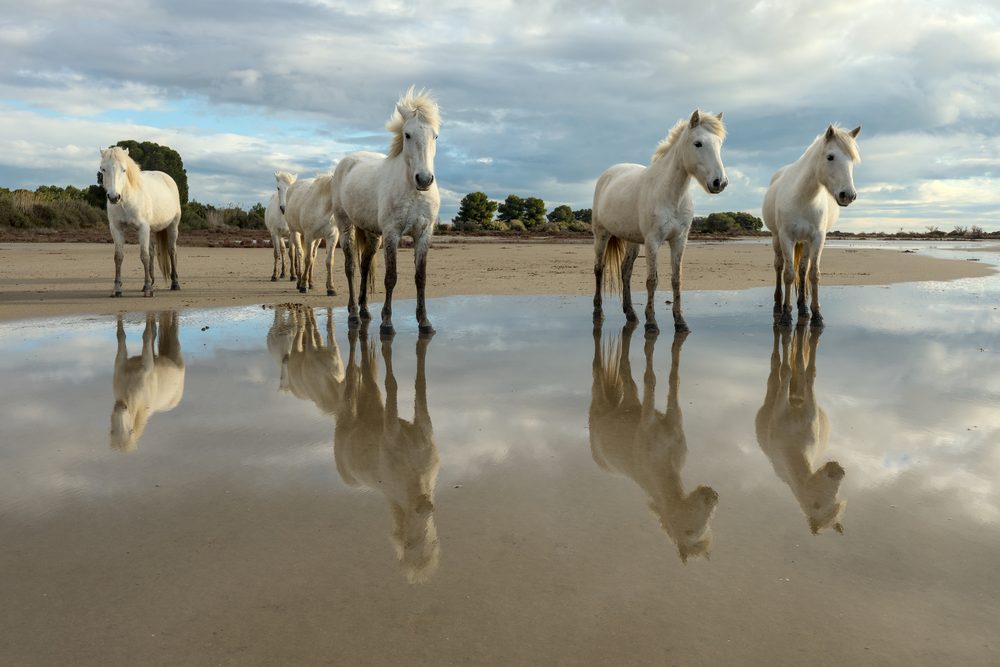
Photo: Benjamin Smith / Wikimedia Commons (CC BY-SA 4.0)
French animal vocabulary is one of the first themed word sets most courses introduce after greetings and numbers, since the words are concrete and useful almost immediately, in children's books, nature documentaries, or a conversation about someone's pet. This guide lists 50 common French animal words, grouped into pets and farm animals, wild animals, birds, and sea creatures and insects. Each word is shown with its article, le or la, a plain pronunciation guide, and its English meaning, so the gender is learned correctly the first time rather than corrected later.
Short answer: This list covers 50 French animal words across four groups: 12 pets and farm animals, 14 wild animals, 8 birds, and 16 sea creatures and insects. Every French noun, including animal words, is either masculine (le) or feminine (la), with l' used before a vowel sound and les for every plural regardless of gender.
Animal vocabulary comes up constantly once you start paying attention to it in French: children's shows, nature documentaries, a trip to the zoo, or small talk about someone's pet. It is also some of the most concrete vocabulary a new language offers. You can picture a chien or a lion without needing an abstract explanation, which makes the words easier to attach to memory than something like "cependant" or "néanmoins."
There is a second, practical reason to start here. Every French noun carries a grammatical gender, and that lesson has to be learned eventually no matter which vocabulary set comes first. French only has two genders rather than the three found in some other European languages, which makes it a comparatively gentler place to build the habit of noticing le or la. Teaching materials used by the Alliance française, the long-running network of institutes that teaches French around the world, as described on its Wikipedia overview, place basic noun gender among the earliest grammar points covered, right alongside everyday vocabulary like this.
Finally, animal words are high frequency without being overly simple. A beginner course that only covered greetings and numbers would leave you unable to describe much of the real world. Animals close that gap early, giving you enough vocabulary to talk about a pet, a trip to the zoo, or a wildlife documentary within the first few weeks of study.
Notice l'âne at the end of that list. Both le and la shorten to l' in front of a word that starts with a vowel sound, so le âne becomes l'âne. It is a small spelling and pronunciation shift worth getting used to early, since it shows up again several times later in this list.
Most of these will already look familiar, and that is not a coincidence. A lot of English animal vocabulary came from French in the first place, which is worth a closer look before moving on to the rest of the list.
French and English share an unusually large amount of animal vocabulary, and the reason goes back almost a thousand years. After the Norman Conquest of 1066, French became the language of the English court and administration for several centuries, and thousands of French words settled permanently into English during that time, a history covered in detail in Wikipedia's overview of French influence on English. That is a large part of why le tigre, l'éléphant, and le crocodile all look so close to their English equivalents.
One word on this list carries an extra piece of history. Le dauphin means dolphin, but it was also the historic title given to the heir to the French throne. According to the background on the Dauphin of France, the title traces back to the Dauphiné region in southeastern France, whose ruling family carried a dolphin on their coat of arms long before the title passed to the French crown.
La chauve-souris, the word for bat, has its own small story too. It literally combines chauve (bald) with souris (mouse), roughly "bald mouse," a description of the animal's smooth, furless-looking wings rather than its actual fur. German takes a near-identical approach with its own word for bat, Fledermaus, built from a different pair of roots meaning "fluttering mouse," a reminder that unrelated languages sometimes land on strikingly similar ways of naming the same animal.
Watch this one: le manchot is the correct zoological term for a penguin, but a lot of French speakers say le pingouin instead. Strictly, le pingouin refers to the auk, a different seabird found in the North Atlantic that never actually lives anywhere near penguins. The mix-up is common enough that both words tend to get used loosely in everyday conversation, but manchot is the one you want if you are being precise.
A few of these do not sort themselves by any obvious pattern. La fourmi (ant) is feminine while le papillon (butterfly) is masculine, and nothing about either word hints at why. That is a fair summary of French noun gender generally: it has to be learned case by case rather than predicted from sound or meaning.
French splits every noun into one of two genders, masculine (le) or feminine (la), which is simpler than languages with three or more genders but still has to be memorized rather than reasoned out. Both articles shorten to l' before a vowel sound, which is why this list includes l'ours, l'abeille, and l'écureuil rather than le ours, la abeille, or le écureuil.
A loose pattern exists, nouns ending in -e are often feminine, but animal vocabulary breaks that pattern often enough that it cannot be relied on. Le singe (monkey) and le zèbre (zebra) both end in -e yet are masculine, which the overview of French grammar on Wikipedia notes is typical of how unevenly that particular shortcut applies across the language as a whole.
Getting gender right matters beyond the article itself, since it also decides how adjectives agree with the noun later in a sentence. The Common European Framework of Reference for Languages expects a learner to have this kind of agreement under control by around the A2 to B1 stage, and the Académie française, the official body that has overseen the French language since the 17th century, treats correct gender agreement as one of the basic marks of careful French. Learning the article with the word the first time, rather than fixing it later, saves a lot of relearning.
Fifty words with an article attached to each one is a lot to take in at once. These methods spread the work out in a way that actually sticks.

Screenshot from the Noun Town Steam store page, showing the spaced repetition review-scheduling feature
A word list like this one is a good starting point, but vocabulary tends to stick better when it is attached to something more than a translation and an article on a page. This is the idea behind Noun Town's language learning game, which places animal vocabulary and hundreds of other everyday words inside a 3D world, so you encounter la vache standing in an actual field or le poisson swimming in an actual pond rather than sitting in a column next to its English translation.
Every word in the game is spoken by a native speaker, and a built-in spaced repetition system brings words back for review at the intervals that best support long term memory, the same principle behind the study tips above, just handled automatically instead of something you have to track yourself. The game also includes speech recognition, so you can practice saying le perroquet or l'hippopotame out loud and get feedback on pronunciation rather than only reading it silently.
Noun Town is a one-time $19.99 purchase on Steam for PC and Mac, with no subscription and nothing paywalled once you own it. That was a deliberate decision. The team behind it used the major subscription language apps themselves, found the ads and the locked lesson tiers frustrating, and heard the same complaint from a lot of other learners before building something without either.
Want to see French animal vocabulary taught this way in action?
Try Noun Town on SteamThis guide covers 50 words, split into 12 pets and farm animals, 14 wild animals, 8 birds, and 16 sea creatures and insects. Each one includes its article, le or la, plus a plain pronunciation guide.
Every French noun is either masculine (le) or feminine (la), and animal words follow the same rule as any other noun. Grammatical gender does not reliably track the animal's actual sex, so it has to be memorized along with the word rather than guessed from meaning.
Both le and la shorten to l' before a word starting with a vowel sound, which is why this list includes entries like l'ours (the bear) and l'abeille (the bee) rather than le ours or la abeille.
Most add an -s, which is usually silent in speech, and the article becomes les for every plural noun regardless of whether the singular form was masculine or feminine.
Le manchot is the correct zoological term for a penguin. Le pingouin technically refers to a different seabird, the auk, though many French speakers use pingouin loosely for penguins too, a mix-up similar to how English speakers sometimes confuse the two birds.
Most learners can recognize and recall a list of this size within one to two weeks of short, regular review sessions, and keep the words long term if they come back to them a few more times over the following month.
Moderately. English borrowed a huge amount of vocabulary from French after the Norman Conquest, so many words are already familiar, but French pronunciation and the need to memorize grammatical gender for every noun take dedicated practice.
Yes, particularly for retention. Seeing a word attached to an animal in a real scene, hearing it spoken by a native voice, and being tested on it again later through spaced repetition tends to stick better than memorizing a flat list, which is the basic idea behind vocabulary-focused language games.
Yes. Animals are typically introduced alongside greetings, numbers, and family vocabulary, since the words are concrete and give learners an early, low-pressure way to practice gender and articles.
Noun Town teaches vocabulary, including animal words and their correct article, inside a 3D world where each word is tied to a real object or scene, backed by native speaker audio and a spaced repetition review system, rather than through a flat list or flashcard deck alone.