Babbel company logo, via Wikimedia Commons (public domain)
Short answer: Babbel is a subscription app built around structured grammar lessons across roughly 14 languages. Noun Town is a one-time purchase game on Steam ($19.99, PC and Mac) built around exploring a 3D world where vocabulary is picked up through spoken context and spaced repetition, across 12 languages. Babbel wins on grammar teaching and mobile convenience. Noun Town wins on vocabulary retention, engagement length and long-term cost. Neither fully replaces the other for every learner.
People ask us this a lot, usually after they have already tried Babbel or something similar and found it useful but a bit dry. The short version is that Babbel and Noun Town are solving different parts of the same problem, and picking one over the other depends on what has actually been holding your progress back.
We should be upfront that we built Noun Town, so we are not a neutral referee here. But we have also used Babbel and apps like it extensively while researching what our own product should and should not try to do, so this comparison is grounded in real use, not guesswork.
Babbel is a subscription-based language app available on phones, tablets and desktop browsers. Lessons run in short bursts, typically ten to fifteen minutes, and each one is built around a specific grammar point or set of phrases, such as ordering food or talking about the weather. You move through units in a fairly linear order, with review exercises mixed in to reinforce earlier material.
The strength of this format is clarity. You always know what you are meant to be learning in a given session, and grammar rules are explained directly rather than left for you to infer. For learners who like textbooks and syllabuses, this structure feels familiar and reassuring.
Babbel covers around 14 languages, weighted heavily toward European ones such as French, German, Spanish, Italian, Portuguese and several Nordic languages, alongside a smaller number of others. It runs on a subscription model, with pricing that varies by plan length and occasional promotions, generally landing somewhere in the $80 to $100 range for a year.
Noun Town takes a different starting point entirely. Instead of a lesson screen, you are dropped into a 3D open world on PC or Mac, where nouns are attached to the objects, characters and locations around you. A market stall might teach you the words for fruit. A conversation with a shopkeeper might introduce a handful of new verbs in context, spoken aloud by a native speaker.
Underneath the game world sits a spaced repetition system, or spaced repetition, a scheduling method that brings words back for review right before you are likely to forget them. Noun Town also includes speech recognition, so you can practise saying words aloud and get feedback on your pronunciation, something Babbel offers in a more limited form.
You can read more about how the whole system fits together on the Noun Town language learning game page. The game covers 12 languages: Japanese, Korean, Mandarin Chinese, Spanish (both Spain and Mexico), French, German, Italian, Russian, Greek, Egyptian Arabic and English. It is a single $19.99 purchase on Steam, with a free demo available if you want to try it before buying.
A note from us: if you are coming to Noun Town straight from a mobile app, it might look and feel quite different at first, and that is intentional.
Mobile apps are usually built around a tailored onboarding path designed to give you a quick dopamine hit early on and turn opening the app into a daily habit. We took a different approach with Noun Town, closer to how a child learns their first language: through exposure to words in the context they naturally occur in. You are not being nudged to complete a streak, you are seeing a spoon on a table in a cafe, hearing what it is called, and picking it up the same way you once picked up your own first words.
Laid out side by side, the differences become clearer than either product's marketing usually admits.
| Category | Babbel | Noun Town |
|---|---|---|
| Format | App, phone and desktop | Winner 3D game, PC and Mac |
| Grammar teaching | Winner Direct, structured lessons | Learned through exposure only |
| Vocabulary retention | Flashcard style drills | Winner Contextual, spoken, spaced repetition |
| Pricing model | Subscription, roughly $80-$100/year | Winner One-time $19.99, lifetime access |
| Languages available | Winner Around 14, mostly European | 12, including less common options like Greek and Egyptian Arabic |
| Mobile convenience | Winner Full phone app | Desktop and laptop only |
| Session length that works best | Short, five to fifteen minutes | Winner Longer sessions, thirty minutes or more |
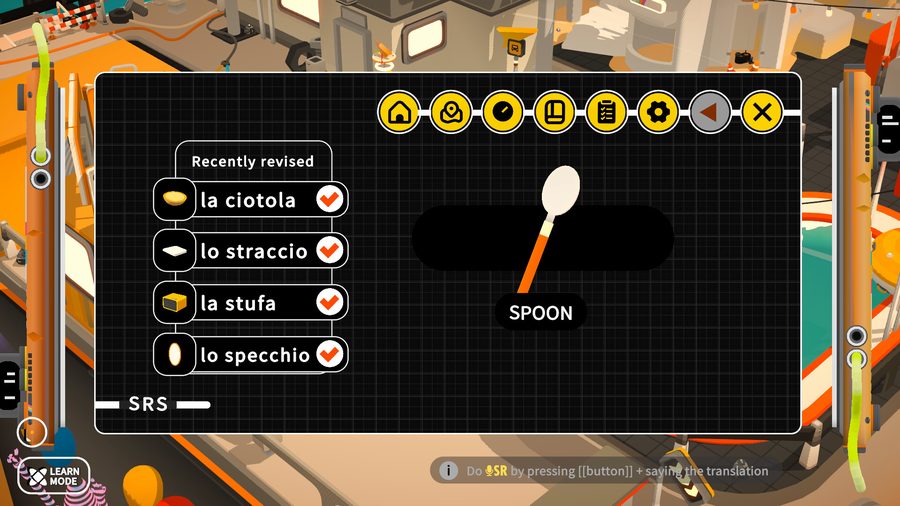
Screenshot from the Noun Town Steam store page, showing the in-game spaced repetition review screen
For most learners, the honest answer is that it replaces part of the job rather than all of it. If your main obstacle has been sticking with a routine long enough to make progress, a game like Noun Town solves that problem better than most apps manage, because it does not feel like a chore to open. If your main obstacle is understanding how a language's grammar actually fits together, an app like Babbel, or a structured course, still does that job more directly.
A pattern we hear often from players is a kind of split use: Noun Town for the vocabulary heavy sessions where they want to properly sit down and get immersed, and a lighter app or grammar resource for the more mechanical side of learning. That is not a hedge to avoid picking a side, it reflects that vocabulary and grammar are genuinely different skills, and no single tool currently nails both.
It is also worth being realistic about what each format asks of you day to day. Babbel is built to squeeze into small gaps in a schedule. Noun Town is built for someone who wants to sit down and spend real time somewhere. Neither approach is wrong, but choosing the one that matches your actual daily habits will matter more than which one has the better marketing page.
If you have tried apps like Babbel before and quietly stopped opening them after a few weeks, that is usually a sign the format is not the problem, engagement is. A well-made game is worth trying in that case, since holding your attention is most of the battle for vocabulary learning. If grammar has always been your sticking point rather than motivation, Babbel's structured lessons will likely serve you better in the short term.
We built Noun Town because we believe vocabulary retention and sustained attention are underrated in language learning, and games are simply well positioned to deliver both. We are not going to pretend it replaces every function of a grammar-focused app, but for a lot of learners, it replaces enough of the job to be worth the one-time price of admission.
See the vocabulary system for yourself with the free demo on Steam.
Try Noun Town on SteamBabbel is a mobile and desktop app built around short structured lessons that explain grammar rules step by step. Noun Town is a 3D game on PC and Mac where you pick up vocabulary by exploring a world, talking to characters and reviewing words through spaced repetition, without formal grammar lessons.
Yes, Babbel teaches vocabulary through structured exercises like matching, fill in the blank and short dialogues. It works well for learners who like a clear curriculum, though the words are often presented in isolated sentences rather than a living environment.
For grammar-heavy learners, probably not on its own. Noun Town is strongest at vocabulary, listening and speaking practice through its speech recognition tool. Babbel is stronger at explaining grammar structure directly. Many learners use a game for vocabulary and an app or course for grammar.
Noun Town is a one-time purchase of $19.99 that covers all 12 supported languages for life. Babbel is a subscription, and subscription apps typically cost somewhere in the range of $80 to $100 for a year, depending on the plan length and any promotional pricing. Over several years the one-time model tends to work out cheaper.
No. Noun Town has no adverts and no subscription. You pay once on Steam and everything, including all 12 languages, is included from that point on.
Babbel has the edge here. It explains grammar rules directly with short lessons that build on each other. Noun Town does not teach grammar as a dedicated system, it relies on repeated exposure to natural sentence patterns, which suits vocabulary and listening more than explicit rule learning.
No, this is one of the clearest differences between them. Babbel runs on iOS, Android, and desktop browsers, so it works well for commutes and short pockets of time. Noun Town is a PC and Mac game played through Steam, so it suits longer sessions at a desktop or laptop rather than quick phone checks.
Noun Town supports 12 languages: Japanese, Korean, Mandarin Chinese, Spanish (Spain and Mexico), French, German, Italian, Russian, Greek, Egyptian Arabic and English. Babbel covers a broader list of roughly 14 languages, with more European options and fewer of the less commonly taught ones like Greek or Egyptian Arabic.
It depends on what has stopped you learning before. If you have tried apps and lost interest after a few weeks, a game may hold your attention longer. If you like a clear syllabus and want grammar explained plainly from lesson one, Babbel is the more traditional starting point.
For vocabulary and listening, research into game-based learning suggests words encountered in a meaningful, repeated context are retained at least as well as words drilled through flashcards, often better. For explicit grammar instruction, structured apps and courses still tend to have the advantage.