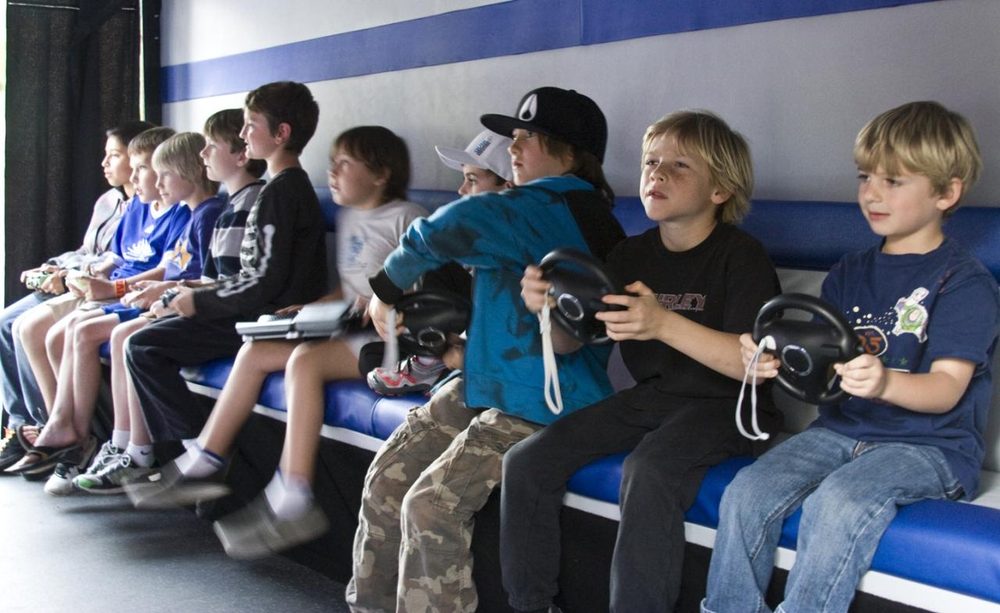
Photo: Gamesingear / Wikimedia Commons (CC BY-SA 3.0)
Short answer: Portal 2, Overcooked 2 and Educational Family Games are the strongest co-op picks on Steam if you want to sit down with your kids and get real learning value out of screen time. Portal 2 builds spatial reasoning through puzzle solving, Overcooked 2 teaches teamwork under time pressure, and Educational Family Games is a dedicated maths, geography and logic title made for exactly this kind of parent-and-child session.
There is a difference between putting a game on for your kid and sitting down to play something together. The second one is where most of the actual learning happens, because a parent narrating, coaching and asking questions turns a game session into something closer to a lesson without it feeling like one.
I looked specifically for co-op titles on Steam that hold up to that kind of shared play, rather than games that merely allow a second player without giving them anything meaningful to do.
Portal 2's dedicated co-op campaign puts two players in a testing facility solving puzzles that genuinely require both of you, not just one person doing the work while the other watches. It has mild sci-fi peril but nothing graphic, and it is widely considered appropriate for older children. The spatial reasoning it builds, thinking through routes, angles and timing before acting, is linked to stronger later performance in maths and physical sciences.
A kitchen management game where two or more players run increasingly chaotic restaurants together. It sounds like pure comedy, and it is, but underneath that it teaches division of labour, fast communication and adjusting a plan mid-task when things go wrong, which is exactly the kind of teamwork practice that is hard to replicate outside a shared activity like this.
Unlike the other two, this one is explicitly built as a learning title rather than a mainstream game with educational side effects. It supports one to four local players across 80 short games spanning maths, geography, logic, memory, reflexes, science, chemistry, art and anatomy. It is a good option if you want something the whole family can rotate through in a single sitting, including younger kids who might struggle with Portal 2 or Overcooked 2's controls.
Before picking any game off this list, it is worth being clear on a distinction a lot of store pages blur together: co-op is not the same thing as pure multiplayer, where you get paired up with random people online. Co-op just means more than one player working toward the same goal. That can be with your own kid on the sofa next to you, or it can be paired matchmaking with strangers over the internet, depending entirely on how the game and the mode are set up.
Before you buy anything on this list, check the specific mode you plan to use. Look for local co-op or private lobby options that let you play only with people you already know, rather than a public or ranked queue that puts your child in a lobby with strangers. Portal 2's co-op campaign, for instance, works fine split-screen or over a private link with someone you invite. The same is not automatically true of every online co-op title, so read the store page and a few reviews before assuming.
A quick way to check: search the store page for "local co-op," "split screen," or "invite only," and avoid anything that only offers open matchmaking if playing with strangers is not something you want for your child.
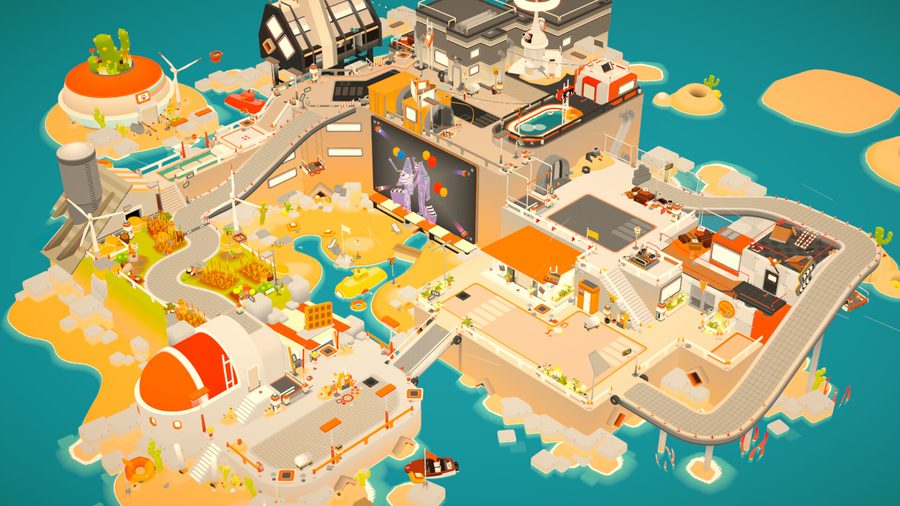
Screenshot from the Noun Town Steam store page
A kid playing alone absorbs what the game teaches at whatever pace the game allows. Add a parent next to them and you get a second layer on top: someone explaining the reasoning behind a puzzle, praising a good call, or catching a mistake before it turns into frustration. Researchers into digital game-based learning generally find that engagement and social context matter as much as the content itself for what gets retained. A puzzle solved together tends to stick better than the same puzzle solved alone, mostly because there was conversation attached to it.
Educational Family Games suits younger kids well since a parent can carry the harder rounds and each mini-game is short. Portal 2 and Overcooked 2 tend to click once a child can read instructions and handle a controller confidently, usually somewhere around seven or eight, though this swings a lot by child. Teenagers get on fine with all three, though they often gravitate toward Portal 2 or Overcooked 2 over the shorter family format. None of this is a hard rule. A confident six year old can manage Overcooked 2's easier levels with a parent covering the trickier stations.
Portal 2 and Overcooked 2 both need a second controller or a keyboard setup, since each player controls a separate character at the same time. Educational Family Games is more forgiving and lets you pass a single controller between rounds.
Noun Town is one example. It is a single player game at heart, a 3D world where you pick up vocabulary in a new language through native speaker audio and spaced repetition, not a co-op title in the traditional sense. Even so, plenty of parents play it alongside their kids anyway, taking turns on the same save file and quizzing each other on whatever words came up that session. It is not the same as true co-op, but it recreates a fair amount of the shared benefit without needing a second controller at all.
There is a free demo on Steam if you want to try that approach first. The full purchase is a one-time $19.99 covering all 12 supported languages, no ads, nothing paywalled once you own it.
So which one should you actually start with? If you have one evening a week set aside for family game time, Portal 2 or Overcooked 2 will likely win out purely because they are more fun, and fun is what gets everyone back for round two. If the priority is subject-specific learning across a range of topics in short bursts, Educational Family Games is the more direct tool. Either way, the game matters less than whether a parent is actually sitting there playing it with them.
Looking for something to explore solo or take turns on with your kids? There is a free demo on Steam.
Try Noun Town on SteamPortal 2, Overcooked 2 and Educational Family Games are three co-op Steam titles that build real skills alongside genuine fun. Portal 2 develops spatial reasoning through two-player puzzles, Overcooked 2 builds communication and planning under time pressure, and Educational Family Games is a dedicated learning title covering maths, geography and logic for up to four players.
Portal 2's co-op campaign is generally considered suitable for older children, with mild sci-fi peril but no graphic violence. The puzzles require two players to think out loud, plan routes and coordinate timing, which are the same skills associated with strong performance in maths and science.
It is chaotic on purpose, but underneath that it teaches division of labour, quick communication and adapting a plan when it stops working, which are genuinely useful skills for kids to practice with a parent watching and coaching in real time.
Educational Family Games is a local multiplayer title for one to four players built around 80 short games across five boards, covering maths, geography, logic, memory, reflexes, science, chemistry, art and anatomy. It is designed specifically as a family co-op learning game rather than a mainstream game with incidental educational value.
It depends heavily on the game and the child. Educational Family Games is built for a wide age range including younger children, since a parent can carry the harder rounds. Portal 2 and Overcooked 2 tend to work better once a child can read instructions and handle a controller confidently, usually from around seven or eight upward, though this varies a lot by child.
Playing alongside a parent adds a layer of explanation and encouragement a solo session cannot replicate. Kids narrate their thinking, ask questions in the moment, and get immediate feedback, which reinforces whatever the game is teaching far more than passive solo play.
Noun Town is primarily a single player experience rather than co-op, but it is common for parents and kids to take turns exploring the same save file and quiz each other on words they have learned, which recreates much of the shared-learning benefit of true co-op.
For proper co-op titles like Portal 2 and Overcooked 2, yes, you will want a second controller or keyboard setup, since both players are controlling separate characters simultaneously. Some family games support passing a single controller between rounds instead.
Overcooked 2 is available on PC via Steam. Platform availability can change, so it is always worth checking the current store page before buying, particularly if you specifically need a Mac version.
Spatial reasoning built through puzzle games like Portal 2 is associated with stronger later performance in mathematics, engineering and physical sciences, since many concepts in those fields rely on mentally manipulating shapes, routes and structures before you ever put pen to paper.