
Photo: CEphoto, Uwe Aranas / Wikimedia Commons (CC BY-SA 3.0)
A Duolingo alternative for German is any tool that covers what Duolingo tends to leave underexplained in German specifically: the four noun cases, the gender system behind der, die and das, and the way German word order moves the verb depending on the clause. For most learners that means Noun Town for vocabulary immersion with native audio, Nicos Weg for a completely free structured grammar course, and italki for real speaking practice. Duolingo is a solid habit builder, but German's case system tends to expose the limits of a pure translation app faster than languages that skip declension altogether.
Short answer: For vocabulary immersion with native German audio, Noun Town is the strongest pick at $19.99 one time, no subscription. For a free, structured grammar course, Nicos Weg from Deutsche Welle covers A1 through B1 in short video lessons at no cost. Babbel runs roughly $7 to $15 a month for more guided paid lessons. For speaking practice, italki tutors start around $5 to $10 an hour. Most serious German learners end up combining at least two of these rather than sticking with Duolingo alone.
Duolingo is genuinely good at getting people to open an app every day. The streaks, the reminders, the short bite-sized lessons, all of it is built around habit formation, and for a lot of learners that part works fine. The trouble tends to start a few months in, once the early vocabulary runs out and the grammar underneath it starts to matter.
German exposes that gap earlier than most languages. Duolingo teaches mostly through translation and pattern repetition, which is a reasonable way to pick up vocabulary but a weak way to absorb a case system with this many moving parts. Learners often get through a big chunk of the course and still hesitate over whether to say "der Mann", "den Mann" or "dem Mann", because the app drilled the sentences without ever laying out why the ending changes.
There's also the format itself to consider. Duolingo's free tier runs ads and caps how many mistakes you can make before a "hearts" system locks the lesson, which is enough on its own to send some learners looking elsewhere regardless of how the German course holds up. It's part of why Noun Town was built as a single $19.99 purchase with nothing held back afterward. The team had used the big mobile apps themselves, got frustrated by the same ad breaks and paywalled tiers, and heard the identical complaint from thousands of other learners before deciding to build it differently.
Here's how the main options actually compare, ranked by what each one does best.
Best for vocabulary immersion with native German audio and built-in speaking practice. Objects in a 3D open world are labelled with their full article included, so der, die or das gets learned as part of the word rather than added on afterward.
Best free structured course. Produced by Germany's international broadcaster in cooperation with the Federal Employment Agency, it covers A1 through B1 across short video episodes following a single storyline, with no sign-up cost.
Best for guided, paid grammar lessons. Organised around practical conversation topics, with clearer explanation of case usage and word order than Duolingo tends to offer.
Best for real speaking practice. Connects learners with native German tutors for one-to-one video sessions, priced by the hour rather than a monthly subscription.
Best for pronunciation and spoken recall. An audio-only method that prompts you to produce German phrases from memory at increasing intervals.
Best once you already have some vocabulary. Lets you read and listen to real German articles, podcasts and stories while tracking which words you already know.
Noun Town teaches German through a 3D open world rather than a lesson screen, with native speaker audio at natural pace and speech recognition for practising the words back. A spaced repetition system tracks which words are sticking and schedules reviews automatically. German is one of 12 supported languages, and the game has 590+ reviews on Steam with an 87% positive rating across the series and 200,000+ players. There's a free demo available on Steam before you buy.
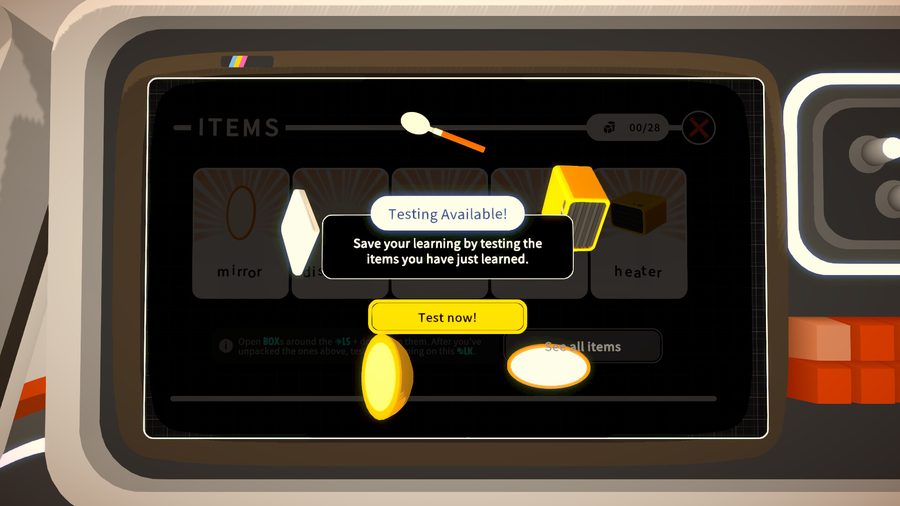
Screenshot from the Noun Town Steam store page, showing the vocabulary testing prompt
Three things trip up German learners more than anything else, and none of them are really about vocabulary at all.
None of this is covered well by an app that teaches primarily through matching a German sentence to its English translation. You can get the translation right without understanding why the ending on "der gute Mann" becomes "den guten Mann" once it's the object of the sentence, and that gap tends to surface the moment a learner tries to speak rather than just tap through exercises.
If you've started and abandoned Duolingo's German tree more than once, or you'd rather pay once than take on another monthly subscription, Noun Town is probably the better starting point. It attaches vocabulary to objects in context, with the article built in, and it turns the review process into something closer to a game than a chore.
If you'd rather have someone walk you through the case system explicitly before you start applying it, Nicos Weg or Babbel fit better. Both spend real time on why the grammar works the way it does rather than expecting the pattern to sink in through repetition alone. Nicos Weg costs nothing, while Babbel trades a monthly fee for a more guided, conversation-focused structure.
Most learners end up needing a bit of both. Vocabulary exposure on its own won't teach you when to use the dative case, and grammar drills on their own won't build the instinct to reach for the right word quickly in conversation. The two work better paired than either does alone.
Over a single month, a $10 or $15 subscription barely registers. Stretch that across the year or two it typically takes to get comfortable with German's case system, and the gap between paying once and paying monthly gets a lot more obvious.
None of this means the paid tools are a bad deal. Babbel's structured lessons and italki's live tutors both do something Nicos Weg and Noun Town don't, which is walk you through a problem in real time or correct you the moment you make a mistake. The point is just that a one-time cost and a recurring one add up very differently once you're a year or two into learning a language with grammar as involved as German's.
The most efficient setup for most learners pairs Noun Town for vocabulary, since it bundles native audio, spatial context and spaced repetition into one place with the gendered article attached from day one, with Nicos Weg or Babbel for the explicit grammar walkthrough that a vocabulary-first tool won't fully replace. Add italki sessions every couple of weeks once you have enough vocabulary to hold a basic conversation, so the case system gets tested out loud rather than staying theoretical.
That combination costs less over two years than a single mid-tier subscription used on its own, and it covers the three things German specifically punishes learners for skipping: case endings, gender, and word order that moves. Duolingo isn't a bad place to start, but German tends to make the ceiling on a translation-only app obvious well before most other languages do.
Want to try Noun Town for German? There is a free demo on Steam.
Try Noun Town on SteamIt depends on what Duolingo isn't giving you. For vocabulary immersion with native German audio, Noun Town is the strongest option at $19.99 one time. For a free, structured grammar course, Nicos Weg from Deutsche Welle covers A1 through B1 with short video lessons. For guided paid lessons, Babbel offers clearer grammar explanations than Duolingo. For real speaking practice, italki connects you with native German tutors from around $5 an hour. Most learners combine two or three of these rather than relying on one alone.
Yes. German is one of the 12 languages supported in Noun Town. The game teaches vocabulary through a 3D open world using native German speaker audio, speech recognition for speaking practice, and a built-in spaced repetition system. It is available on PC and Mac via Steam for $19.99 as a one-time purchase, with a free demo available.
German sits a notch above French, Spanish and Italian on most difficulty scales, mainly because of its four noun cases and three genders, which change the articles and adjective endings around almost every noun. Vocabulary is actually a relative strength for English speakers, since German and English share the same Germanic roots, so words like Haus, Wasser and Winter are recognisable on sight. The grammar is what takes the extra time, not the words.
The most common complaints are that Duolingo drills case endings through repetition rather than explaining the underlying system, that gender is presented as something to memorise word by word rather than through the patterns that predict it, and that the app rarely addresses German word order, where the verb moves to the end of a subordinate clause or splits apart entirely with separable verbs.
Contextual learning paired with native audio and spaced repetition tends to produce the fastest long-term retention, especially for German, where a word's gender needs to be learned alongside the word itself. Tools like Noun Town attach vocabulary to objects and scenes with the article included, so der, die or das gets encoded as part of the word from the start rather than bolted on afterward.
Babbel generally spends more time explaining German grammar directly, including case usage and word order, than Duolingo does. It is a paid subscription rather than free, running roughly $7 to $15 a month, so the right choice comes down to whether you value that grammar depth enough to pay for it, or prefer a free, gamified format and are willing to look elsewhere for the grammar explanations.
No. Nicos Weg, produced free by Deutsche Welle, is a genuinely thorough structured course covering A1 through B1, and Duolingo's free tier still teaches useful vocabulary. A paid tool tends to help most with either faster grammar depth, native speaking practice, or immersive vocabulary exposure, but a determined learner can get a long way into German without spending anything.
The Foreign Service Institute places German in its own category above French, Spanish and Italian, estimating around 750 hours of study to reach professional working proficiency. Conversational ability tends to arrive well before that, often somewhere in the 300 to 400 hour range with consistent, varied practice covering vocabulary, case usage and speaking.
No. Noun Town has no adverts and no content locked behind an additional paywall once you own the game. The team built it this way after using major mobile language apps themselves and getting frustrated by ad breaks and paywalled lesson tiers, then hearing the same complaint from other learners. It is a single $19.99 purchase with everything included.
Further reading: German declension on Wikipedia covers the four-case system in detail. The Goethe-Institut is Germany's official cultural institute and publishes its own course level guidance. The Common European Framework of Reference for Languages from the Council of Europe outlines the proficiency levels referenced by most German courses. Background on how language difficulty categories are assessed is on the Foreign Service Institute Wikipedia page. The review technique used by Noun Town and several apps above is explained on the spaced repetition Wikipedia page.
← Back to blog