A Duolingo alternative for Italian is any tool that covers what Duolingo tends to underplay: the subjunctive mood, which shows up in ordinary Italian speech far more than the app's drills suggest, the exceptions to Italian's mostly regular gender system, and the double consonants that change how a word sounds and sometimes what it means. For most learners, that's Noun Town for vocabulary immersion with native audio, Language Transfer for a free grammar-logic course, and italki for real speaking practice. Duolingo gets people started, but Italian has a habit of exposing the cracks in a translation-only app once the sentences get more complex.
Short answer: For vocabulary immersion with native Italian audio, Noun Town is the strongest pick at $19.99 one time, no subscription. For a free course built around grammar logic, Language Transfer's Complete Italian costs nothing. Coffee Break Italian, a free podcast, runs from absolute beginner through intermediate. Babbel runs roughly $7 to $15 a month for structured paid lessons. For speaking practice, italki tutors start around $5 to $10 an hour. Most Italian learners end up combining at least two of these.
Claim: Italian is one of the "easy" languages, so Duolingo's drills are basically enough.
Reality: Italian is genuinely easier than German, Russian or Japanese for an English speaker, and it sits in the Foreign Service Institute's easiest language category alongside French and Spanish. That's true for vocabulary. It's less true for grammar, because Italian leans on the subjunctive mood (il congiuntivo) constantly in everyday speech, for wishes, doubts, opinions and hypotheticals, and Duolingo introduces it late and thinly compared to how often native speakers actually use it.
Claim: Gender in Italian is simple, words ending in -o are masculine and -a are feminine, done.
Reality: That pattern covers a lot of ground, which is exactly why it lulls learners into treating it as a rule rather than a tendency. La mano (the hand) is feminine despite ending in -o. Il problema (the problem) is masculine despite ending in -a, along with a whole family of Greek-origin words like il tema and il sistema. These exceptions aren't rare edge cases, they're common everyday words, and an app that drills the -o/-a pattern without flagging the exceptions sets learners up to guess wrong on words they'll use constantly.
Claim: If you can read Italian, you can pronounce it, the spelling is phonetic.
Reality: Mostly true, with one significant catch. Double consonants are held longer than single ones, and that difference isn't cosmetic, it changes meaning. Pappa (baby food) and papa (pope) are distinguished entirely by consonant length. Duolingo's audio is clear but rarely draws attention to this distinction directly, which means learners often can't hear the difference even after they've technically been exposed to both words.
None of this means Duolingo is a waste of time. It's a genuinely good way to build a vocabulary base and a daily habit. The gaps above are exactly where pairing it with something else pays off.
Noun Town teaches Italian through a 3D open world rather than a lesson screen. Objects are labelled in Italian with the correct article attached, native speaker audio plays at natural pace, and a speech recognition feature lets you practise saying words back. A built-in spaced repetition system tracks what's sticking and schedules reviews automatically. Italian is one of 12 supported languages, and the game has 590+ reviews on Steam with an 87% positive rating and 200,000+ players across the series. There's a free demo on Steam before you commit to buying.
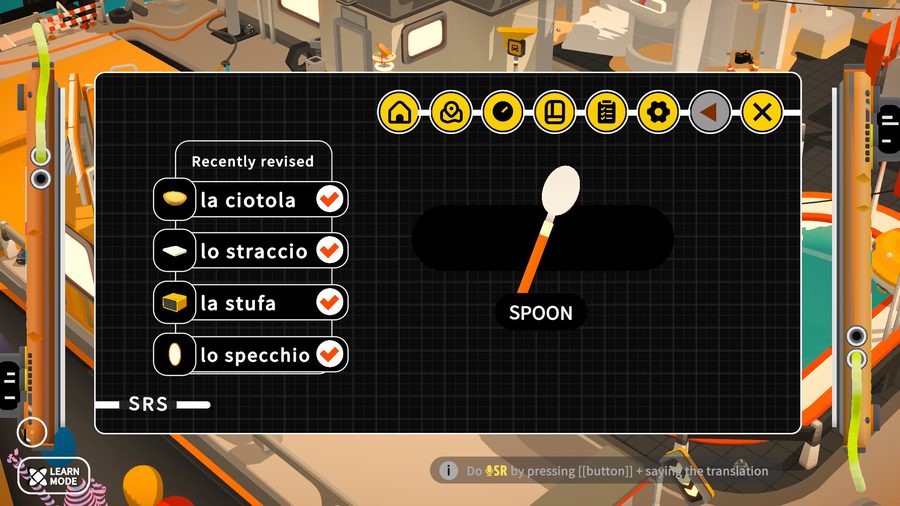
Screenshot from the Noun Town Steam store page, showing Italian words in the spaced repetition review screen
The subjunctive is the biggest one. English still has a faint trace of it, "if I were you" rather than "if I was you", but it's optional and mostly ignored in casual speech. Italian uses it constantly and treats it as grammatically required after certain verbs and expressions of doubt, hope, opinion and emotion. Penso che sia vero (I think it's true) needs the subjunctive sia rather than the indicative è, and getting that wrong doesn't just sound slightly off, it's a genuine grammatical error native speakers will notice immediately.
Verb conjugation more broadly is heavier than English learners expect, even setting the subjunctive aside. Italian conjugates for person, number, tense and mood, and the three verb groups (-are, -ere, -ire) each follow different patterns with plenty of irregular verbs woven through the most common ones, essere and avere chief among them since they're also used to form compound tenses.
Then there's the article system. Il, lo, la, i, gli and le all mean "the", and which one you use depends on the noun's gender, number, and even the sound the following word starts with. Lo studente becomes gli studenti in the plural, but il libro becomes i libri, because lo (and its plural gli) is reserved for masculine words starting with s plus a consonant, z, gn, ps, or a vowel. It's a real system with real logic behind it, but it's not something a translation-matching app tends to explain outright.
Noun Town is a single $19.99 purchase that covers Italian permanently, along with the other 11 supported languages if you ever branch out. Language Transfer and Coffee Break Italian are both completely free, which makes them hard to argue with as a starting point for the grammar side specifically. Babbel runs roughly $7 to $15 a month depending on how many months you commit to upfront, which adds up to somewhere between $84 and $180 over a year. italki is pay-per-session rather than subscription-based, typically $5 to $10 an hour for a community tutor without formal teaching credentials, or $15 to $20 an hour for a certified teacher. Pimsleur runs around $20 a month, or roughly $240 a year at the standard rate.
Stretched over the year or two it typically takes to get properly comfortable in Italian, the gap between a one-time cost and a recurring one becomes hard to ignore. That's part of the reasoning behind Noun Town's pricing model specifically. The team had used the big subscription language apps themselves, run into the same ad breaks and paywalled lesson tiers that frustrate a lot of learners, and heard the identical complaint from thousands of others before deciding to sell the game outright instead, with nothing held back after the purchase.
The combination that tends to work best pairs Noun Town for vocabulary, since it bundles native audio, spatial context and spaced repetition into daily practice, with Language Transfer or Coffee Break Italian for the grammar logic a vocabulary-first tool won't cover on its own, subjunctive included. Add italki sessions every couple of weeks once you have enough vocabulary to hold a basic conversation, specifically to get feedback on double consonants and natural rhythm, which are much harder to self-correct than grammar.
That stack costs nothing beyond the one-time price of the game, plus whatever you choose to spend on tutoring, and it directly targets the three things that tend to catch Italian learners out: a mood that barely exists in English, gender exceptions hiding in common words, and consonant length that changes meaning. Duolingo remains a reasonable way to get started, but it's rarely the whole answer once Italian starts asking more of you than vocabulary recall.
Want to try Noun Town for Italian? There is a free demo on Steam.
Try Noun Town on SteamIt depends on the gap you're trying to close. For vocabulary immersion with native Italian audio, Noun Town is the strongest option at $19.99 one time. For a free course built around grammar logic, Language Transfer's Complete Italian is one of the best available. For guided paid lessons, Babbel offers structured conversation-based courses. For real speaking practice, italki connects you with native Italian tutors from around $5 an hour. Most learners end up combining two or three of these.
Yes. Italian is one of the 12 languages supported in Noun Town. The game teaches vocabulary through a 3D open world using native Italian speaker audio, speech recognition for speaking practice, and a built-in spaced repetition system. It is available on PC and Mac via Steam for $19.99 as a one-time purchase, with a free demo available.
Italian is generally considered one of the easier languages for English speakers, sitting in the Foreign Service Institute's easiest category alongside French and Spanish. The vocabulary overlap with English through shared Latin roots helps a lot. The harder parts are the subjunctive mood, which shows up more often in everyday Italian than most learners expect, and double consonants, which change both pronunciation and sometimes meaning.
The most common complaints are that Duolingo barely touches the subjunctive mood despite how often it appears in normal Italian speech, that gender exceptions get drilled as isolated facts rather than explained through the patterns behind them, and that the app's audio doesn't prepare learners for how double consonants and regional accents actually sound in natural conversation.
Contextual learning paired with native audio and spaced repetition tends to produce the fastest long-term retention. Tools like Noun Town attach vocabulary to objects and scenes so words are encoded with meaning and the correct article rather than as an isolated translation pair, which also happens to be one of the more reliable ways to internalise Italian's gender patterns.
Babbel generally spends more time on grammar structure for Italian than Duolingo does, including earlier and clearer coverage of verb tenses. It's a paid subscription rather than free, so the choice comes down to whether the grammar depth is worth paying for, or whether you'd rather stay with Duolingo's free, gamified format and fill the grammar gap elsewhere.
No. Language Transfer's Complete Italian course is free and widely regarded as one of the better ways to understand Italian grammar logic rather than memorise rules, and Coffee Break Italian offers a free podcast course that runs from absolute beginner through intermediate. A paid tool tends to help most with speaking practice or immersive vocabulary exposure, but a determined learner can get a long way on free resources.
The Foreign Service Institute classifies Italian as a Category I language for English speakers, estimating around 600 to 750 hours of study to reach professional working proficiency. Conversational ability typically arrives well before that, often somewhere between 250 and 350 hours of consistent, varied practice covering vocabulary, grammar and speaking.
No. Noun Town has no adverts and no content locked behind an additional paywall once you own the game. The team built it this way after using major mobile language apps themselves and getting frustrated by ad breaks and paywalled lesson tiers, then hearing the same complaint from other learners. It is a single $19.99 purchase with everything included.
Further reading: Italian grammar on Wikipedia covers the subjunctive and article system in more depth. The Accademia della Crusca, Italy's oldest language academy, is the standard authority on the Italian language. The Common European Framework of Reference for Languages from the Council of Europe outlines the proficiency levels referenced by most Italian courses. Background on how language difficulty categories are assessed is on the Foreign Service Institute Wikipedia page. The review method used by Noun Town and several apps above is explained on the spaced repetition Wikipedia page.
← Back to blog