
Photo: Getfunky Paris / Wikimedia Commons (CC BY 2.0)
Quick answer: The best dedicated game for learning French on Steam in 2026 is Noun Town. It teaches French vocabulary inside a 3D open world with native speaker audio, spaced repetition and speech recognition, costs $19.99 once with no subscription, and sits at 87% positive across 590+ Steam reviews. A free demo lets you try the French module before spending anything. Full disclosure: we made it, and this post explains exactly why we think it earns the top spot anyway.
If you searched for a game to learn French on Steam, you have probably already discovered the awkward truth: the store has thousands of games with French language options, but only a handful actually built to teach French. This guide covers the one we think does it best, what it will cost you, how long French realistically takes, and how to use the rest of your Steam library as practice material once you have some vocabulary under your belt.
One thing before we start. We develop Noun Town, so treat this as a maker explaining their reasoning rather than a neutral review site. We will point out the game's limits as well as its strengths, because pretending it does everything would be silly and you would find out within an hour of playing anyway.
French is one of the most learnable languages an English speaker can pick. English borrowed so heavily from French after 1066 that linguists estimate around a third of English vocabulary has French origins. When you meet words like restaurant, hotel, page or table in French, you already know them. That head start is real and measurable.
The US Foreign Service Institute classifies French as a Category I language, estimating roughly 750 class hours for an English speaker to reach professional working proficiency. Compare that with 2,200 hours for Japanese or Mandarin. French is, by the government's own numbers, one of the fastest routes to a second language.
Here is the catch though. 750 hours is still 750 hours. The reason most learners never get close is not difficulty, it is boredom. They stop showing up around week three. This is exactly the problem games solve better than any other format: they make the hours something you want to do rather than something you schedule and then skip. And the payoff for sticking with French is enormous, since French is spoken by over 300 million people and holds official status in 29 countries.
Before naming a pick, it helps to know what separates a game that teaches French from a game that merely contains French. We spent years on this problem, and the list below is what we believe matters most, in order.
That last point comes from experience on both sides. Before building Noun Town we used the big mobile apps ourselves, hit the ad breaks and the locked lesson tiers, and heard the same complaint from thousands of other learners. It shaped the entire pricing model of our game.
Noun Town is a 3D open world town where everything you see can teach you its French name. You wander districts, point at objects, hear a native speaker say the word, then say it back with the game listening. Words you have met come back for review through a built-in spaced repetition system, and as your vocabulary grows you unlock conversations with the town's characters, full sentences and listening challenges.
The French module covers the core vocabulary a beginner needs, taught noun-first with the gendered article attached. You never learn "pain", you learn "le pain", which means the le and la patterns that torment French students settle into your memory without a single grammar drill. It will not replace formal grammar study if you want to write elegant French, and we say so plainly further down, but it removes the most common beginner failure point: an empty vocabulary.
The numbers, since a recommendation should have some: $19.99, one purchase, all 12 languages included, so if French leads you to Spanish or Japanese later there is nothing more to pay. No ads, no locked content. 590+ Steam reviews at 87% positive, over 200,000 players across the series, 3 awards won and shortlisted for 7 more. It runs on PC and Mac, and there is a free demo so the first hour costs nothing.
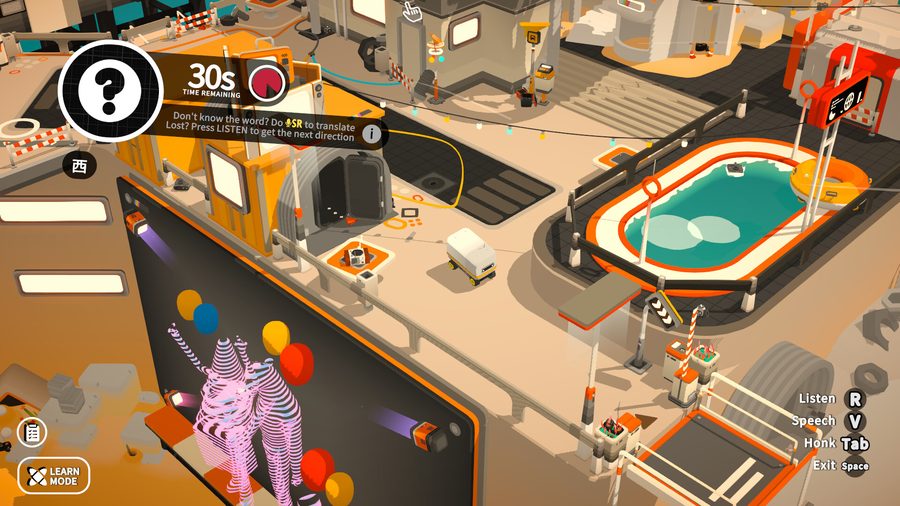
Exploring a Noun Town district, with listen and speech controls in the corner. Screenshot from the Steam store page
A dedicated learning game is the strongest starting point, but it is not the only way Steam can serve your French. Once you have a few hundred words, the rest of the store opens up as practice material, and it is worth knowing the options.
The simplest trick costs nothing: open the properties of games you already own and check the language tab. A surprising number of major titles ship with complete French text and audio. Story-heavy games work best, since dialogue carries the learning. The technique has limits for true beginners, because commercial games never slow down or repeat themselves for your benefit, which is why it works far better as a second step than a first one.
| Approach | Best for | Cost |
|---|---|---|
| Dedicated learning game (Noun Town) | Beginners building vocabulary, pronunciation and listening from zero | $19.99 once |
| Playing owned games with French language settings | Intermediate learners reinforcing vocabulary through stories | Free with games you own |
| French visual novels and text-heavy indies | Strong readers wanting volume of written French | Varies, often under $15 |
The three approaches stack rather than compete. Learners who combine a structured vocabulary tool with native media exposure consistently outperform people relying on either alone, a pattern language institutions like the Alliance Française have built their teaching around for over a century.
Numbers help set honest expectations, so here are ours. A typical Noun Town session teaches and reviews somewhere between 15 and 30 words. Play four or five sessions a week and a 1,000 word French vocabulary, enough to understand a large share of everyday spoken French, is reachable inside three to four months. That pace holds up because the spaced repetition system keeps old words alive while new ones arrive.
Measured against the CEFR levels used across Europe, that puts a consistent player around A2 territory for vocabulary and listening within a season. Grammar and conversation lag behind vocabulary at that point, which is normal and fixable with a textbook, a tutor or a patient French-speaking friend.
Fluency, meaning comfortable professional-level French, remains a 750 hour project whatever tools you choose. Nothing on Steam changes the arithmetic. What a good game changes is the fraction of those hours that actually happen. In our experience that fraction, not talent, is what separates people who learn French from people who own French apps.
If you want to turn this from reading into progress, the path is short.
Learning French does not require suffering through drills, and it never did. It requires hours, and hours follow enjoyment. Pick tools you look forward to opening.
Try the French module free with the Noun Town demo on Steam.
Try Noun Town on SteamNoun Town is the strongest dedicated option in 2026. It teaches French vocabulary in a 3D open world with native speaker audio, spaced repetition and speech recognition, costs $19.99 as a one-time purchase, and holds an 87% positive rating across 590+ Steam reviews. A free demo is available.
Yes. The game assumes no prior French. You start by learning individual nouns attached to objects in the world, then build toward phrases and full sentences with native audio guiding your pronunciation from the first minute.
Noun Town costs $19.99 once, with no subscription, no ads and no paywalled lessons. By comparison, subscription language apps commonly run $70 to $150 per year. There is also a free demo so you can try before paying anything.
The US Foreign Service Institute estimates roughly 750 class hours for an English speaker to reach professional working proficiency in French, making it one of the faster languages for English speakers. A game will not shortcut those hours, but it makes a lot more of them enjoyable enough to actually happen.
No single tool makes you fluent, and anyone claiming otherwise is selling something. A good game builds a large vocabulary, solid listening comprehension and confident pronunciation. For fluency you add conversation practice and grammar study on top of that base.
Yes. Every word and phrase in the French module is recorded by native speakers, and the game's speech recognition listens to you say the words back, so you practise speaking rather than just tapping answers.
It teaches vocabulary, phrases, listening and speaking rather than explicit grammar rules. You absorb patterns like gendered articles naturally because nouns are taught with le and la attached, but for formal grammar study a textbook or course is a better companion.
Yes, and it is a great intermediate technique. Many big Steam titles include full French text and audio in their language settings. It works best once you already have a base vocabulary, which is exactly what a dedicated learning game builds first.
Yes. The free demo on the Steam store page lets you try the French module before buying. The full game is $19.99 and includes all 12 supported languages, so you can add Spanish or Japanese later at no extra cost.
Yes, Noun Town runs on both PC and Mac through Steam, so you can learn French on either platform with the same account and one purchase.