
Photo: Wikimedia Commons (CC0)
Short answer: Noun Town is the clearest option if you want a dedicated Greek learning game on Steam. It is a 3D open world game that teaches Greek vocabulary through native speaker audio, spaced repetition and speech recognition practice, costs $19.99 as a one-time purchase, and includes a free demo. Greek is one of 12 languages the game supports, which is unusual since most language learning games on Steam stop at Spanish, French or Japanese.
Greek does not get much attention from language learning games. Search Steam for "learn Greek" and you will mostly find general trivia apps, a handful of alphabet flashcard tools, and not much built specifically around teaching the spoken language through play. That gap is exactly why we included Greek as one of the twelve languages in Noun Town.
This is written by someone on the team that built the game, so take the recommendation with that in mind. But the honest picture of what exists for Greek on Steam right now is worth laying out plainly, because most learners searching for this are disappointed by how thin the options actually are.
The Steam catalogue for language learning is dominated by big-language options. Spanish, French, German and Japanese all have multiple dedicated tools. Greek, by comparison, has very few games built around it specifically. Most people trying to learn Greek on a PC end up using a browser-based app or a general language platform that happens to include Greek as one of dozens of languages, rather than a Steam title designed around it.
Noun Town is one of the few Steam games where Greek gets the same full treatment as the more commonly requested languages: full vocabulary sets, native speaker audio, and the same open world structure used for every other supported language.
The game places you in a 3D world full of everyday objects, characters and small interactions. A word for "bread" is attached to an actual loaf on a market stall. A greeting is spoken by a character you walk up to. You are not reading a list of Greek words and their translations, you are encountering them the way you would if you were dropped into a Greek-speaking town.
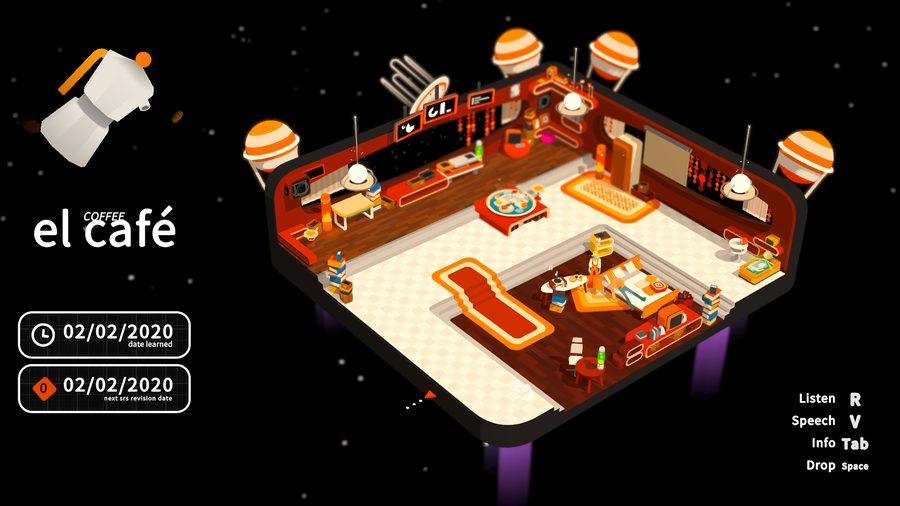
Screenshot from the Noun Town Steam store page, showing a vocabulary card and its spaced repetition schedule
It is worth being upfront about the limits. Noun Town is not built as a dedicated Greek alphabet course, and it does not walk you through grammatical cases the way a textbook would. Written Greek appears throughout the game alongside the audio, so you will pick up familiarity with the script through repeated exposure, but if reading and writing Greek from scratch is your main goal, pairing the game with a short alphabet primer will get you there faster.
Greek grammar, particularly its case system, is also something the game will not explain explicitly. You will absorb some patterns just from hearing the language repeatedly, but a grammar-focused resource alongside the game covers that side more directly.
The US Foreign Service Institute groups modern Greek in Category III, meaning it typically takes English speakers noticeably longer to reach proficiency than Category I languages like Spanish or French. Two things drive that: an unfamiliar alphabet, and a case-based grammar system that does not map neatly onto English sentence structure.
Because Greek has a smaller global learner base than Spanish or Mandarin, it is also less commercially attractive for large app companies and game studios to build dedicated content for. That is a market reality, not a reflection of the language's importance. Greek is the language of a rich literary, philosophical and historical tradition, and it remains an official language of both Greece and Cyprus, spoken by around 13 million people according to figures from the Greek language entry maintained by contributors familiar with the linguistic literature.
Languages supported in Noun Town, including Greek
One-time price on Steam, no subscription
FSI difficulty rating for Greek, for native English speakers
Noun Town is not literally the only thing on Steam with Greek in the title, so it is worth naming what else is out there rather than pretending the shelf is empty.
Compared to those two, Noun Town's Greek content sits inside the same full 3D world, native audio and speech recognition system used for the game's other 11 languages, rather than being a separate, more limited build. That is the main practical difference if you are choosing between them.
If you have tried a general app and found Greek treated as an afterthought buried in a menu of forty languages, a dedicated experience is a different feeling entirely. Noun Town suits people who want to build real listening comprehension and speaking confidence in Greek, who prefer learning through exploration rather than drilling flashcards, and who are looking for a one-time cost rather than another monthly subscription.
It suits less well anyone whose immediate goal is reading news articles or formal written Greek, or anyone who wants a structured grammar curriculum from day one. Those learners will get more out of pairing the game with a textbook or a grammar-focused course from the start.
Curious how Greek sounds and plays in the game? There is a free demo on Steam.
Try Noun Town on SteamYes. Noun Town supports Greek as one of its 12 languages, teaching vocabulary through a 3D open world with native speaker audio, spaced repetition and speech recognition, rather than through isolated flashcards.
Noun Town focuses on spoken vocabulary and listening comprehension rather than acting as a dedicated alphabet course. Players see written Greek throughout the game alongside audio, which builds familiarity with the script over time, but a separate alphabet primer alongside the game will get you reading fluently faster.
Noun Town is a one-time purchase of $19.99 on Steam, covering all 12 supported languages including Greek. There is no subscription and a free demo is available before you buy.
The US Foreign Service Institute classifies modern Greek as a Category III language, meaning it typically takes longer for native English speakers than French or Spanish, mostly because of the unfamiliar alphabet and different grammatical case system. It is not considered as difficult as Category IV languages like Japanese or Arabic.
A game can take you a long way with vocabulary, listening and pronunciation, especially in the early and intermediate stages. Most learners still pair a game with a grammar resource or textbook at some point, since games rarely teach explicit grammar rules the way a course does.
Noun Town runs on PC and Mac through Steam. It does not require a VR headset.
A couple. Lang Ops: Modern Greek is a small, budget title focused on the alphabet and around 250 vocabulary words, with no speaking practice or grammar. Lingotopia does not officially support Greek, though it has unofficial, voice-less language packs the developer does not vouch for accuracy on. Noun Town is the option that treats Greek the same as its other 11 languages, with full native audio and speech recognition.
No. Noun Town has no adverts and no content locked behind an extra paywall once you own the game. The team built it this way after getting frustrated with ad-supported and freemium mobile apps themselves, and hearing the same complaint from thousands of other learners.
Most players notice they are recognising common words within the first few sessions. Building a working vocabulary of a few hundred words typically takes several weeks of regular play, since the spaced repetition system is designed to reinforce words right before you would otherwise forget them.
The free demo on Steam covers a slice of the game and lets you hear native Greek audio and try the vocabulary and speech recognition systems firsthand, which is usually enough to tell whether the format suits how you like to learn.