
Photo: Basile Morin / Wikimedia Commons (CC BY-SA 4.0)
Short answer: Noun Town is a strong pick for learning Japanese on Steam because it builds the entire game around vocabulary acquisition rather than adding language as a minor feature. It uses native speaker audio, furigana above kanji, a spaced repetition system and speech recognition, all for a one-time price of $19.99 on PC and Mac, with a free demo available.
A game that happens to include some Japanese text is not the same thing as a game built to teach Japanese. That distinction matters a lot if you are actually trying to learn the language rather than just enjoy an aesthetic. This post looks at what separates a genuinely useful language learning game from one that just borrows the visuals, and why Noun Town's approach to Japanese specifically has ended up working the way it has.
Japanese presents a few specific challenges that a general purpose game rarely accounts for. There are three writing systems in everyday use, hiragana, katakana and kanji, and pronunciation is closely tied to pitch accent patterns that are hard to pick up from text alone. A game aimed at Japanese learners needs to handle all of that without turning into a dense reference manual.
The features that matter most are native speaker audio for every word, so pronunciation is learned correctly from the start, a review system that brings vocabulary back before it is forgotten, and some way of engaging with kanji that does not require memorising hundreds of characters before you can read anything at all. A game that skips these and just drops some Japanese-styled scenery into an otherwise unrelated game is unlikely to move the needle on your actual Japanese.
Beyond the mechanics, engagement is arguably the bigger factor. A lot of people start learning Japanese with strong motivation and lose it within a few weeks, often because the study format feels like homework. A game that people actually want to keep playing solves a problem that vocabulary lists alone cannot.
In Noun Town, Japanese vocabulary is attached to the 3D world itself rather than delivered through flashcard-style screens. A vending machine, a train platform sign, a conversation with a character in a shop, each becomes a moment where a word is introduced with native audio and visual context. You are not stopping to complete an exercise, the vocabulary is simply part of what you are looking at and interacting with.
This matters more than it might sound. Research on digital game-based learning consistently finds that words picked up in a meaningful, repeated context are retained better than the same words drilled in isolation, since more of your attention and memory systems are engaged at once. Hearing a word spoken naturally while seeing the object it refers to gives your brain more to hold onto than a word printed next to its translation.
Underneath the exploration sits a spaced repetition system, the same principle used in tools like Anki, which resurfaces words at increasing intervals right before you are statistically likely to forget them. You can read more about how this and the rest of the system fit together on the Noun Town language learning game page.
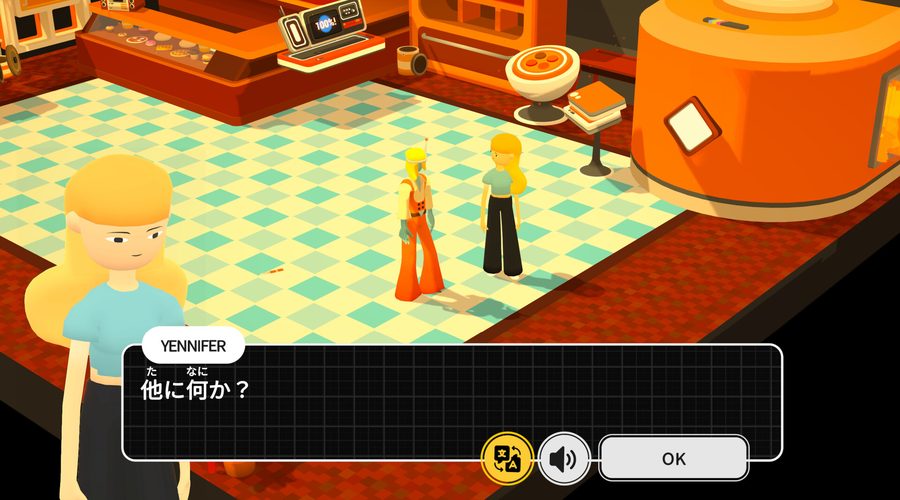
Screenshot from the Noun Town Steam store page, showing furigana printed above kanji in a dialogue line
Kanji is usually the part of Japanese that scares people off, and it is worth being straightforward about what Noun Town does and does not do here. The game does not teach kanji as a dedicated system with stroke order drills or radical breakdowns. Tools built specifically for that job, such as WaniKani, do it better than a vocabulary game reasonably could.
What Noun Town does instead is use furigana, small kana characters printed above kanji that show how they are pronounced. This lets you read and understand a sentence correctly even before you recognise the kanji underneath, while still exposing you to the real script rather than hiding it.
This was not the original design. Noun Town used to display romaji, the Latin-alphabet transliteration of Japanese, throughout the game. Feedback on that approach was genuinely mixed. Some players appreciated the extra support, particularly early on, while others felt it let them coast without ever properly engaging with hiragana, katakana or kanji. Furigana turned out to be the middle ground that satisfied both groups, since it keeps the native script front and centre while still giving you the pronunciation. Through ordinary repeated exposure, most players find they start recognising common kanji naturally over time, even without ever sitting down to study them directly.
Speech recognition is worth calling out on its own. A lot of language tools stop at listening and reading, but speaking is a separate skill that needs its own practice. Noun Town's speech recognition tool lets you attempt to say a word or phrase aloud and get feedback on how close you are, which is closer to how you would practise with a tutor than how most apps handle pronunciation.
Japanese is, in our honest opinion, one of the best served languages on Steam for this kind of game. Look across the store and you will find more titles built specifically to teach Japanese than any other single language, which is not something we say lightly given that we make one of them. Between the popularity of anime and manga and a genuinely large community of self-taught learners, Japanese has attracted more dedicated language learning games than French, Spanish or German have on the platform so far.
That said, there is a real difference between a game built to teach Japanese and a game that simply has some Japanese flavour to it. Plenty of visual novels with untranslated dialogue or puzzle games set in Japanese-styled towns exist on Steam, and most of these treat Japanese text as scenery rather than structuring the whole play loop around vocabulary acquisition, review and pronunciation.
Noun Town is one of a number of genuinely well made options for learning Japanese specifically, not the only one, and different tools suit different learners. Our honest recommendation, even though we would obviously like you to pick ours, is to check out a few of the serious options and try as many demos as you reasonably can before deciding. Noun Town has a free demo on its Steam page, and so do several of the other proper Japanese learning games. A few minutes with each will tell you more about fit than any single review, including this one.
Most players notice they are recognising and correctly recalling core vocabulary within their first few sessions, largely because spaced repetition brings new words back for review before they have had a chance to fade. Building a genuinely useful working vocabulary, several hundred words that come up in everyday situations, typically takes a few weeks of consistent play rather than a single weekend.
How quickly that translates into real fluency depends heavily on how much time you put in and whether you pair the game with anything else, such as grammar study or exposure to Japanese media outside the game. Vocabulary is one piece of a larger picture, but it is often the piece that determines whether you can follow along with anything at all.
One thing worth mentioning for anyone with an eye on more than one language: once you have built up a solid Japanese vocabulary in Noun Town, moving on to another language costs nothing extra. The $19.99 purchase covers all 12 supported languages, not just Japanese, so if Korean, Mandarin or any of the others are next on your list, you can start straight away inside the same game, using the same world, the same review system and the same interface you already know, at no additional cost.
For anyone with genuine polyglot ambitions, that removes one of the more annoying parts of learning several languages, which is having to learn a whole new app or platform each time you switch. Here, the only thing that changes is the vocabulary.
Try the Japanese vocabulary content for yourself with the free demo on Steam.
Try Noun Town on SteamNoun Town is one of the few Steam games built entirely around teaching Japanese vocabulary, rather than including a language as a side feature. It uses a 3D open world, native speaker audio, furigana above kanji, and a spaced repetition system to help words stick.
Not as a dedicated system. Noun Town shows furigana above kanji so you can read and hear words correctly, and players pick up recognition of common kanji incidentally through repeated exposure. For structured kanji study, a dedicated tool like WaniKani is a better fit.
Noun Town originally showed romaji throughout, but feedback was mixed, some players liked the extra support while others felt it discouraged them from learning the real script. Furigana, small kana printed above kanji to show pronunciation, was received well across the board and is what the game uses now.
Noun Town is a one-time purchase of $19.99 on Steam for PC and Mac. There is no subscription, no ads, and no content locked behind an additional paywall once you own it. A free demo is available if you want to try the Japanese content first.
Games are strongest at vocabulary, listening comprehension, and pronunciation practice, particularly when they include speech recognition, as Noun Town does. They are less suited to explicit grammar instruction, so most learners pair a game with a grammar resource for a fuller picture of the language.
Yes. The game introduces vocabulary gradually through everyday objects and situations, with native audio for every word, so no prior knowledge of Japanese is assumed. Furigana means you can read along even before you recognise the kanji underneath.
Noun Town is built for PC and Mac. It is not a VR title. Compatibility with handheld devices like Steam Deck depends on Steam's own compatibility rating for the game at the time of purchase, which is worth checking on the store page before buying if that is your primary device.
Many educational games treat a language as one feature among several. Noun Town is built specifically around vocabulary acquisition as its core mechanic, with native audio, spaced repetition and speech recognition all working toward that single goal rather than being added on top of an unrelated game.
Most players notice they are recognising and recalling core vocabulary within the first few sessions, since spaced repetition surfaces new words repeatedly before you are likely to forget them. Building a working vocabulary of several hundred words typically takes weeks of consistent play rather than days.
Yes, a free demo is available on the Steam store page, which includes a slice of the Japanese vocabulary and lets you test the controls, audio and review system before deciding whether to buy the full game.