
Photo: Luu / Wikimedia Commons (CC BY-SA 4.0)
Short answer: Mandarin is one of the hardest languages for English speakers to pick up, mostly down to tones and characters, and there are not many Steam games built specifically to teach it. Noun Town is one of the few, using a 3D open world, native speaker audio and a spaced repetition system across all 12 of its supported languages, Mandarin included. It will not replace focused tone drilling with a tutor, but it gives you daily, low-pressure exposure that most learners find easier to stick with than an app alone.
Mandarin has a reputation, and it is mostly earned. Ask anyone who has tried to learn it and they will bring up two things almost immediately: the tones and the characters. Both are real obstacles, and both are also the reason games can genuinely help, more so than with a language like Spanish or French where the barrier to entry is lower.
This post is about what actually makes Mandarin difficult, whether a game can move the needle on that difficulty, and where Noun Town fits if you are looking at Steam specifically rather than the usual pile of phone apps.
The US Foreign Service Institute, which trains American diplomats in dozens of languages, puts Mandarin in its top difficulty category for English speakers, alongside Arabic, Japanese and Korean. Their estimate is around 2,200 class hours to reach professional working proficiency, roughly three to four times what they estimate for French or Spanish.
Two things drive that gap.
Neither of these is insurmountable. Millions of people learn Mandarin as a second language every year. But it does mean the tools that work fine for an easier language, straightforward flashcard apps with no audio depth, tend to fall short faster with Mandarin than they would with something like Spanish.
The honest case for games in Mandarin specifically comes down to repetition with context, and repetition with sound.
| Challenge | Where a typical app struggles | Where a game can help |
|---|---|---|
| Tone recognition | Static audio clips repeated in isolation | Tones heard repeatedly in different sentences and situations, closer to real listening |
| Character memory | Flashcard decks with no visual anchor | Characters attached to objects and scenes you already remember |
| Speaking practice | Often limited or absent | Speech recognition lets you attempt the tone yourself and get feedback |
| Motivation to keep going | Daily streak pressure, easy to burn out on | Longer, voluntary sessions inside a world you want to keep exploring |
Tone recognition in particular improves with volume of exposure. The more times you hear ma said correctly in four different tones, attached to four different meanings and situations, the faster your ear starts to separate them without conscious effort. That is closer to how children pick up tonal distinctions than how most adults are taught in a classroom.
Characters benefit from the same principle in a different form. A character tied to a specific object in a 3D scene, a shopkeeper saying it aloud, a label on a door, gives your memory more to hang onto than a character sitting alone on a flashcard. It is not a shortcut around the work of learning several hundred characters, but it changes how much of that work feels like effort versus incidental pickup.
Noun Town treats Mandarin the same way it treats its other 11 supported languages: as one of a full set built around a 3D open world where words are learned in spatial context rather than through a lesson screen. You explore, talk to characters, and pick up vocabulary as a byproduct of playing, with native speaker audio attached to every word so tones are heard correctly from the start rather than approximated.
Underneath that sits a spaced repetition system, which resurfaces words shortly before you are likely to forget them, and speech recognition, so you can attempt to say a word or phrase back and get a sense of whether your tone landed. None of that replaces a native speaker correcting you directly, but it gives you a low-stakes way to practise production, which most flashcard-only apps skip entirely.
If you want the fuller picture of how Noun Town approaches language learning as a whole, across all 12 languages, the language learning game landing page covers the mechanics in more depth than makes sense to repeat here.
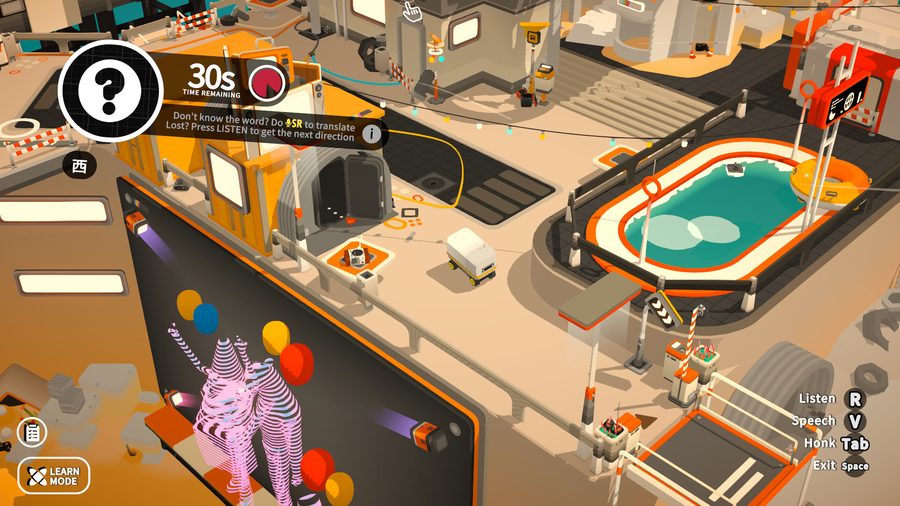
Screenshot from the Noun Town Steam store page
A note from the developers: Mandarin was prioritised ahead of several other language requests because of how much demand we saw for it, both in player feedback and in our own research before building the game.
We would like to add other varieties of Chinese in the future, Cantonese being the one we hear about most, but we do not have a timeline for that yet. If it is something you want, it is worth letting us know.
Not really, and it is worth being straightforward about that rather than pretending there is a crowded market. Steam has plenty of general edutainment titles and a scattering of visual novels or story games set in China, which give incidental exposure to spoken Mandarin without teaching it directly. What is much rarer is a game built specifically as a structured Mandarin learning system, with audio, spaced repetition and vocabulary progression, the way Noun Town or a dedicated app would be.
That scarcity is not unique to Mandarin. Most language learning games on Steam cover a handful of the more commonly requested languages, Spanish, French, German, Japanese, Korean, and treat Mandarin as one option among several rather than the sole focus of the product. Noun Town takes that same approach, Mandarin sits alongside Japanese, Korean, Spanish, French, German, Italian, Russian, Greek, Egyptian Arabic and English inside one game.
If you are starting from zero, most teachers recommend getting pinyin pronunciation and the four tones solid before pushing into a large vocabulary, since a mispronounced tone learned early has a habit of sticking around. A rough first month looks like this.
None of that requires a specific tool. It is just a sequence that tends to reduce the number of bad habits you have to unlearn later, whether you are using a game, an app, a textbook, or a tutor to get there.
Mandarin tuition and structured courses can run into hundreds of dollars a year, and several major subscription apps charge $70 to $150 annually for full access. Noun Town is a one-time purchase of $19.99 covering all 12 languages including Mandarin, with no ads and nothing locked behind an additional paywall once you own it. That was a deliberate decision by the team after using ad-supported and freemium mobile apps themselves and hearing the same frustration from thousands of other learners.
There is also a free demo on Steam if you want to try the Mandarin content, and the game world generally, before deciding whether it fits how you like to learn.
Curious what learning Mandarin inside a 3D world actually feels like? There is a free demo on Steam.
Try Noun Town on SteamMandarin is generally ranked as one of the more time-intensive languages for native English speakers to reach fluency in, largely because of its tonal system and its writing system, which uses characters rather than an alphabet. The US Foreign Service Institute places Mandarin in its highest difficulty category, estimating around 2,200 hours of study to reach professional working proficiency, compared to roughly 600 to 750 hours for languages like Spanish or French.
Mandarin uses four main tones plus a neutral tone, and the same syllable can mean completely different things depending on pitch. The word ma, for example, can mean mother, hemp, horse or a scolding depending on the tone used. English speakers are not used to pitch changing the meaning of a word, so tone deafness in this specific sense is a learned skill, not a fixed trait, and it improves with repeated listening and speaking practice.
No, you can learn to speak conversational Mandarin using pinyin, the romanised writing system, without ever reading a character. Many learners do this for speaking practice early on. That said, characters unlock reading menus, signs and messages, and most learners eventually want at least basic character recognition alongside their spoken Mandarin.
Estimates generally put functional newspaper literacy at around 2,000 to 3,000 characters, though many everyday texts and signage can be understood with somewhere between 500 and 1,500 of the most frequently used characters, since a relatively small set covers a large share of everyday written Mandarin.
A game cannot replace a human ear correcting you in real time, but repeated exposure to native speaker audio tied to specific words and situations trains tone recognition over time, in the same way children absorb tone before they can explain what a tone even is. Games that include speech recognition, like Noun Town, also give you a chance to practise producing the tone yourself rather than only listening to it.
There are relatively few games on Steam built specifically around teaching Mandarin as a full language learning system, compared to the number of general edutainment or trivia-style language apps. Noun Town includes Mandarin as one of its 12 supported languages, using the same 3D open world, native audio and spaced repetition system as its other languages.
Most teachers recommend starting with pinyin pronunciation and the four tones before moving into vocabulary, since mispronounced tones early on can become a habit that is harder to unlearn later. Pairing that early tone training with vocabulary you actually encounter in context, rather than isolated word lists, tends to help it stick faster.
Noun Town's Mandarin content is built around the vocabulary and character forms most useful for a general beginner to intermediate learner, paired with native speaker audio and pinyin support so you can follow along by sound as well as by character.
No. Noun Town is a one-time purchase with no adverts and nothing locked behind an additional paywall onc