Photo: Vyacheslav Argenberg / Wikimedia Commons (CC BY 4.0)
Short answer: Noun Town is the best all-round game for learning Russian on Steam, teaching vocabulary through a 3D open world with native speaker audio, speech recognition and spaced repetition for a one-time $19.99. Influent's dedicated Russian pack and Lingotopia are strong alternatives for a different style of exploration-based learning, and Da! Russian Quiz suits players who just want a quiz format with over 5,000 words and phrases to review.
If you have searched for a game to learn Russian on Steam, you have probably already noticed the results are a mixed bag: a few genuine language-learning games, a scattering of quiz apps, and a lot of unrelated titles that just happen to have Russian localisation. This guide only covers games actually built to teach you the language, what each one does well, and which one fits how you like to learn.
I work on Noun Town, so take the recommendation for what it is. But the comparison below is honest, and I have tried to be specific about where other tools do things differently rather than just worse.
Not every game that touches on Russian is built the same way, and the format matters more than people expect once you are a few weeks in. Before comparing specific titles, it helps to know what actually separates a game that teaches Russian well from one that just has Russian text somewhere in it.
A game missing most of these can still be fun, but it will not do much for your actual Russian. Keep this list in mind as you read the comparisons below.
These are the Steam titles genuinely built around teaching Russian vocabulary, rather than games that simply support a Russian language option in their menus.
| Game | Format | Price | Best for |
|---|---|---|---|
| Noun Town Editor's pick | 3D open world, NPC conversations, SRS, speech recognition | $19.99 one-time | Learners who want depth and a full review system |
| Influent (Russian DLC) | 3D apartment, click-to-learn objects | Small DLC price | Short, focused sessions in a compact space |
| Lingotopia | City exploration, native audio recordings | Standalone purchase | Learners who like a "lost in the city" premise |
| Da! Russian Quiz | Quiz format, 5,000+ words and phrases | Budget quiz game | Reviewing vocabulary you already half know |
Noun Town leans toward depth: a full open world, native speaker audio for every word, speech recognition for output practice, and spaced repetition built into the review screen so nothing you learn just evaporates after a session. Influent takes the opposite approach and keeps things small and contained, which some learners find less overwhelming as a starting point. Lingotopia sits somewhere in between, with a lighter world but a similar "explore to learn" premise. Da! Russian Quiz is not really a teaching tool so much as a large quiz bank, useful once you already have some vocabulary and want to drill it.
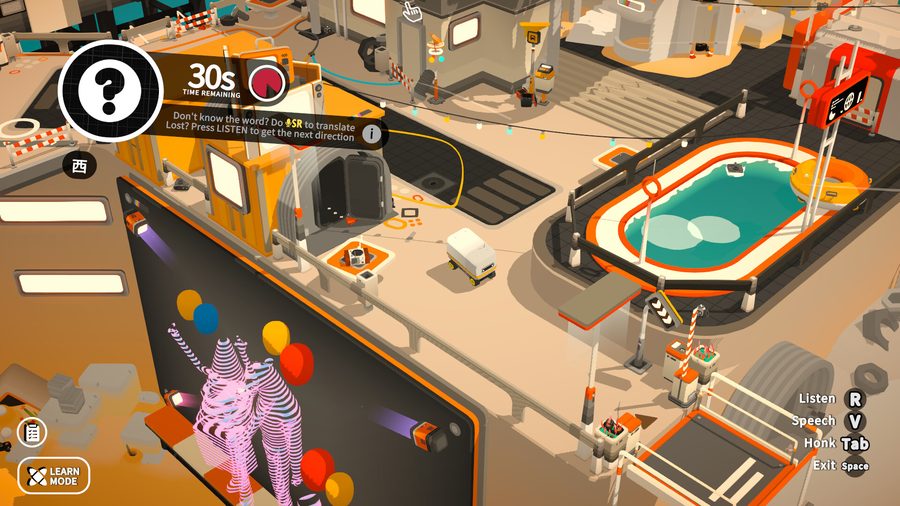
Screenshot from the Noun Town Steam store page
Russian vocabulary in Noun Town is attached to the 3D world itself. A samovar sitting on a market stall, a word spoken by a shopkeeper, a sign above a door. You are not stopping to complete a flashcard drill, you are picking words up as a side effect of exploring, the same way you would pick up vocabulary living somewhere the language is actually spoken.
Every word comes with native speaker audio, so your pronunciation is modelled correctly from the first time you hear it rather than guessed at from spelling. The game also uses speech recognition, so once you have learned a word you can practise saying it out loud and get feedback, which most Steam-based Russian games skip entirely.
Underneath all of this sits a spaced repetition system. Once you have met a word, the game schedules it to come back for review right before you are statistically likely to forget it. You can read more about how the full game works, and which of the 12 supported languages are available, on the Noun Town language learning game page.
Noun Town also has no ads and nothing locked behind an additional paywall once you own it. That was a deliberate decision. The team used the big mobile language apps before building this and got frustrated hitting a paywall a few lessons in, the same complaint we heard from thousands of other learners, so the game is a single $19.99 purchase with everything included from day one.
Russian uses the Cyrillic alphabet, which is the first thing that puts a lot of learners off before they have even started. It looks unfamiliar, but it is only 33 letters, and several of them look identical or close to Latin letters you already know. Most learners recognise the shapes comfortably within two to three weeks of regular exposure, especially when the letters are attached to real words rather than studied in isolation.
The US Foreign Service Institute, which trains American diplomats, classes Russian among the harder languages for native English speakers, estimating around 1,100 class hours to reach solid professional proficiency, according to the widely cited FSI language difficulty rankings. That figure covers professional fluency, not casual conversation, so do not let it put you off starting. Reaching a genuinely useful travel or conversational level takes a fraction of that.
Grammatically, Russian's case system trips up a lot of learners coming from English, where word endings change depending on a noun's role in the sentence. None of the games in this guide teach case endings explicitly, they are vocabulary and listening tools first. If grammar structure is your main sticking point, pairing a game with a short grammar-focused course or textbook covers the gap neatly.
The four games above split into two genuinely different formats, and picking the wrong one for your habits is the most common reason people bounce off a language tool after a week.
Neither format is objectively better. Immersive games tend to hold attention for longer sessions, which matters if consistency has been your problem in the past. Quiz games are faster to open and close, which matters if you only have five minutes between other things.
Most learners who play an immersive Russian game for 20 to 30 minutes a day can comfortably recognise 300 to 500 common nouns and everyday phrases within four to six weeks, once spaced repetition has cycled through the core vocabulary a handful of times. That is enough to read simple signage, follow basic conversations, and order food or ask directions with some confidence.
Speaking fluently and following fast native conversation takes considerably longer, closer to the hundreds of hours the FSI figures above describe. The good news is that vocabulary and listening, the two things games are genuinely strong at, are also the two things that make the biggest difference to how confident you feel using a language early on.
Want to try learning Russian this way? There is a free demo on Steam.
Try Noun Town on SteamNoun Town is the strongest all-round option, teaching vocabulary through a 3D open world with native speaker audio, speech recognition and a built-in spaced repetition system, for a one-time price of $19.99. Influent's Russian language pack and Lingotopia are also worth trying if you want a different style of exploration-based learning, and Da! Russian Quiz suits players who prefer a straightforward quiz format.
Yes. Noun Town teaches Russian vocabulary in spatial context inside a 3D world, pairs every word with native speaker audio, and uses spaced repetition to bring words back right before you would otherwise forget them. It also includes speech recognition so you can practise saying words out loud, not just recognising them.
You can build real vocabulary and listening skills this way, particularly when a game repeats words in context and uses spaced repetition. Games are generally weaker than textbooks or courses at teaching grammar rules explicitly, so most learners get the best results pairing a game with some structured grammar study.
Russian is generally classed as a harder language for native English speakers, requiring around 1,100 hours of study to reach solid professional working proficiency according to the US Foreign Service Institute's difficulty rankings. The Cyrillic alphabet is the first hurdle, but it only has 33 letters and most learners pick up the shapes within a couple of weeks of regular exposure.
Noun Town costs $19.99 as a one-time purchase covering all 12 supported languages, including Russian, with no subscription and no paywalled content afterward. Other Steam options vary: Influent's Russian DLC and Lingotopia are typically priced lower as smaller add-ons or standalone titles, while Da! Russian Quiz is a budget quiz game.
Most vocabulary-focused Russian games, including Noun Town, show words written in Cyrillic alongside native audio, which helps you absorb the alphabet through repeated exposure rather than a dedicated lesson. If you want the alphabet taught explicitly step by step before anything else, a short standalone Cyrillic course is worth doing first.
Most learners can comfortably recognise 300 to 500 common Russian nouns and everyday phrases within four to six weeks of regular play, roughly 20 to 30 minutes a day, once spaced repetition has cycled through the core vocabulary a few times. Speaking confidently and understanding fast native speech takes considerably longer.
Yes. Noun Town has a free demo on Steam so you can try the Russian vocabulary and mechanics before buying. Several other language games also offer demos or free chapters, which is a sensible way to check the teaching style suits you before spending anything.
Influent teaches vocabulary by clicking on objects inside a single 3D apartment, which makes it compact and focused. Noun Town uses a larger open world with NPC conversations, speech recognition and a full spaced repetition review system, and covers Russian alongside 11 other languages under one purchase rather than as a separate language pack.
No. These games are built for complete beginners and introduce the Cyrillic alphabet and vocabulary from the very first session. You do not need to know any Russian, or even be familiar with the alphabet, before you start playing.