Photo: Jonashtand / Wikimedia Commons (CC BY-SA 4.0)
A good gift for someone learning Japanese should either fill a gap in their current study routine or make an already tedious part of it more enjoyable. That rules out generic "Japan-themed" novelty items and points toward things that hold up after the first week: a proper dictionary, a decent notebook for handwriting practice, or a language learning game they will actually keep opening. Below are ten picks across a range of budgets, roughly ordered from small stocking-fillers to bigger, more considered gifts.
Quick picks: Under $20, go for a genkouyoushi practice notebook or kanji flashcard deck. Around $20, Noun Town on Steam ($19.99, 12 languages including Japanese, free demo) is one of the more complete single gifts available. For a dedicated learner further along, a JLPT-level vocabulary guide or a proper electronic dictionary makes a more targeted gift.
This is our own game, so weigh that accordingly. Noun Town teaches Japanese vocabulary inside a 3D open world, with native speaker audio, a spaced repetition system, and speech recognition for pronunciation practice. Kanji is not taught as a dedicated system, the game shows furigana above kanji so words can be read correctly without needing to already know the character, and recognition builds gradually through repeated exposure. For someone who wants to actually enjoy their study sessions on PC or Mac rather than grind through drills, it is worth trying the free demo first.
Genkouyoushi is the standard grid paper used across Japan for handwriting practice, with square boxes sized for kanji and kana that enforce consistent stroke order and spacing. It sounds like a small thing, but it is genuinely hard to find outside Japan, and any learner who writes by hand will notice the difference immediately.
For a learner who already has some vocabulary and wants to focus specifically on reading kanji, a well-organised flashcard deck ordered by JLPT level or frequency is one of the more targeted gifts available. Physical decks have the advantage of being screen-free, which some learners specifically want as a break from app-based study.
A paperback pocket dictionary is a genuinely useful, unglamorous gift, especially for a learner who has been relying entirely on phone apps. Look for one that includes example sentences and common compound words rather than a bare word list, since context is what actually makes a dictionary entry usable.
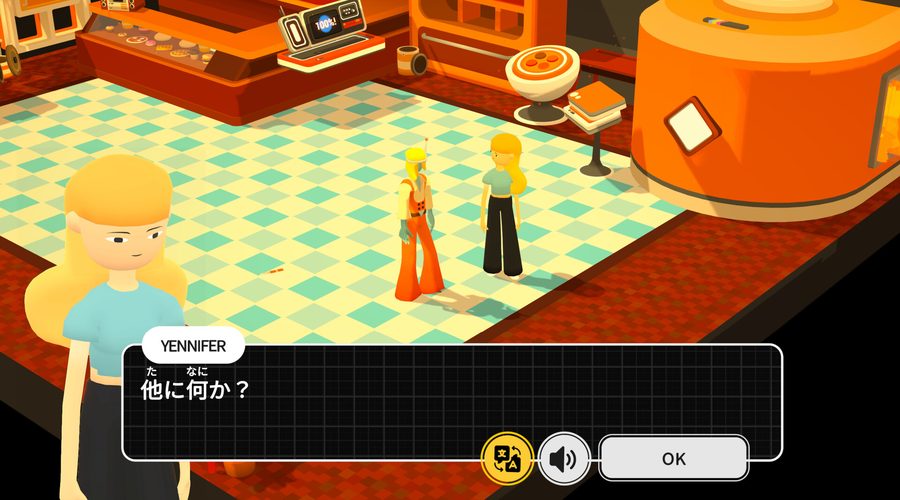
Screenshot from the Noun Town Steam store page, showing furigana displayed above kanji in a dialogue line
Not directly a study tool, but a genuinely popular pick among Japanese learners who keep a vocabulary notebook or journal. A nicely made stationery set makes handwriting practice feel less like a chore, and Japanese stationery design in particular has a strong following well beyond the language-learning community.
If the person you are buying for has mentioned studying for a specific JLPT level, a guide targeted at that exact level, N5 through N1, is one of the more thoughtful gifts on this list. Getting the level wrong makes the book far less useful, so this one is worth double-checking before you buy.
Mostly novelty, and worth treating as one. Snack boxes include packaging printed in Japanese, which gives a small, low-pressure chance to recognise real-world vocabulary outside a textbook. It works best as a fun add-on gift alongside something more substantial, not as the main present.
A gift credit for a language exchange or tutoring platform gives the recipient real conversation practice, which is the piece self-study, games and apps all struggle to fully replace. It works especially well as a gift for someone who has built up vocabulary independently but has not had much chance to actually speak.
Manga printed with furigana above the kanji is genuinely readable for learners well below native fluency, and it gives study a reason to continue outside a textbook. Picking a series the recipient already likes in translation makes this a considerably stronger gift than a random pick off a shelf.
When in doubt, letting the recipient choose is not a cop-out, it is often the most useful gift you can give. Steam's library includes Noun Town and a number of other language and culture-focused titles, and a gift card leaves the final decision with the person who actually knows their own study habits.
Level matters more than most gift guides admit. A JLPT N5 vocabulary book is close to useless for someone already comfortable reading manga, and a dense kanji reference is intimidating rather than helpful for a total beginner. If you are not sure where the person is in their studies, ask directly, or lean toward gifts that work at any level, stationery, a language learning game with adjustable difficulty, or a snack box, none of which require guessing correctly.
For a complete beginner, the priority is usually something that keeps them motivated past the first few weeks, since that is where most people quit. A game like Noun Town or a well-designed notebook they will actually enjoy filling in tends to matter more early on than a serious reference book. For someone further along, targeted tools like a JLPT-level guide or dedicated kanji flashcards become more valuable, since they already have the foundation those tools build on.
The official JLPT website lists the vocabulary and grammar scope for each level, which is a useful reference if you want to check that a book or guide actually matches where the recipient says they are.
A language learning game is strong at vocabulary, listening and pronunciation, but it is not really designed to teach handwriting or dense kanji study on its own. The kanji writing system in particular rewards repeated physical practice, tracing the same character enough times that the stroke order becomes automatic, which is why a notebook or flashcard deck still earns a place on this list even for someone who already owns a language game.
Noun Town's approach to this is to use furigana, small phonetic characters placed above kanji, rather than teaching kanji as its own subject. The game used to display romaji throughout instead, and feedback on that was genuinely mixed, some players liked the extra support, others felt it was letting them avoid learning the real script. Furigana replaced it and has been received well across the board, since it still lets players read correctly without blocking them from gradually recognising the kanji itself. For a learner who wants to go deeper into kanji specifically as a subject, a dedicated tool such as WaniKani is generally a better fit used alongside a vocabulary game rather than instead of one.
Not sure if it's the right fit? Try the free Japanese demo on Steam before you buy.
Try Noun Town on SteamGood gifts fall into a few categories: study tools like a dictionary or kanji notebook, immersive tools like a language learning game, cultural items like stationery or snacks, and structured resources like a JLPT vocabulary guide. The best pick depends on whether the person prefers structured study or more playful, immersive practice.
Yes, particularly for someone who plays games on PC or Mac and wants vocabulary practice that does not feel like homework. Noun Town is a one-time purchase of $19.99 covering Japanese and 11 other languages, with a free demo available so the recipient can try it before you commit to buying.
A genkouyoushi kanji practice notebook, a set of kanji flashcards, or Noun Town's $19.99 one-time purchase are all solid picks under or around $20. A good Japanese-English pocket dictionary can also be found in this range secondhand or as a paperback edition.
No. Most of the gifts worth giving, stationery, study notebooks, games, snack boxes and dictionaries, require no Japanese knowledge to choose or purchase. The main thing to check is the recipient's current level, since a beginner's JLPT N5 book is not useful for someone already studying N2.
Genkouyoushi is the standard grid paper used in Japan for handwriting practice, with square boxes for kanji and kana that keep stroke order and spacing consistent. It is a small, inexpensive gift that genuinely helps anyone practising handwritten Japanese, since it is harder to find outside Japan than most learners expect.
It depends on what the person already has. Kanji-specific tools like flashcards or a dedicated kanji app are best for someone who already has a vocabulary base and wants to focus on reading and writing. A vocabulary-first tool like a language game suits someone earlier in their learning who needs spoken words and listening practice first.
The JLPT, Japanese-Language Proficiency Test, is the standard certification for non-native Japanese ability, run in five levels from N5 (beginner) to N1 (advanced). If the person you are buying for has mentioned a specific level they are studying for, a vocabulary or grammar guide targeted at that exact level is one of the more thoughtful gifts you can give.
Mostly novelty, but that is not a bad thing. Snack boxes usually include packaging printed in Japanese, which gives a small, low-pressure opportunity to recognise words in context. They work best as a fun add-on gift rather than a primary study tool.
There is a free demo on Steam, available on PC and Mac. The full game is a one-time purchase of $19.99 with no subscription and nothing paywalled once you own it, a deliberate choice after the team got frustrated with ads and paywalled tiers in mobile language apps and heard the same complaint from thousands of learners.
Not as a dedicated system. Noun Town shows furigana, small phonetic characters, above kanji so players can read words correctly without needing to already know the character, and kanji recognition builds naturally through repeated exposure. For learners who want to study kanji directly as its own subject, a dedicated tool such as WaniKani is generally a better fit alongside the game.