
Photo: Luis García (Zaqarbal) / Wikimedia Commons (CC BY-SA 3.0)
Short answer: Noun Town is a strong choice for learning Spanish on Steam because the whole game is built around vocabulary rather than treating Spanish as a side feature. It covers both Spain and Mexican Spanish, uses native speaker audio, spaced repetition and speech recognition, and costs a one-time $19.99 on PC and Mac, with a free demo available.
Plenty of games on Steam have a Spanish-speaking character or a level set somewhere in Latin America, but very few are actually designed to teach you Spanish. If you are searching for a video game that will help you build real vocabulary rather than just look the part, the pool of genuine options is smaller than the search results suggest. This post walks through what to look for, how Noun Town approaches Spanish specifically, and what else is worth knowing before you buy anything.
A game set in Spain or Mexico is not automatically a language learning tool. Plenty of adventure and puzzle games borrow Spanish-language signage, music or dialogue purely for atmosphere, without ever asking the player to actually learn a word. That is fine for the game they are trying to be, but it will not move your Spanish forward.
A genuine Spanish learning game needs a few things in place. Native speaker audio matters most, since pronunciation learned from a synthetic voice or, worse, no audio at all, tends to need unlearning later. A review system that resurfaces vocabulary before you forget it matters almost as much, because exposure without repetition fades quickly. And some way of practising speaking, not just recognising words on a screen, closes a gap that a lot of apps and games leave completely open.
Judged against that bar, the number of Steam titles built specifically around teaching Spanish, rather than just being set somewhere Spanish is spoken, is small. That narrows the decision considerably once you know what to actually check for on a store page.
Noun Town places Spanish vocabulary inside a 3D open world rather than behind a series of lesson screens. Walking through a market stall, ordering at a café, or talking to a shopkeeper introduces a word with native audio and a visual object attached to it, so the word is tied to something concrete rather than sitting in a list to memorise.
Underneath the exploration, a spaced repetition system tracks which words you already know well and which need to come back around sooner. This is the same underlying idea used in flashcard tools like Anki, timing reviews to land right before you are statistically likely to forget a word rather than on a fixed daily schedule. You can see the full breakdown of how the system fits together on the Noun Town language learning game page.
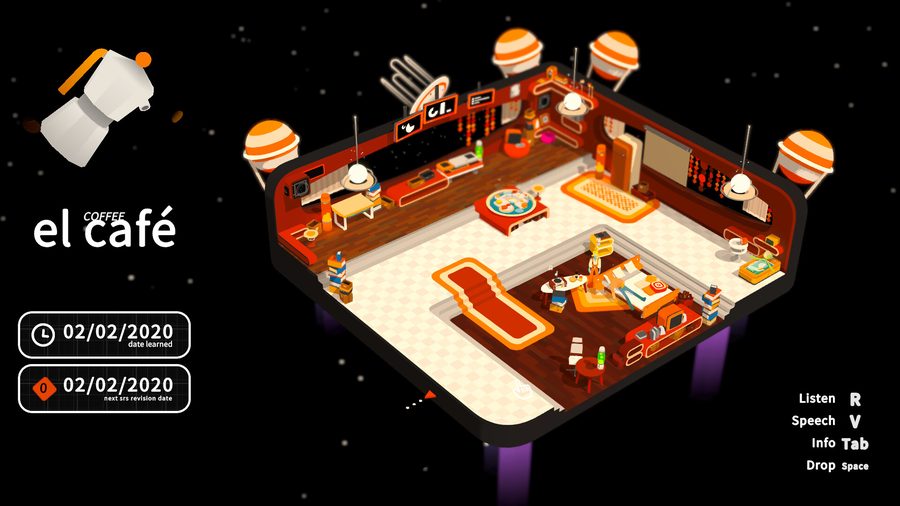
Screenshot from the Noun Town Steam store page, showing a cafe scene labelled "el cafe"
One detail that a lot of general language apps gloss over is that Spanish is not one single accent or vocabulary set. Spain Spanish and Mexican Spanish differ in pronunciation, some everyday vocabulary, and occasionally in grammar habits like how "you" is addressed informally. Noun Town treats these as two separate language tracks with their own native speaker audio, so you are not stuck learning an accent that does not match where you actually plan to use the language.
Distinct "th" sound for c and z before certain vowels, vosotros as the informal plural you, and vocabulary choices common across Spain.
No lisped "th" sound, ustedes used for the informal plural you, and vocabulary that lines up more closely with everyday Mexican and broader Latin American usage.
If you are learning for travel to Spain, a Spain-facing job, or media from Spain, the Spain track makes sense. If your goal is travel to Mexico, family connections, or the kind of Spanish most commonly heard across the Americas, the Mexico track is the better starting point. Either way, both are included in the same purchase, so switching later costs nothing extra.
Choosing which Spanish to launch with was one of the harder calls we made early on. We are a UK-based team, so European Spanish was the natural starting point. Looking back, we probably should have started with a South American variant instead, which is what eventually led us to add Mexican Spanish. We would like to add more Spanish variants over time, so if there is one you would like to see next, contact@noun.town.
Spanish learning tools range from completely free to fairly expensive, and it is worth being clear about where a game like Noun Town sits.
None of these are strictly better than the others in every situation. A free app is a sensible starting point if you are not sure Spanish is for you yet. A tutor is worth the cost once you need feedback a piece of software cannot give. A one-time purchase game sits in between, useful if you want a deeper, ad-free way to build vocabulary without an ongoing bill.
The US Foreign Service Institute classifies Spanish as a Category I language for English speakers, its easiest tier, estimating roughly 600 to 750 class hours to reach professional working proficiency. That is considerably less than languages like Japanese or Arabic, which sit in the hardest category at closer to 2,200 hours.
Spanish being easier does not mean it is instant. What a shorter learning curve does mean is that consistent vocabulary practice pays off faster than it would for a harder language, since you are not fighting an unfamiliar script or wildly different sentence structure at the same time as new words. Most Noun Town players report recognising and recalling common Spanish vocabulary within their first few sessions, with a working vocabulary of several hundred words building up over a few weeks of regular play.
A vocabulary-focused game will not replace grammar study, immersion, or conversation practice on its own, and it is not trying to. Where it helps most is the part a lot of learners struggle with quietly: staying consistent long enough for anything to stick. Organisations like the Instituto Cervantes, the official body for promoting Spanish language and culture worldwide, and the Real Academia Española, which maintains the standard reference for the Spanish language, are both useful once you want to go deeper into grammar and formal usage than a game is built to cover.
The Common European Framework of Reference for Languages is also worth knowing about if you want a standard way to measure your progress, since most courses and exams describe proficiency using its A1 to C2 scale.
Try the Spanish vocabulary content for yourself with the free demo on Steam.
Try Noun Town on SteamNoun Town is one of the few Steam games built specifically to teach Spanish vocabulary rather than including Spanish as a minor feature. It uses a 3D open world, native speaker audio, spaced repetition and speech recognition, and covers both Spain and Mexican Spanish as separate options.
Yes. Noun Town includes Spanish (Spain) and Spanish (Mexico) as two separate language tracks, each with its own native speaker audio, so you can pick the accent and vocabulary that matches where you plan to use the language.
Noun Town is a one-time purchase of $19.99 on Steam for PC and Mac. There is no subscription, no ads, and no content locked behind an extra paywall once you own it. A free demo is available before you buy.
The US Foreign Service Institute lists Spanish as a Category I language for English speakers, estimating around 600 to 750 hours of study to reach professional working proficiency. A vocabulary game will not replace that full study path on its own, but consistent play can build a working vocabulary of several hundred words within a few weeks.
Yes. Vocabulary is introduced gradually through everyday objects and situations, with native audio for every word, so no prior knowledge of Spanish is assumed. The spaced repetition system adjusts to how well you already know a word rather than assuming a fixed starting level.
Games are strongest at vocabulary, listening comprehension and pronunciation practice, particularly with speech recognition, which Noun Town includes. They are less suited to explicit grammar instruction, so most learners pair a game with a grammar resource or course for a complete picture of the language.
No. There are no adverts and nothing locked behind an additional paywall once you own the game. This was a deliberate decision after the team experienced the frustration of ad-supported and freemium mobile apps firsthand, and heard the same complaint from thousands of learners.
Yes, a free demo is available on the Steam store page, which includes a slice of the Spanish vocabulary and lets you test the controls, audio and review system before deciding whether to buy the full game.
Compared to many other languages, yes, at least for English speakers. Spanish shares a large amount of vocabulary with English through Latin roots, uses a phonetic spelling system, and is classified by the Foreign Service Institute as one of the easiest language groups for English speakers to learn.
Noun Town is built for PC and Mac. It is not a VR title. Compatibility with handheld devices like Steam Deck depends on Steam's own compatibility rating for the game at the time of purchase, which is worth checking on the store page before buying if that is your primary device.