Photo: Dandy1022 / Wikimedia Commons (CC BY-SA 3.0)
Body parts in Japanese are the vocabulary words for the parts of the human body, such as atama (頭, head), me (目, eyes), te (手, hand) and ashi (足, foot or leg), and most learners need around 30 to 40 of them to describe appearance, pain and everyday routines. Nearly all of these words are written with a single kanji character, which makes them some of the earliest kanji most learners actually recognize, since body-part characters appear constantly in daily speech, medical forms and casual conversation. Furigana, the small reading hints printed above a kanji, make these words approachable long before you can read the character on its own. Here is the full list, with romaji, kanji and meanings.
Short answer: atama (頭, head), kao (顔, face), me (目, eyes), mimi (耳, ears), hana (鼻, nose), kuchi (口, mouth), te (手, hand), ashi (足, foot or leg) and onaka (お腹, stomach) are the words you will use most. Most are written with a single kanji and read with furigana until you have memorized them.
Body-part words are an unusually good entry point into kanji because so many of them are built from a single, simple character rather than a long compound. 目 (eye), 耳 (ear), 口 (mouth), 手 (hand) and 足 (foot) are all taught within the first year or two of elementary school in Japan, as part of the official set of characters known as jōyō kanji, the roughly 2,100 characters designated for general everyday use. Learning them early gives a beginner a small set of genuinely useful building blocks rather than an abstract set of strokes memorized in isolation.
These characters also show up far beyond anatomy. 目 appears in words about attention and observation, 手 appears in words about skill and assistance, and 口 appears in words about speech and entrances. Recognizing a body-part kanji on sight means recognizing a piece of dozens of other words later, which is one reason this vocabulary set rewards early, careful attention rather than a quick skim.
Several of the most commonly used Japanese idioms are built around words from this group, especially te (hand), so it is worth learning this section with an ear toward phrases as well as plain vocabulary.
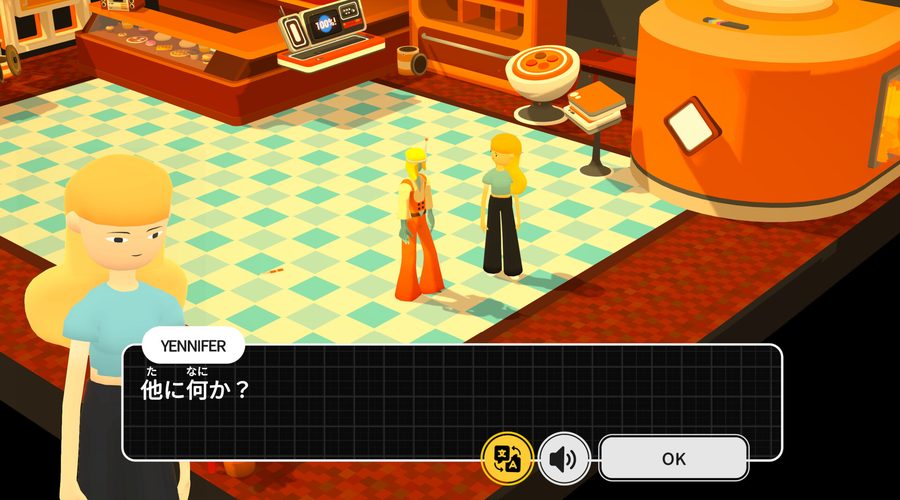
Screenshot from the Noun Town Steam store page, showing furigana-assisted dialogue
Notice that foot and leg are both read ashi but written with two different kanji. 足 covers the foot and is also used informally for the whole leg, while 脚 specifically singles out the leg, especially in more formal, medical or anatomical writing. Context, not pronunciation, is what tells you which one a sentence means.
Just like in English and Spanish, Japanese reuses body-part vocabulary constantly in set phrases whose meaning has little to do with the literal body part involved.
Reading body-part kanji is one of the clearest places where furigana earns its keep. A beginner who has never seen 膝 before has no way to guess it is read hiza, but a small reading hint printed directly above the character solves that instantly, without forcing the learner to stop and look the word up mid-sentence.
Noun Town's own approach to this changed over time. The game originally displayed romaji throughout, and player feedback on that choice was mixed: some learners appreciated the easier entry point, while others felt it discouraged them from ever engaging with the real Japanese script. The game now shows furigana above kanji instead, a change that was received well across the board, since it keeps the actual script front and center while still giving a beginner enough support to read it correctly.
Noun Town does not teach kanji as a dedicated, standalone system the way a tool built specifically for that purpose would, and better options exist if kanji mastery on its own is your main goal. What it does instead is let players pick up kanji incidentally, through repeated exposure to the same characters across dozens of in-world conversations, which is a reasonable way to build initial familiarity with high-frequency characters like the body-part set covered here.
Games built around spatial, context-based vocabulary learning tend to help here too, since seeing te or ashi attached to an actual character and scene in a 3D world gives the word, and its kanji, somewhere real to live in memory rather than just another line on a flashcard deck.
Want to see Japanese kanji like these learned in context, with furigana support, instead of on a flashcard?
Try Noun Town on SteamThe basic body parts in Japanese are atama (頭, head), kao (顔, face), me (目, eyes), hana (鼻, nose), kuchi (口, mouth), mimi (耳, ears), te (手, hand) and ashi (足, foot or leg). Japanese nouns have no grammatical gender, which makes the vocabulary itself simpler than languages like Spanish or German, though the kanji take some getting used to.
Head is atama in Japanese, written with the kanji 頭. It also appears in common phrases like atama ga ii, literally head is good, meaning smart or clever.
Atama ga ii translates literally as head is good, and it means someone is smart or clever. It is one of the most common body-part idioms in everyday Japanese.
Onaka ga suita, literally stomach has emptied, is the standard everyday way to say I am hungry in Japanese.
Foot and leg are both pronounced ashi, but they use different kanji depending on meaning and formality. 足 covers the foot and is used informally for the whole leg too, while 脚 specifically singles out the leg, especially in more formal, medical or anatomical contexts.
Furigana are small kana characters printed above a kanji to show how it is pronounced, letting a reader who has not yet memorized the character still read it correctly. Noun Town displays furigana above kanji in its in-game dialogue for exactly this reason, after testing romaji throughout the game and finding furigana worked better for most players.
Ankle is ashikubi in Japanese, written 足首, which literally combines the kanji for foot (足) and neck (首).
Most learners can recall the roughly 35 body-part words in this guide within one to two weeks of short, regular practice, similar to other beginner vocabulary sets. Recognizing the kanji by sight, rather than just the romaji, usually takes a bit longer and benefits from furigana support early on, broadly in line with CEFR-aligned pacing for comparable vocabulary sets.
Noun Town does not teach kanji as a dedicated standalone system, since tools built specifically for that purpose already exist, such as those documented by language research bodies like the National Institute for Japanese Language and Linguistics. Players pick up kanji incidentally through repeated exposure, with furigana displayed above each character in dialogue until it becomes familiar.
Yes. Noun Town teaches vocabulary like body parts inside a 3D world with native speaker audio and spaced repetition, attaching new words to a real scene rather than a flat list, which tends to help them stick. The Steam page has a free demo if you want to try it before buying.