
Photo: Laurie Nevay / Wikimedia Commons (CC BY-SA 2.0)
Short answer: Yes, a video game can teach real Korean vocabulary if it is actually built for that purpose, not just set in a Korean-styled world. Noun Town does this with native speaker audio, Hangul from day one, spaced repetition and speech recognition, for a one-time cost of $19.99 on PC and Mac. Korean itself is rated among the harder languages for English speakers, around 2,200 study hours for full proficiency, so a game works best as one part of a wider study routine rather than the whole plan.
Interest in Korean has grown enormously alongside K-pop, K-dramas and Korean cinema, and a lot of that interest naturally lands on gaming platforms where people already spend their time. The honest question worth asking before buying anything is whether a game can genuinely teach the language, or whether it just borrows the aesthetic. The answer depends entirely on how the game was built.
Korean has a reputation, not entirely unearned, as one of the more demanding languages for English speakers to pick up. Sentence structure differs substantially from English, verb conjugation carries layers of formality that do not map onto anything in English, and vocabulary shares very little common ground with European languages the way Spanish or French does.
That difficulty is exactly why the format matters so much. A study method that keeps you engaged long enough to absorb vocabulary through repeated exposure has a real advantage over one you abandon after two weeks, purely because Korean rewards sustained effort more than most languages do.
Miss enough of these and a game becomes decorative rather than educational. A visual novel with Korean-style art and English subtitles, for instance, is a fine game, but it is not doing the job of teaching you the language, even if it feels adjacent to Korean culture.
Noun Town treats Korean as one of its 12 supported languages, with vocabulary attached to objects and moments inside a 3D open world rather than delivered through flashcard-style screens. A word for a piece of furniture, a food item on a market stall, or a phrase from a character in conversation gets introduced with native audio and a visual object tied to it, so it is anchored to something concrete rather than floating in a list.
Hangul is shown from the start, alongside native audio for every word, so you are reading and hearing the real script rather than a workaround version of it. You can see the full picture of how the vocabulary system, spaced repetition and speech recognition work together on the Noun Town language learning game page.
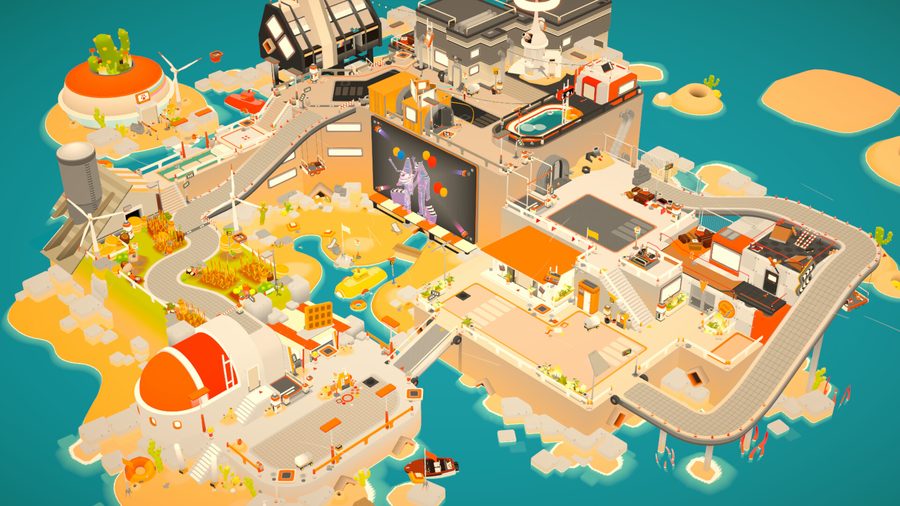
Screenshot from the Noun Town Steam store page, showing the open 3D world players explore
Korean was not part of the original launch line-up. We added it as a free update afterwards, once it became clear just how much demand there was for it. It has since grown into the fourth most used language in the game, which we mostly put down to the sheer number of players who come to Noun Town through a love of Korean culture in the first place.
Hangul, the Korean writing system, was created in 1443 under King Sejong the Great specifically to be easy for ordinary people to learn, in deliberate contrast to the Chinese characters used for Korean writing before it. That design goal mostly succeeded. Hangul is widely considered one of the more logical, systematic scripts in active use anywhere, with a small set of characters that combine in predictable ways to represent sounds.
This means the part of Korean that looks most intimidating to a total beginner, the script itself, is often the part that gets learned fastest. Most people who commit a few focused sessions to Hangul can read basic Korean words within days, well before they have built any real vocabulary. That gives a vocabulary-focused game a genuine head start compared to a language like Japanese or Mandarin, where the writing system itself takes much longer to become functional.
Estimated study time for an English speaker to reach professional working proficiency in Korean, according to the US Foreign Service Institute, placing it in the hardest of five difficulty categories
That figure covers full proficiency, not the point where a game becomes useful or enjoyable. Most Noun Town players notice they are recognising Hangul and recalling common vocabulary within their first few sessions, since new words are deliberately brought back for review before they are likely to be forgotten. Building a working vocabulary of several hundred words typically takes a few weeks of consistent play, not the full multi-year path implied by the proficiency estimate above.
Vocabulary is one piece of a much larger picture that includes grammar, sentence particles and formality levels that shift depending on who you are speaking to. Resources like the National Institute of Korean Language and the King Sejong Institute, South Korea's government-backed body for promoting Korean language education abroad, are useful once you are ready to study grammar and formal usage in more depth than a vocabulary game is designed to cover.
Probably not, and it is worth saying that plainly rather than overselling what any single tool can do. A vocabulary game is excellent at the part most learners struggle with quietly, which is staying consistent long enough for anything to actually stick. It is not built to explain when to use formal versus informal speech, or how sentence particles change meaning, the way a structured course or a fluent tutor can.
Many Korean learners eventually aim for a recognised benchmark like the Test of Proficiency in Korean, the standard exam used to certify Korean ability for study or work purposes. A vocabulary game will not prepare you for that exam on its own, but a solid vocabulary base built through consistent, engaging practice makes the grammar and reading sections considerably less daunting once you get there.
Try the Korean vocabulary content for yourself with the free demo on Steam.
Try Noun Town on SteamYes, particularly for vocabulary, listening and reading Hangul. Games that are built specifically around language, rather than just featuring Korean text as scenery, can teach real vocabulary through repeated, contextual exposure. They work best alongside grammar study rather than as a total replacement for it.
Noun Town is one of the few Steam games built specifically to teach Korean vocabulary. It uses a 3D open world, native speaker audio, spaced repetition and speech recognition, covering Korean as one of 12 supported languages.
Yes. Korean vocabulary in Noun Town is shown in Hangul with native speaker audio for every word, so you read and hear the real script from the start rather than relying on a romanised version of the language.
Noun Town is a one-time purchase of $19.99 on Steam for PC and Mac. There is no subscription, no ads, and no content locked behind an extra paywall once you own it. A free demo is available before you buy.
The US Foreign Service Institute places Korean in its hardest category for English speakers, estimating around 2,200 class hours to reach professional working proficiency, similar to Japanese, Mandarin and Arabic. Hangul itself, however, is considered one of the more logical writing systems to learn, and most learners pick it up faster than the rest of the language.
Yes. Vocabulary is introduced gradually through everyday objects and situations, with native audio for every word, so no prior knowledge of Korean or Hangul is assumed at the start.
No. There are no adverts and nothing locked behind an additional paywall once you own the game. This was a deliberate decision after the team experienced the frustration of ad-supported and freemium mobile apps firsthand, and heard the same complaint from thousands of learners.
Yes, a free demo is available on the Steam store page, which includes a slice of the Korean vocabulary and lets you test the controls, audio and review system before deciding whether to buy the full game.
Noun Town is built for PC and Mac. It is not a VR title. Compatibility with handheld devices like Steam Deck depends on Steam's own compatibility rating for the game at the time of purchase, which is worth checking on the store page before buying if that is your primary device.
Most players notice they are recognising Hangul and recalling common vocabulary within their first few sessions, since spaced repetition brings new words back before they are likely to be forgotten. A working vocabulary of several hundred words typically takes a few weeks of consistent play to build.