Colours in Japanese split into two grammar groups rather than one single list. A small set of core colours, red, blue, black and white among them, are true adjectives that end in -i and conjugate like any other Japanese adjective. A larger group, including green, purple, pink and orange, are nouns that attach to whatever they describe with no instead of changing shape at all. Altogether there are about 14 colour words most learners need for everyday conversation, and this guide covers every one of them with pronunciation, kanji, and the grammar reason behind the split.
Short answer: Japanese has around 14 common colour words. Only four, aka (red), ao (blue), kuro (black) and shiro (white), are true native adjectives going back to Old Japanese (akai, aoi, kuroi, shiroi). Two more, kiiro (yellow) and chairo (brown), later picked up the same -i ending by analogy (kiiroi, chairoi). Every other colour, including midori (green), murasaki (purple), pinku (pink) and orenji (orange), is a noun that attaches to whatever it describes with no rather than changing form.
| Japanese | Adjective form | Pronunciation | English |
|---|---|---|---|
| 赤 aka | 赤い akai | ah-kah / ah-kah-ee | red |
| 青 ao | 青い aoi | ah-oh / ah-oh-ee | blue |
| 黒 kuro | 黒い kuroi | koo-roh / koo-roh-ee | black |
| 色 shiro | 色い shiroi | shee-roh / shee-roh-ee | white |
These four words are the oldest colour terms in the Japanese language, and they are the only colours that have always been true adjectives, going all the way back to Old Japanese. That history is exactly why they behave differently from every other colour on this page: aka, ao, kuro and shiro conjugate like any ordinary Japanese adjective, so akai hana means a red flower and kuroi neko means a black cat, with the -i ending doing real grammatical work rather than just being tacked on.
Ao carries an unusual quirk worth knowing. In older Japanese, ao covered a much wider range of shades than the modern English word blue, stretching into territory that today's speakers would call green. That broad historical meaning never fully disappeared. Japan's traffic law still officially calls the green go light ao shingo, literally a blue signal, even though the light itself is the same colour used on traffic signals everywhere else. Fresh green leaves are also still sometimes described with ao in everyday speech, a small fossil of how the word used to work before midori took over as the standard word for green.
Pronunciation for all four is straightforward once you know the pattern. Dropping the final -i turns the adjective into the plain noun form, which is what you would use if you were just naming the colour rather than describing an object directly, for instance when answering the question "what colour is this?" with a single word.
| Japanese | Adjective form | Pronunciation | English |
|---|---|---|---|
| 黄色 kiiro | 黄色い kiiroi | kee-ee-roh / kee-ee-roh-ee | yellow |
| 茶色 chairo | 茶色い chairoi | chah-ee-roh / chah-ee-roh-ee | brown |
Kiiro and chairo are not among the four original colour adjectives, but both gained the same -i ending by analogy and now function as fully normal i-adjectives in modern Japanese. Notice that both words already contain iro, the general Japanese word for "colour": kiiro breaks down as ki (a word related to turmeric-yellow pigment) plus iro, and chairo breaks down as cha (tea) plus iro, so chairo literally means "tea colour."
Because kiiroi and chairoi conjugate exactly like akai or shiroi, you can use them the same way: kiiroi hana for a yellow flower, chairoi inu for a brown dog. This is good news for learners, since once the four original adjectives are solid, these two slot straight into the same pattern without any extra grammar to learn.
The iro building block inside both words is worth remembering on its own, since it reappears constantly in the colours that follow, and understanding it makes the rest of the Japanese colour system far more predictable than trying to memorise every word as a separate, unrelated item.
| Japanese | Pronunciation | English | Used with "no" |
|---|---|---|---|
| 網 midori | mee-doh-ree | green | midori no shibafu (green lawn) |
| 肯 murasaki | moo-rah-sah-kee | purple | murasaki no hana (purple flower) |
| ピンク pinku | pin-koo | pink | pinku no fuku (pink clothes) |
| オレンザ orenji | oh-ren-jee | orange | orenji no kaban (orange bag) |
This is where the GSC-confirmed high-interest queries for this topic sit: pink and purple in particular get searched often, and both behave the same way grammatically. None of these four words ever takes an -i ending. They are plain nouns, so to describe something directly you need the particle no in between the colour and the noun it modifies, as shown in the examples above.
Pinku and orenji are especially easy to spot once you know what to look for, since both are loanwords from English, written in katakana rather than kanji. Japanese never built native adjective forms for them, because they entered the language relatively recently, long after the grammar for colour adjectives had already settled around the four original words.
Midori and murasaki are older, native Japanese words, but they still never developed adjective forms of their own. Historically, Japanese treated colour mostly as a small, closed set of four core adjectives, and every colour added after that point, whether a native word or a loanword, joined the open-ended noun category instead of expanding the adjective category.
| Japanese | Pronunciation | English |
|---|---|---|
| 灰色 haiiro | hah-ee-ee-roh | grey |
| 金色 kin'iro | keen-ee-roh | gold |
| 銀色 gin'iro | geen-ee-roh | silver |
| 緮 kon | kohn | navy blue |
Haiiro, kin'iro and gin'iro all show the same -iro pattern already seen in kiiro and chairo: a base word describing the source of the colour, hai (ash), kin (gold) or gin (silver), attached to iro, "colour." This pattern is genuinely productive in Japanese, meaning you can build a reasonable colour name for almost any shade by pairing a noun with iro, even for colours that don't have a single dedicated word of their own.
The English loanword guree, from grey, is also widely used, especially in fashion, design and product descriptions, and most native speakers treat haiiro and guree as interchangeable. Kon, meanwhile, is a genuinely distinct colour word in Japanese that doesn't map perfectly onto a single English word. It covers a deep navy blue used constantly for school uniforms, suits and formal wear, sitting in its own space between ao and kuro rather than simply being "dark blue."
None of the four colours in this section ever takes an -i ending, which fits the wider pattern: outside the original four adjectives plus the two analogical extensions, every colour in Japanese stays fixed in noun form and leans on no to connect to whatever it describes.
Fourteen words is a short list, but the grammar split is what trips most learners up, so it helps to practice with that split in mind rather than treating every word identically.
This kind of real-object, in-context vocabulary is exactly the approach behind the Noun Town language learning game, where words like these are learned attached to real 3D scenes and native speaker audio, then brought back automatically on a spaced repetition schedule rather than fading out of memory after a single study session.
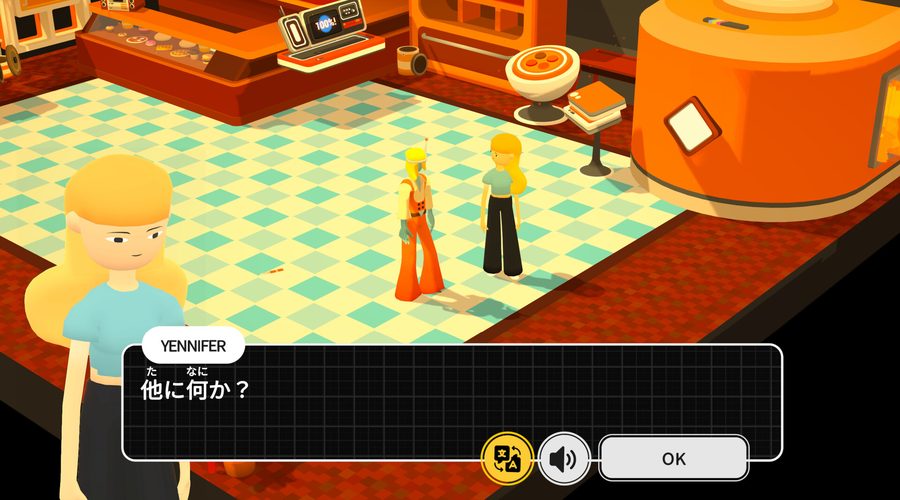
Screenshot from the Noun Town Steam store page, showing furigana above kanji during in-game dialogue
Japanese colour kanji show up constantly once you start reading menus, clothing tags and signage, which is why recognising them in context matters just as much as knowing the spoken word. Rather than teaching kanji as a dedicated system, which other tools like WaniKani already do well, Noun Town displays furigana reading hints above kanji in dialogue, including colour words, so players pick characters up naturally through repeated exposure instead of a separate memorisation course. An earlier version of the game showed romaji throughout, but feedback on that approach was mixed, and the switch to furigana was received well across the board.
Want to learn these colours and hundreds of other Japanese words in context? Try the free demo on Steam.
Try Noun Town on SteamMost learners need around 14 colour words for everyday Japanese. Four of them, aka (red), ao (blue), kuro (black) and shiro (white), are true native adjectives. The rest, including green, purple, pink and orange, are nouns that attach to whatever they describe with no.
Black is kuro, written as a noun, pronounced roughly koo-roh. As an adjective describing something directly it becomes kuroi, pronounced koo-roh-ee, as in kuroi neko, a black cat.
Pink is pinku, written in katakana as a loanword from English and pronounced pin-koo. It is grammatically a noun, so it attaches to a noun with no, as in pinku no fuku, pink clothes.
Purple is murasaki, pronounced moo-rah-sah-kee. Like green and pink, it is a noun rather than an adjective, so it needs no to describe something, as in murasaki no hana, a purple flower.
An i-adjective colour, such as akai (red) or shiroi (white), changes form and conjugates on its own, the same way any other Japanese adjective does. A no colour, such as midori (green) or murasaki (purple), is grammatically a noun and never changes form. It simply attaches to whatever it describes using the particle no.
In older Japanese, ao covered a much wider range than modern blue, stretching into shades Western speakers would call green. That broad historical use never fully disappeared, so Japan's traffic signal law still officially calls the go light ao shingo even though the light itself is the same green used elsewhere in the world.
Grey is usually haiiro, pronounced hah-ee-ee-roh, built from hai (ash) plus iro (colour). The loanword guree, from English grey, is also common, especially in fashion and design contexts.
It depends on the word's origin. Native Japanese colours like aka, ao, kuro and shiro are usually written in kanji. Colours borrowed from other languages, such as pinku (pink) and orenji (orange), are written in katakana, the script Japanese reserves mainly for loanwords.
Noun Town shows kanji with furigana reading hints above the characters rather than romaji, after player feedback on an earlier romaji-based version was mixed. Players still pick up common kanji, including colour kanji like aka and kuro, through repeated exposure in context rather than a dedicated kanji curriculum.
Learn the four native adjectives, aka, ao, kuro and shiro, as a group first, since they behave differently from every other colour. Attach each word to a real object, hear it spoken by a native speaker rather than just reading it, and review the full list on a spaced schedule instead of memorising everything in one sitting.
Further reading: Japanese grammar on Wikipedia covers i-adjectives and na-adjectives in more depth. The National Institute for Japanese Language and Linguistics and The Japan Foundation are good official sources for standard Japanese usage, and the Wikipedia entry on Basic Color Terms explains the broader linguistic theory behind why languages tend to develop colour vocabulary in a predictable order.
← Back to blog