The seven days of the week in Japanese are nichiyoubi (Sunday), getsuyoubi (Monday), kayoubi (Tuesday), suiyoubi (Wednesday), mokuyoubi (Thursday), kin'youbi (Friday), and doyoubi (Saturday). Each one ends in youbi, meaning roughly "weekday", and the first part names the sun, the moon, or one of five classical elements: fire, water, wood, metal, and earth. That system arrived in Japan from China more than a thousand years ago, and it quietly runs on the exact same seven-body astrological tradition, sun, moon, and five planets, that gave English Thursday its link to Thor and French jeudi its link to Jupiter.
Short answer: Japanese weekday names come from the sun, moon and five classical elements. Sunday is nichiyoubi (sun), Monday is getsuyoubi (moon), Tuesday is kayoubi (fire), Wednesday is suiyoubi (water), Thursday is mokuyoubi (wood), Friday is kin'youbi (metal, written with the kanji for gold), and Saturday is doyoubi (earth). The system reached Japan from China over a thousand years ago and traces back to the same seven-body astrological tradition behind English and French weekday names.
Every Japanese weekday name follows the same pattern: one kanji for the sun, the moon, or an element, followed by youbi (曜日), which roughly means "day of the week", according to Wiktionary's entry for 曜日. Here is each one, in order, with its kanji, pronunciation, and what the first character actually means.
Nichi (日) means "sun" or "day", the same kanji that starts the word for Japan itself, Nihon (日本), literally "origin of the sun". Sunday being the sun's day is one weekday name Japanese and English actually agree on directly, since English Sunday also traces back to the sun.
Getsu (月) means "moon". Just like Sunday, this is a direct match with English: Monday comes from "moon day" in Old English too, so Japanese and English landed on the exact same idea here independently, through two different astrological traditions that both put the sun and moon first.
Ka (火) means "fire". This is where Japanese and English visibly part ways: English Tuesday comes from Tiw, a Norse war god later matched to Mars, while Japanese keeps the element, fire, that Chinese astrology assigned to the planet Mars, without naming the planet or a god directly at all.
Sui (水) means "water". Chinese astrology linked water to Mercury, the fastest moving planet, in the same five element system that assigns fire to Mars. English Wednesday instead comes from Woden (Odin), the Norse figure matched to Mercury in Roman mythology.
Moku (木) means "wood" or "tree". Jupiter was linked to wood in the Chinese element system, while English Thursday keeps Thor, the Norse thunder god matched to Jupiter in Roman mythology. Same planet, two completely different naming choices.
Kin (金) means "metal" or "gold", the same kanji you'll see in the word for money, okane (お金). Chinese astrology linked metal to Venus, and English Friday keeps Frigg, the Norse goddess matched to Venus.
Do (土) means "earth" or "soil". Chinese astrology linked earth to Saturn, the slowest moving of the five visible planets, and English Saturday is the one weekday that kept the Roman name directly, Saturn's day, rather than swapping in a Norse equivalent the way Tuesday through Friday did.
The fire, water, wood, metal, earth system isn't unique to Japanese. It comes from wu xing, the Chinese five elements theory, which assigns each of five visible planets, Mars, Mercury, Jupiter, Venus and Saturn, to one element: fire, water, wood, metal and earth respectively. Add the sun and the moon, and you get seven heavenly bodies total, the same seven that anchor most astrological week systems worldwide, as explained in Wikipedia's overview of wu xing.
Japan adopted this system, known there as the Seven Luminaries (shichiyou), from China during the Heian period, roughly the 9th century, along with a large amount of other Chinese astronomical and calendrical knowledge. It settled into the fixed seven day week structure still used today, with the kanji names staying essentially unchanged for well over a thousand years.
Korean and Chinese both use closely related systems for their own weekday names, built from the same sun, moon and five element foundation, which is why a learner who already knows Japanese weekday names will often recognise the pattern immediately in Mandarin or Korean too, even with completely different pronunciation.
It looks, at first glance, like Japanese and English went in totally different directions, one names days after elements, the other after gods. Underneath, though, both systems are describing the exact same seven heavenly bodies, the sun, the moon, Mars, Mercury, Jupiter, Venus and Saturn, inherited from the same Hellenistic era astrological tradition that spread both east into China and west into the Roman world.
The Roman and later Norse influenced Germanic languages named each day after a god associated with that planet, which is why Thursday keeps Thor, standing in for Jupiter, and Friday keeps Frigg, standing in for Venus, in English. Chinese astrology instead named each day after the element associated with that same planet, fire for Mars, water for Mercury, wood for Jupiter, metal for Venus, earth for Saturn, and Japan inherited that element based naming wholesale rather than inventing its own.
So kayoubi and Tuesday are, in a real sense, naming the same thing two different ways: one calls it Mars's day through a god, the other calls it fire's day through an element historically tied to that planet. Once you see the seven body structure underneath, the two systems stop looking unrelated and start looking like two regional dialects of the same very old idea. You can read more about how this planetary naming tradition spread across different cultures and languages on Wikipedia's overview of the names of the days of the week.
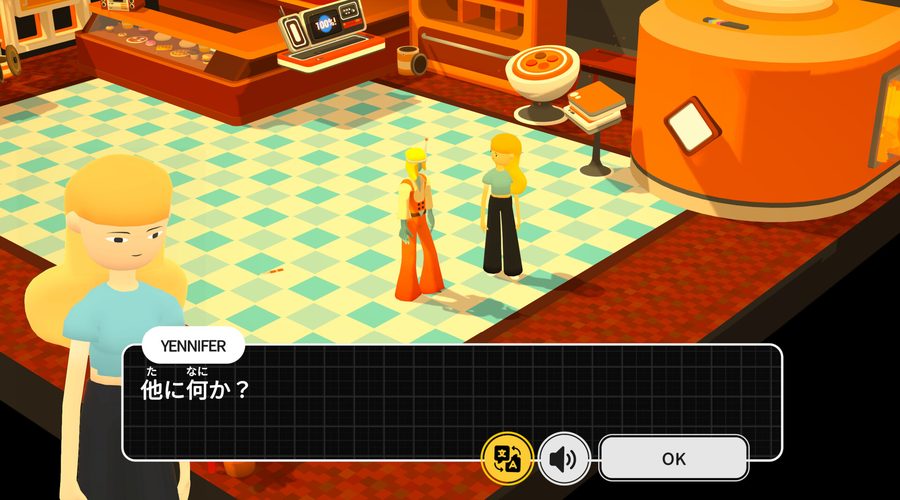
Screenshot from the Noun Town Steam store page, showing furigana guiding pronunciation above kanji in dialogue
日, 月, 火, 水, 木, 金, and 土 aren't just useful for telling someone what day it is. They're among the most frequent kanji in the entire language, and learning them through the days of the week gives you a running start on dozens of other words.
This is part of why weekday vocabulary is such a cost effective early target in Japanese. You aren't just memorising seven isolated words, you're getting first exposure to seven kanji that will keep reappearing across completely unrelated vocabulary for as long as you keep studying.
Days of the week in Japanese attach easily to a handful of simple sentence patterns, and you don't need complex grammar to start using them.
Kayoubi ni gakkou ni ikimasu. (I go to school on Tuesday.)
Kyou wa nichiyoubi desu. (Today is Sunday.)
Doyoubi to nichiyoubi wa yasumi desu. (Saturday and Sunday are days off.)
Ni after the day marks "on", the same particle used for specific points in time generally, and desu simply means "is". That's enough grammar to state what day it is, or what happens on a given day, in almost any everyday conversation. Add wa to mark the topic of the sentence, as in kyou wa, "as for today", and you can build most scheduling conversations in Japanese with just these pieces.
This vocabulary set, plus the basic grammar around it, generally sits at the JLPT N5 level, the entry point of the Japan Foundation's official Japanese Language Proficiency Test, which makes it one of the very first practical vocabulary sets most structured Japanese courses introduce.
Kanji like 火, 水, and 金 are exactly the kind of character that benefits from repeated, contextual exposure rather than rote memorisation from a chart. Noun Town doesn't teach kanji as a dedicated system the way a tool built specifically for kanji study, such as WaniKani, does. Instead, players pick up kanji incidentally, through repeated exposure inside everyday scenes and sentences, the same way the weekday kanji in this guide start to stick once you've seen doyoubi and getsuyoubi a few dozen times.
Noun Town used to show romaji throughout, the Latin alphabet transliteration used in guides like this one, but feedback on that approach was mixed: some players liked the easier entry point, and others felt it let them avoid learning the real script for too long. The game now shows furigana, small hiragana characters placed above the kanji, instead, which was received well across the board. You still get a clear pronunciation guide right there on screen, but the kanji itself, 火, 水, 金, and the rest, stays visible the whole time, rather than being replaced outright.
That balance, readable the moment you need it, but never hidden behind a substitute script, is a big part of how Noun Town's language learning game approaches Japanese specifically, kanji included.
Want to see how kanji like these actually show up in context?
Try Noun Town on SteamSunday is nichiyoubi, Monday is getsuyoubi, Tuesday is kayoubi, Wednesday is suiyoubi, Thursday is mokuyoubi, Friday is kin'youbi, and Saturday is doyoubi. Each one combines a kanji for the sun, moon, or an element with youbi, "day of the week".
Nichi means "sun". Japanese keeps the sun as Sunday's namesake directly, the same way English Sunday also traces back to the sun, making it one of the two weekday names, alongside Monday, where Japanese and English agree outright.
Chinese astrology, which Japan inherited this system from, linked the planet Mars to the element fire. English Tuesday instead names the Norse war god Tiw, who was matched to Mars in Roman mythology, so both languages are naming the same planet through two different cultural lenses.
Yes. Tuesday through Saturday in Japanese are named after fire, water, wood, metal and earth, the five elements of the Chinese wu xing system, each one originally linked to one of the five visible planets.
Yes, more closely than it looks. Both systems ultimately name the same seven heavenly bodies, the sun, moon and five planets, inherited from the same ancient astrological tradition. English uses gods associated with each planet, while Japanese uses the Chinese elements associated with the same planets.
Roughly: nichiyoubi (nee-chee-YOH-bee), getsuyoubi (GET-soo-YOH-bee), kayoubi (KAH-YOH-bee), suiyoubi (SOO-ee-YOH-bee), mokuyoubi (MOH-koo-YOH-bee), kin'youbi (KEEN-YOH-bee), and doyoubi (DOH-YOH-bee). Stress falls roughly on the syllables shown in capitals.
Yes, significantly. The seven kanji involved, 日, 月, 火, 水, 木, 金, and 土, are among the most frequently used in the language and reappear constantly in unrelated words, from Nihon (Japan) to okane (money) to hanabi (fireworks).
Noun Town shows the kanji with furigana, small hiragana reading guides placed above each character, rather than replacing it with romaji. You get a clear pronunciation cue without the kanji itself disappearing from view.
Most learners pick up all seven within a few days of focused practice, since the pattern, an element or luminary plus youbi, repeats across all seven and only the first part actually changes each time.
Very useful. They sit at the JLPT N5 level, come up constantly in scheduling and everyday conversation, and double as an introduction to seven of the most common kanji in the language.