Family in German is die Familie, and the core immediate family words are Mutter (mother), Vater (father), Bruder (brother), Schwester (sister), Sohn (son), and Tochter (daughter). Unlike Spanish or Italian, German family vocabulary doesn't follow one single gender pattern you can apply everywhere. Some pairs share a root with a simple ending change, and others, like mother and father themselves, are completely unrelated words that just have to be learned separately. This guide covers every common German family term, including the quirks that trip up learners who expect one tidy rule to cover everything.
Short answer: The core German family words are Mutter (mother), Vater (father), Bruder (brother), Schwester (sister), and Kind (child, plural Kinder). Siblings together are Geschwister, a single gender neutral word rather than a masculine plural standing in for a mixed group. German has around 25 to 30 family terms once you add grandparents, in-laws, and step-family, and most learners pick up the core 15 to 20 within one to two weeks.
Start with the words you'll use constantly. A few of these look like tidy pairs, and a few genuinely don't.
Notice that Mutter and Vater don't share a root, and neither do Bruder and Schwester. This is different from Spanish, where madre and padre, or hermano and hermana, at least rhyme with a predictable swap. German just asks you to learn these as separate words from the start. The good news is Geschwister: a word that means siblings outright, with no gender assumption baked in at all, which is tidier than how many other languages handle a mixed group of brothers and sisters. You can hear words like these used inside full scenes rather than a flat list using Noun Town's language learning game, which places vocabulary into everyday 3D environments with native speaker audio.
Eltern is worth flagging on its own. German technically has a singular form, Elter, but it's rare enough in daily conversation that most native speakers barely use it. If you want to talk about one parent specifically, you simply say Mutter or Vater rather than reaching for the singular of Eltern at all.
Extended family vocabulary in German mixes genuinely regular patterns with a couple of words that don't follow any pattern at all.
Opa and Oma are what you'll actually hear in nearly every family conversation. Großvater and Großmutter exist and are perfectly correct, but they read as slightly formal next to the warmth of Opa and Oma, which German-speaking children typically learn first and keep using well into adulthood.
Cousin and Cousine are both borrowed directly from French, which is why they don't follow the usual German -er or -in pattern you might expect. Enkel and Enkelin do follow a regular pattern, adding -in for the feminine form, the same way many German nouns build their feminine version. Neffe and Nichte, though, break that expectation completely: the two words don't share a root or a suffix at all, so they simply have to be memorised as a standalone pair rather than derived from each other.
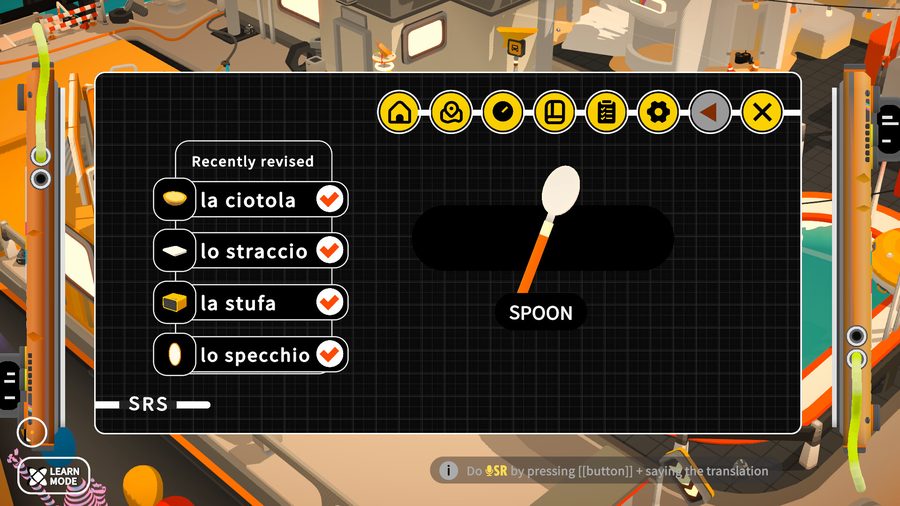
Screenshot from the Noun Town Steam store page, showing the spaced repetition review screen
German builds most in-law words with a predictable prefix, which makes this section easier than it looks at first glance.
Schwieger- attaches to a parent or child to mark the in-law relationship, so once you know Vater, Mutter, Sohn, and Tochter, you can build Schwiegervater, Schwiegermutter, Schwiegersohn, and Schwiegertochter without memorising four completely new words. Schwager and Schwägerin break that pattern slightly, since they don't attach Schwieger- to Bruder or Schwester the way you might expect, but they do follow the regular -er to -erin style gender swap seen elsewhere in German.
Stief- and Halb- work the same predictable way for step-family and half-siblings. Stief- marks a step relationship through remarriage, and Halb- marks a sibling who shares only one parent with you, and both prefixes attach cleanly to Vater, Mutter, Bruder, and Schwester without any irregular exceptions to watch for.
If you've studied Spanish, French, or Italian before, you might expect German family vocabulary to follow one clean masculine-feminine ending pattern throughout. It doesn't, and that's worth understanding early rather than getting caught out by it later.
Some pairs genuinely are regular: Enkel and Enkelin, Schwager and Schwägerin, and Cousin and Cousine all swap or add an ending to move from the masculine to the feminine form. Other pairs, Mutter and Vater, Bruder and Schwester, Neffe and Nichte, are simply unrelated words that happen to describe a male and female version of the same relationship, inherited that way from the language's history rather than built from a shared modern rule. A deeper look at how German nouns handle gender more broadly is available on Wikipedia's overview of German grammar, which covers how grammatical gender works across the language, not just in family vocabulary.
The practical takeaway is simple: don't assume you can guess the female form of a German family word just by swapping an ending, the way you often can in Spanish. Some German pairs reward that instinct and some genuinely don't, so it's worth treating each word in this list as its own small fact to learn rather than one big rule to apply everywhere.
Possessive adjectives in German change their ending depending on the grammatical case and the gender of the noun that follows, which is more involved than Spanish or English. At a beginner level, though, mein (my) and dein (your) in the simple nominative case will cover most everyday conversation about family.
Ich habe zwei Bruder und eine Schwester. (I have two brothers and one sister.)
Meine Mutter und mein Vater wohnen in Hamburg. (My mother and my father live in Hamburg.)
Wie viele Cousins hast du? (How many cousins do you have?)
Haben (to have) is the verb that does most of the work in this topic, almost always in the present tense, which keeps most family conversations in German fairly approachable grammatically even before you've tackled the full case system. This vocabulary set generally sits within the A1 to A2 range described by the Common European Framework of Reference for Languages (CEFR), the standard used across Europe to describe language proficiency levels.
The vocabulary above works the same way across Germany, Austria, and German-speaking Switzerland, so you'll be understood everywhere using these standard words. The differences that exist are mostly casual and regional rather than a separate vocabulary to learn on top.
None of this regional variation changes the core vocabulary, so learning Mutter, Vater, Bruder, Schwester, Großeltern, Onkel, Tante, and Cousin or Cousine first will serve you correctly from Berlin to Vienna to Zurich. The Goethe-Institut, Germany's official cultural and language institute, is a reliable place to look further into regional variation beyond family vocabulary, and the Duden, the standard reference dictionary of the German language, is the place to check any individual word's spelling or usage in detail.
Want to practice these words in real sentences instead of a flashcard list?
Try Noun Town on SteamDie Familie. It's a feminine noun, and it covers both the people and the household in roughly the same way the English word does.
Die Eltern. German has no everyday singular form of this word, unlike English mother or father. If you need to name just one parent, you use Mutter or Vater directly instead.
Geschwister. Unlike many languages that default to the masculine plural for a mixed group, Geschwister is its own gender neutral word that never needs to be guessed from Bruder or Schwester.
Die Großeltern, formally, or Oma and Opa for grandmother and grandfather in everyday speech. Großmutter and Großvater are the formal individual terms, used less often in casual conversation.
Tante is aunt and Onkel is uncle. Both words apply equally whether the relative is on your mother's or your father's side, unlike some other languages that split aunts and uncles by side of the family.
Cousin for a male cousin and Cousine, also spelled Kusine, for a female cousin. Both are borrowed from French and keep the French-style spelling in most formal writing.
Schwiegervater and Schwiegermutter are father-in-law and mother-in-law, Schwiegersohn is son-in-law, Schwiegertochter is daughter-in-law, and Schwager and Schwägerin are brother-in-law and sister-in-law.
Unlike Enkel and Enkelin, or Cousin and Cousine, Neffe and Nichte don't share a visible root or a regular suffix pattern in modern German. They simply have to be learned as a separate pair rather than derived from one shared stem.
Most learners pick up the core 15 to 20 words, covering immediate and extended family, within a week or two of regular short practice sessions, since the vocabulary set is small and repeats often in daily conversation.
Yes. Noun Town places family words like Mutter or Onkel inside everyday 3D scenes with native speaker audio and spaced repetition, so the words get reinforced through contextual recall rather than a flat list to memorise.