In Japanese, the general word for family is kazoku (家族), but most individual family members have two versions: one used for your own family and a different, more respectful one used for someone else's family, or when addressing your own relatives directly. On top of that, sibling words split by relative age rather than just gender, so there is no single word that simply means "brother" without first saying whether he is older or younger than you. This guide breaks down the most common Japanese family words and the logic that connects them.
Short answer: Kazoku (家族) is the general word for family. Parents together are ryoushin (両親). Individually, your own mother is okaasan or haha, and your own father is otousan or chichi. Siblings split by age and gender: ani (older brother), otouto (younger brother), ane (older sister), imouto (younger sister). Most relatives have at least two versions: one for your own family, one for someone else's.
English speakers learning Japanese often assume each family relationship has one word, the way "mother" or "uncle" works in English. Japanese usually splits each relationship into two forms instead, depending on whose family is being discussed.
The humble form is used when you talk about your own family to someone outside it. Haha (mother) and chichi (father) are humble forms: you use them when telling a colleague about your own parents. The respectful form, okaasan and otousan, is used two ways: when referring to someone else's parents, or when you are speaking directly to your own parents and addressing them by that title instead of by name.
This in-group versus out-group logic runs through a large part of Japanese, not just family vocabulary, and family words are actually one of the more approachable places to first encounter it, since the pattern repeats consistently across almost every relative in the language. The same humble-versus-respectful split shows up throughout Japanese honorific speech more broadly, as explained on Wikipedia's overview of Japanese honorifics.
These are the words you will use constantly, both talking about your own household and asking someone about theirs.
Younger siblings are the one exception to the humble/respectful split: otouto and imouto stay roughly the same whether you are talking about your own younger sibling or someone else's, with only a small, optional honorific suffix changing in more formal speech.
This is the part of Japanese family vocabulary that surprises most new learners. English asks whether a sibling is male or female. Japanese asks that too, but it also requires knowing whether they are older or younger than you before you can choose a word at all.
There is no neutral Japanese word that just means "brother" the way English allows. You either say ani (older brother) or otouto (younger brother), and the same split applies to ane (older sister) and imouto (younger sister). If you do not know the relative age, you genuinely cannot form the sentence correctly, which is a different kind of challenge than most European languages present, where gender alone decides the word.
Kyoudai works as a generic cover-all for "siblings" when age and gender do not need to be specified, similar to how Spanish defaults to a masculine plural form to cover a mixed group. It is a useful word to fall back on in casual conversation, even though the two kanji that build it literally translate to "older brother" and "younger brother." Research bodies such as the National Institute for Japanese Language and Linguistics document this kind of age-based kinship distinction as a long-standing feature of the language rather than a modern simplification.
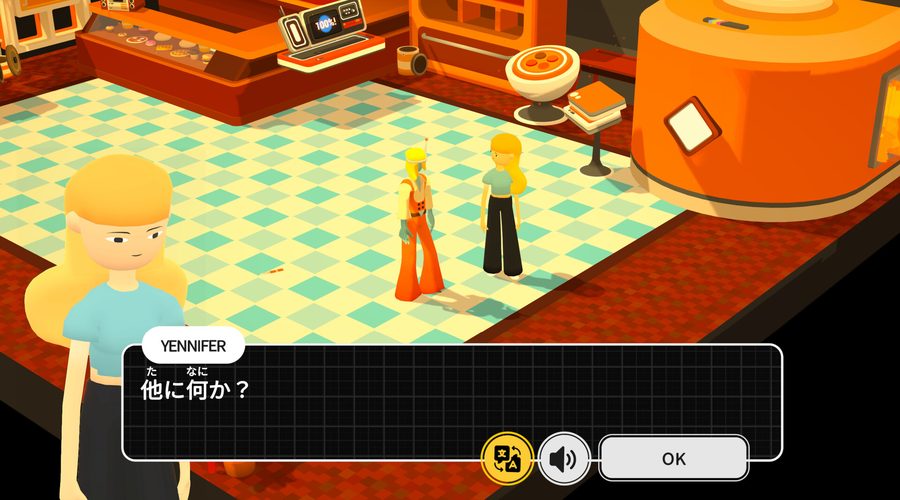
Screenshot from the Noun Town Steam store page, showing the furigana reading aid above kanji during an in-game conversation
Extended family vocabulary follows the same in-group pattern as parents and siblings, though a little less strictly in casual speech.
Itoko and mago are genuinely easier than their equivalents in many languages, since neither one requires you to know the person's gender before you can use it correctly. That makes cousin and grandchild two of the simplest words in this entire topic, a small relief after the ani/otouto age split above.
Put the previous sections into practice with a direct comparison. If you are telling a Japanese colleague about your own mother, you would say something like "haha wa Osaka ni imasu" (my mother is in Osaka), using the humble form because you are discussing your own family with someone outside it.
Ask that same colleague about their mother, and you would switch to the respectful form: "okaasan wa genki desu ka" (how is your mother doing). Using haha to ask about someone else's mother would sound off, even though English speakers instinctively want to use one word for both directions of the conversation.
The same switch happens if you are at home speaking to your own mother directly. In that moment, you address her as okaasan rather than haha, since haha is reserved for describing her to a third party. It takes a bit of practice to internalize which direction the word is pointing, but the pattern is consistent once you notice it. This kind of vocabulary typically sits within the A2 to B1 range of the Common European Framework of Reference for Languages (CEFR), the standard used internationally to describe proficiency levels.
Family vocabulary is a good example of why context matters more than memorization for Japanese specifically, since the own-family and other-family split only really makes sense once you see it used in an actual conversation rather than on a flashcard. Noun Town's language learning game teaches vocabulary like this inside full 3D scenes with native speaker audio, so a word like okaasan shows up in the kind of exchange where its respectful meaning is obvious from who is speaking to whom.
On the script side, Noun Town does not teach kanji as a dedicated system. The team originally displayed romaji throughout the game, but feedback on that approach was mixed: some players liked the easier entry point, while others felt it discouraged them from engaging with the real Japanese script at all. The game now shows furigana above kanji instead, which was received well across the board, and it means a word like kazoku (家族) or kyoudai (兄弟) gets reinforced in its proper written form every time it appears, even for players who are not deliberately studying kanji. Organizations such as the Japan Foundation, which promotes Japanese language education internationally, publish similar guidance on building kanji familiarity gradually through exposure rather than memorization drills alone.
Want to see how furigana and context-based learning work in practice?
Try Noun Town on SteamKazoku. It is written with two kanji that roughly mean "house" and "clan," and it covers family as a whole unit, both your own and someone else's.
Ryoushin covers both parents together. Individually, your own father is chichi and your own mother is haha in humble speech, while otousan and okaasan are the respectful forms used for someone else's parents or when addressing your own directly.
Haha is the humble form used when talking about your own mother to someone outside your family. Okaasan is the respectful form, used for someone else's mother, or to address your own mother directly within the family.
Ani is an older brother in your own family, and otouto is a younger brother. For someone else's older brother, the respectful form is oniisan.
Kyoudai is used generically for siblings, even though the kanji literally build from "older brother" and "younger brother." In practice it covers any mix of brothers and sisters.
Sofubo is the formal term for grandparents together. Day to day, most people simply say ojiisan (grandfather) and obaasan (grandmother).
Oji means uncle and oba means aunt, regardless of whether the relative is on your mother's or father's side, though the kanji used can differ slightly depending on birth order relative to your parent.
No. Itoko covers cousins of either gender, which makes it one of the simpler words in Japanese family vocabulary.
Most learners can memorize the core dozen or so terms within one to two weeks, though the own-family versus other-family duplication means it takes a little longer than a language with only one word per relative.
Noun Town displays furigana above kanji rather than teaching kanji as a dedicated system, so players pick up characters like those used in kazoku or kyoudai incidentally through repeated exposure while reading.