Family vocabulary in Korean is called gajok (가족), and it covers more ground than most learners expect. The core words are eomma (mom), appa (dad), and dongsaeng (younger sibling), but Korean is one of the few widely studied languages where several family words change depending on the speaker's own gender rather than the relative's. A man and a woman use different words for the exact same older brother. This guide covers every common Korean family term, the three separate reasons the vocabulary branches the way it does, and how to actually use these words in a sentence.
Short answer: Korean has roughly 30 distinct family words once you count siblings, aunts, uncles, cousins, and in-laws. The core set splits three ways: sibling terms change depending on your own gender (hyeong or oppa for older brother), aunt and uncle terms change depending on which side of the family they're on (gomo for a paternal aunt, imo for a maternal aunt), and in-law terms change depending on whether you're the husband or the wife. Most learners pick up the core 15 words within one to two weeks.
Start with the words that come up constantly. Korean has both a formal and a casual version of mother and father, which is worth knowing before anything else.
The -nim ending on bumonim is an honorific suffix, not a plural marker. You'll see it attached to several family words further down this list whenever Korean wants to show respect toward the person being discussed, which happens more often in family vocabulary than in most other topics. You can hear all of these words used naturally inside full scenes, rather than as a flat list, with Noun Town's language learning game, which pairs vocabulary like this with native speaker audio and spaced repetition.
One habit that surprises English speakers: Koreans usually say "uri abeoji" (our father) rather than "nae abeoji" (my father), even when talking about just their own father and nobody else's. It isn't a mistake or a typo you'll see repeated by accident, it's simply the normal, polite way to talk about family in Korean, treating the family as something shared rather than individually owned.
This is the part of Korean family vocabulary that trips up almost every beginner, because the rule has nothing to do with the sibling's gender. It depends entirely on the speaker's own gender.
So a brother and sister talking about the exact same older sibling will use two different words for that one person, depending on which of them is speaking. This is the single biggest adjustment English speakers need to make with Korean family vocabulary, since nothing in English works this way. Once it clicks, though, it's a simple binary choice rather than something you need to puzzle over every time, since your own gender never changes mid-conversation.
Dongsaeng is the easier half of this pattern. Unlike the older-sibling words, it doesn't split by the speaker's gender at all, and in everyday speech people often just say dongsaeng without specifying male or female unless it actually matters to the conversation.
The second branching point in Korean family vocabulary has nothing to do with gender of the speaker, and everything to do with which side of the family a relative belongs to.
Notice that gomo and imo aren't a male-female pair the way hyeong and nuna are. Both words mean "aunt," and the choice between them depends purely on whether she's related through your father or your mother. The same logic applies to the uncle words, where keunabeoji and samchon sit on your father's side and oesamchon sits on your mother's side, with the oe- prefix marking "outside" or maternal-line relatives across several other Korean kinship words too.
Cousin is the one relief in this section. Sachon doesn't split by gender or by side of the family, so once you learn that single word, it covers every cousin you have, which is a welcome break after the branching aunt and uncle terms above.
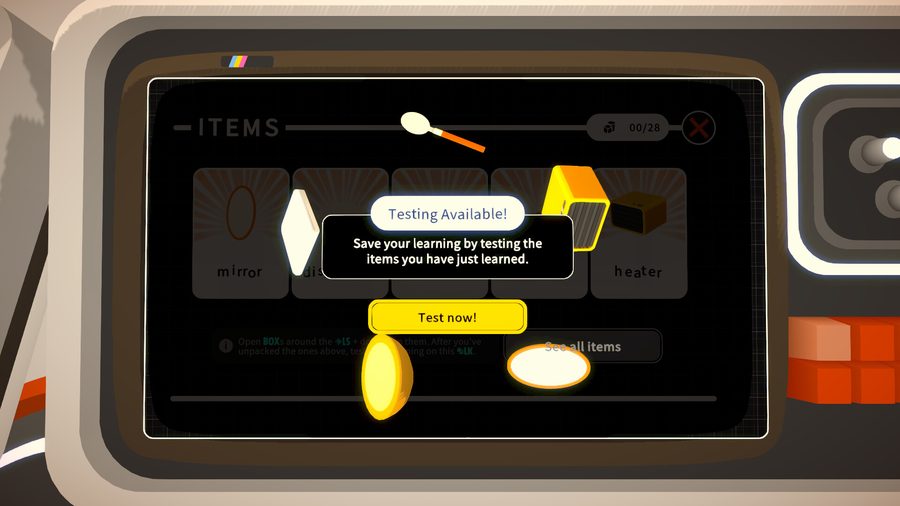
Screenshot from the Noun Town Steam store page, showing the in-game vocabulary testing prompt
If the sibling and aunt/uncle patterns above felt like a lot to track, in-law vocabulary adds a third, completely separate branching rule: it depends on whether you're the husband or the wife in the marriage.
These two sets of words never overlap and never get swapped between husband and wife. A wife never calls her own parents jangin and jangmo, and a husband never calls his in-laws siabeoji and sieomeoni, because those four words are each tied to a specific role in the marriage rather than to the relationship itself. This comes from how Korean kinship terms developed historically around the idea that a married couple occupies two distinct roles within the extended family, not one shared role, and the vocabulary still reflects that split today even though modern Korean family life looks very different.
There's no shortcut for memorising these four beyond practice, since none of them share an obvious root with the immediate-family words you already know. Treating them as their own small set, separate from the gomo/imo/samchon pattern above, tends to make them stick faster.
Here's the detail that genuinely surprises most new learners: Korean speakers use hyeong, oppa, nuna, and eonni constantly for people who aren't related to them at all.
A university student might call a slightly older classmate "oppa" or "eonni" within a few conversations of meeting them, and a junior employee might address an older coworker as "hyeong" outside of work hours as a sign of warmth and closeness. This isn't slang or a shortcut, it's a core feature of how Korean social address works, borrowing directly from family vocabulary to signal familiarity and respect at the same time. The Wikipedia overview of Korean honorifics covers how deeply this kind of relational address is built into the language, well beyond just these four sibling words.
This dual use is exactly why getting the sibling terms right matters even if you never discuss your actual family in Korean. You'll hear oppa and eonni used in dramas, in cafes, and among friend groups far more often than in a literal family context, so learning them properly pays off immediately in everyday conversation, not just in family-specific situations.
Korean sentence structure puts the verb at the end, and possessives work differently from English or Spanish. As mentioned above, "uri" (our) is the default way to refer to your own family members, even when speaking about just one person.
Uri eomma-neun seonsaengnim-ieyo. (My mom is a teacher.)
Jeoneun eonni-ga han myeong isseoyo. (I have one older sister, said by a female speaker.)
Imo-ga Seoul-e sarayo. (My aunt, my mother's sister, lives in Seoul.)
Notice "han myeong" in the second sentence, the counter word used for counting people, which Korean requires whenever you state a number of family members rather than just naming them. Family vocabulary like this generally sits within the A1 to A2 range described by the Common European Framework of Reference for Languages (CEFR), the standard used across Europe to describe proficiency levels, even though Korean itself falls outside that framework's usual language set.
If you want an official reference beyond a textbook, the National Institute of Korean Language maintains the standard dictionary and usage guidelines for the language, and the government-backed King Sejong Institute network runs Korean language classes for learners outside Korea, including dedicated beginner material on exactly this kind of kinship vocabulary.
Want to practice knowing which word to use, not just what the words mean?
Try Noun Town on SteamGajok. The honorific form gajokbun is used when referring politely to someone else's family, while gajok on its own works for your own family or as the general term.
Bumonim is the respectful term for parents, built from the honorific suffix -nim. Mother and father individually are eomeoni (formal) or eomma (mom), and abeoji (formal) or appa (dad).
It depends on the speaker. A man calls his older brother hyeong, while a woman calls hers oppa. Korean sibling terms for anyone older than you change based on your own gender, not the sibling's.
A man calls his older sister nuna, while a woman calls hers eonni. As with older brother, the word depends on the speaker's own gender rather than any feature of the sister herself.
Dongsaeng, which is gender neutral and works for both speakers. To specify, namdongsaeng means younger brother and yeodongsaeng means younger sister, but dongsaeng alone is used constantly in everyday speech.
It depends on which side of the family. Gomo is your father's sister and imo is your mother's sister. Samchon or keunabeoji cover your father's brothers, while oesamchon is specifically your mother's brother.
Sachon, used the same way regardless of the cousin's gender or which side of the family they come from, unlike the more specific aunt and uncle terms.
A wife refers to her husband's parents as siabeoji and sieomeoni, while a husband refers to his wife's parents as jangin and jangmo. The two sets of terms never overlap, reflecting how Korean kinship vocabulary was built around separate roles for each side of a marriage.
These sibling terms double as everyday honorifics for anyone older and close to you, not just blood relatives. A younger coworker might call an older colleague hyeong or eonni as a sign of familiarity and respect, borrowed directly from family vocabulary.
Yes. Noun Town places words like eomma or imo inside everyday 3D scenes with native speaker audio and spaced repetition, so you absorb which word fits which situation rather than memorising a flat list that doesn't show you when to use each term.