
Photo: Sailko / Wikimedia Commons (CC BY 3.0)
Every Italian noun is either masculine or feminine, and that single fact decides whether you reach for il, lo or la, and whether a plural becomes i, gli or le. There is no neuter option and no way around it. The good news is that the ending of a word predicts its gender correctly in the large majority of everyday cases, which means the "il or la" question has a real, learnable answer rather than being pure guesswork.
Short answer: Nouns ending in -o are almost always masculine (il libro) and nouns ending in -a are almost always feminine (la casa). A short, well known list of exceptions, such as la mano and il problema, breaks that pattern. Nouns ending in -e can be either gender and have to be learned individually, such as il cane and la chiave.
Italian kept the two way gender system that most Romance languages inherited from Latin. Every noun, not just words for people and animals, is classified as masculine or feminine, and that classification is not optional decoration sitting on top of the word. It changes the article in front of it, and it usually changes the ending of any adjective describing it too.
This trips up English speaking learners because English dropped grammatical gender for objects centuries ago. A table isn't masculine or feminine in English, it's just "the table". In Italian, la tavola carries a gender the same way a person does, and there's no getting around it once you start forming full sentences rather than memorising isolated words.
The practical upshot is the same as it is for Spanish or French: gender has to be learned at the same time as the word itself, not bolted on afterwards. Learning "tavola means table" and then trying to work out la tavola or il tavola later is much harder than learning "la tavola" as one unit from the very first time you see it.
Italian gender looks unpredictable until you notice that a handful of endings do most of the work. These patterns cover the large majority of the nouns you will actually run into day to day.
1.Ends in -o → masculine. Il libro (book), il tavolo (table), il telefono (phone). This is the most reliable ending in the language, with very few common exceptions.
2.Ends in -a → feminine. La casa (house), la mela (apple), la finestra (window). Also highly reliable, with the known exceptions covered below.
3.Ends in -zione or -sione → feminine. La nazione (nation), la decisione (decision), la televisione (television). Almost no exceptions, and this pattern mirrors the -ción ending in Spanish closely.
4.Ends in -tà or -tù → feminine. La città (city), la libertà (freedom), la virtù (virtue). These endings never change in the plural either, which is worth knowing alongside the gender itself.
5.Ends in -mento → masculine. Il movimento (movement), il momento (moment) and il documento (document) all take this ending and stay masculine, the same pattern Spanish and French show with -miento and -ment.
6.Ends in -e → could be either. This is the one ending that does not predict gender on its own. Il cane (dog) is masculine, la chiave (key) is feminine, and there is no shortcut except learning each one.
None of these patterns require a background in linguistics to use. Most native Italian speakers couldn't explain the rules explicitly either, they absorbed them through years of hearing words paired with their article. Learning the pattern directly is a shortcut through that same process.
Gender decides masculine or feminine, but Italian also changes which specific article you use based on the sound the noun starts with, which is where a lot of learners get stuck even after the gender itself is clear.
Learning nouns inside a spatial, contextual scene rather than from a plain translated word list helps here, because the article is presented as part of the object every single time you see it, not as a separate grammar rule to apply after the fact. Italian is one of 12 supported languages in Noun Town, and the game has 590+ reviews on Steam with an 87% positive rating and 200,000+ players across the series. There is a free demo available on Steam.
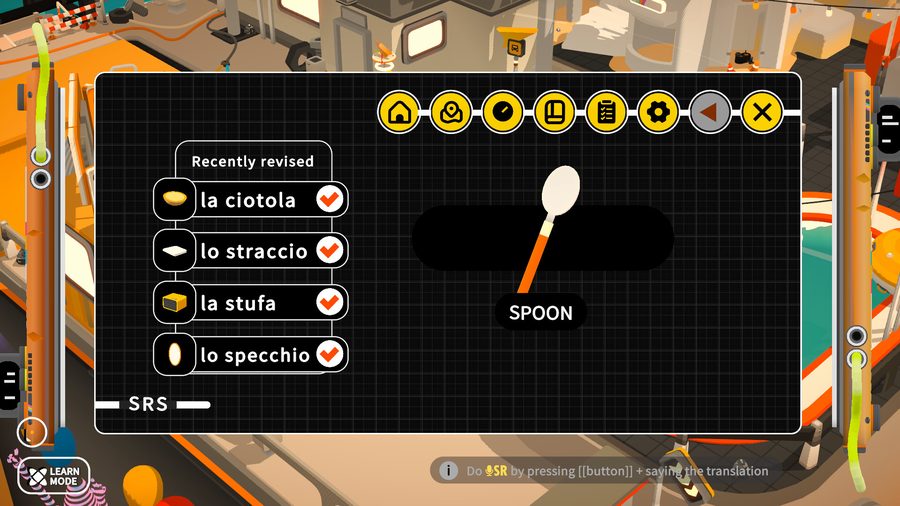
Screenshot from the Noun Town Steam store page, showing an Italian vocabulary review where the article is learned with the word from the start
Every ending rule above has a short list of exceptions attached to it, and the -o and -a rule has the most well known ones. These come up often enough that they are worth learning by name rather than relying on the general pattern.
Feminine words that end in -o:
Masculine words that end in -a:
Notice how many of the -a exceptions share something in common. Il problema, il programma, il sistema and il clima all came into Italian from Ancient Greek, where the ending was already grammatically neuter or masculine rather than feminine. Italian borrowed the word and kept the gender that came with it, which is the same pattern that produces el problema in Spanish and keeps it masculine there too.
When you are mid conversation and unsure of a word's gender, running through a fixed sequence is faster than trying to recall a long list from memory. Here is the order that tends to work best.
Step 1: Check the ending. Does it end in -o, -a, -zione, -tà or -tù? If so, you likely already have the answer from the rules above.
Step 2: Check whether it's on the exception list. A small, fixed set of common words breaks the -o/-a pattern. If the word is one of them, use the exception rather than the general rule.
Step 3: If it ends in -e, accept you'll need to learn it individually. This is the one ending Italian doesn't give you a shortcut for, so treat each -e noun as its own flashcard rather than guessing.
This isn't a perfect system. The Accademia della Crusca, Italy's oldest linguistic academy and the official authority on the Italian language, documents a genuine minority of nouns that simply have to be memorised on their own, with no reliable pattern attached. But running the three step check first means you are only relying on raw memory for a small remainder, not the whole vocabulary.
A gender mistake rarely stops an Italian speaker from understanding you. Say "il mela" instead of "la mela" and most people will still know exactly what you meant. But that is also exactly why the mistake is dangerous, because it does not get corrected by confusion, so it can sit unnoticed in your speech for years.
The deeper problem is that gender mistakes compound. Once you have memorised a noun without its correct article, every adjective you attach to it afterwards inherits the error too. Fixing "il problema rossa" after months of repetition is much harder than learning "il problema rosso" correctly on day one, because by then the wrong version has had time to become automatic.
According to the Common European Framework of Reference for Languages, accurate use of grammatical gender and agreement is one of the markers that separates lower and higher proficiency levels across the Romance languages, so it is worth the extra attention early on rather than treating it as a detail to clean up later. Resources from the Istituto dell'Enciclopedia Italiana Treccani, Italy's major encyclopaedic and reference institution, and the overview of Italian grammar on Wikipedia both go into more depth on gender and agreement than any single blog post can, and are worth bookmarking once the core patterns above are solid.
Want to learn Italian nouns with the right article attached from the very first time you see them?
Try Noun Town on SteamTwo: masculine and feminine. Every Italian noun is one or the other, and the article in front of it, il, lo, la, i, gli or le, along with any adjective describing it, has to agree with that gender and number.
Both are masculine singular articles, but lo is used before a masculine noun starting with z, with s followed by another consonant (known as s impura), or with certain other consonant clusters like gn or ps. Il covers most other masculine nouns starting with a consonant. So it is il libro but lo zaino, and il tavolo but lo studente.
They are closely related since all three descend from Latin, and a lot of cognates share the same gender across languages, but it is not a reliable shortcut. Some words flip gender between languages, so Italian noun gender still needs to be learned on its own rather than assumed from Spanish or French.
La mano (hand), la radio (radio) and la foto (photo, short for fotografia) are feminine despite ending in -o. Il problema (problem), il programma (programme), il sistema (system) and il clima (climate) are masculine despite ending in -a, mostly because they come from Ancient Greek words that were already masculine or neuter.
Most masculine nouns ending in -o switch to -i in the plural, so il libro becomes i libri. Most feminine nouns ending in -a switch to -e, so la casa becomes le case. Nouns ending in -e in the singular, which can be either gender, switch to -i in the plural regardless, such as il cane becoming i cani and la chiave becoming le chiavi.
Yes. Most Italian adjectives change their ending to match the gender and number of the noun they describe, so il libro rosso (the red book) becomes la mela rossa (the red apple). This is one of the main practical reasons gender needs to be learned alongside every noun rather than added on afterwards.
Yes, a large group of nouns end in -e in the singular and can be either masculine or feminine, such as il cane (dog, masculine) and la chiave (key, feminine). These have to be learned individually, since the ending alone does not predict the gender the way -o and -a usually do.
Yes. Italian is one of the 12 languages in Noun Town, and every noun is introduced with its article attached inside a 3D scene, alongside native speaker audio, so the gender is learned as part of the word from the very first time you see it rather than as a separate grammar rule.
Most learners pick up the core -o and -a patterns within a few weeks of regular exposure, since they cover the large majority of everyday nouns. Comfort with the smaller exception lists and the -e ending nouns tends to build gradually over several months of reading, listening and practice.
Italian is generally considered one of the more approachable languages for English speakers, largely due to shared Latin vocabulary and fairly consistent spelling and pronunciation rules. Noun gender is one of the few genuine grammar hurdles, but it follows patterns reliable enough to learn systematically rather than through pure memorisation.