
Photo: Wikimedia Commons (CC BY-SA 4.0)
Myth: Mandarin is too hard for a game to teach. It is a fair assumption, given the reputation Chinese has, but it is wrong. Yes, a handful of games are built specifically to teach Mandarin Chinese vocabulary, characters and pronunciation, not just to feature China as a backdrop, and Noun Town is one of them. What follows is a walk through the biggest myths people carry into this question, and what is actually true once you look closer.
Reality: Mandarin genuinely is hard. The US Foreign Service Institute places it in Category IV, its hardest tier for native English speakers, estimating roughly 2,200 class hours to reach professional working proficiency, several times longer than French or Spanish would take. But difficulty is exactly why the format matters more than the label on the box. A game cannot shortcut 2,200 hours, nothing can, but it can make far more of those hours feel worth showing up for, which is the actual bottleneck for most learners.
People do not fail at Mandarin because tones and characters are impossible. They fail because they stop practising before those skills have time to develop. A format that keeps you coming back on a Tuesday evening is doing more for your Mandarin than a theoretically perfect method you abandon in week three.
Reality: Writing by hand is a separate skill from recognising and understanding, and it is fair to say most games are weak at it. Stroke order, radicals and the muscle memory of actually producing a character need dedicated practice, usually with a proper writing app or workbook.
But recognition and comprehension are not consolation prizes, they are most of what reading actually requires day to day. A vocabulary-focused game can teach you to recognise 你好 and know it means "hello" through repeated exposure, well before you could reliably write it from memory. Whether that counts as "really" learning Chinese depends on your goal, but it is real progress toward reading fluency either way.
Reality: A teacher helps, but tones are carried entirely by sound, and sound is exactly what games are good at delivering repeatedly. Reading "ma" on a flashcard tells you almost nothing about whether it means mother, horse, scold or hemp. Hearing it spoken correctly by a native voice, attached to something you can see and interact with, over and over, trains your ear in a way a textbook cannot.
Games with speech recognition go a step further, giving you a low-pressure way to practise saying tones back without a real person watching you fumble. It is not identical to classroom correction, but for building the initial ear for tones, repetition through play holds up well.
Reality: The full picture is intimidating if you look at it all at once, general literacy in Mandarin is usually put at around 2,000 to 3,000 characters, with fully educated native-level reading running past 3,500. But usefulness arrives in stages long before that.
| Goal | Approximate characters needed |
|---|---|
| Read basic signs, menus, simple text | Around 500 |
| Comfortable everyday reading | Around 1,000 to 1,500 |
| General literacy, newspapers | Around 2,000 to 3,000 |
| Educated native-level reading | 3,500 and above |
Roughly 500 to 1,000 of the most common characters already cover a large share of everyday text, and that early layer is exactly what vocabulary-focused games are best suited to building. You get useful, visible progress well before you are anywhere near the 2,000 to 3,000 mark.
Reality: Some are, honestly. A lot of titles marketed as language learning tools are flashcard drills with points and streaks bolted on top, which is not a meaningfully different experience from an app. But that is not the whole category. Some games are genuine 3D worlds where vocabulary is attached to objects, characters and scenes you interact with directly, so a word for "market" or "noodle" is learned because you walked past a market stall or ordered noodles from a character, not because a card told you to memorise it.
In Noun Town, Mandarin is one of 12 languages available, taught through a 3D open world where each word comes with native speaker audio, a spoken sentence for context, and spaced repetition scheduling so words resurface right before you would naturally forget them. That is a different mechanism from tapping through app exercises, and it tends to hold attention far longer, which matters more for Mandarin than for almost any other language.
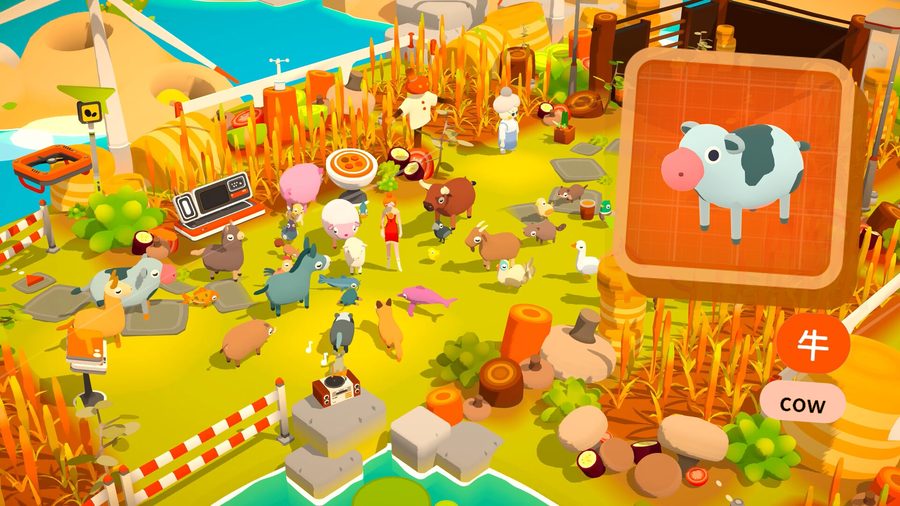
Screenshot from the Noun Town Steam store page, showing a Mandarin vocabulary card in the farmyard area
Reality: This is the myth that causes the most disappointment. Mandarin grammar is, by most accounts, more forgiving than European languages in some respects, no verb conjugation, no grammatical gender, but it has its own logic around measure words, aspect particles and topic-comment sentence structure that benefits from direct explanation. Games teach this implicitly through exposure, which works but is slower than a rule laid out plainly in a textbook.
The honest version is that a game is one of the better tools for building vocabulary and listening comprehension without burning out, but if your goal includes passing a formal test like HSK or writing fluently by hand, treat it as one part of a wider toolkit rather than the whole plan.
Curious what Mandarin looks like in a 3D game world? There is a free demo on Steam.
Try Noun Town on SteamYes. A small number of games are built specifically to teach Mandarin Chinese vocabulary, characters and pronunciation, rather than just featuring Chinese as set dressing. Noun Town is one of them, teaching Mandarin vocabulary through a 3D world with native speaker audio and spaced repetition.
You can build real vocabulary, listening comprehension and pronunciation habits from a well-designed language game. Games are generally weaker at teaching Chinese grammar and stroke order for writing characters by hand, where a textbook or dedicated writing app still has an advantage.
It depends on the game. Some rely heavily on pinyin, the romanised spelling system, and only show characters as a secondary label. Others display characters prominently alongside the spoken word so you get repeated visual exposure, which helps with recognition even if it does not teach you to write by hand.
The US Foreign Service Institute classifies Mandarin as a Category IV language, its hardest tier for native English speakers, estimating around 2,200 class hours to reach professional working proficiency. The tonal system and character-based writing are usually the two biggest early obstacles.
Yes, Mandarin Chinese is one of the 12 languages available in Noun Town, alongside Japanese, Korean, Spanish, French, German, Italian, Russian, Greek and Egyptian Arabic. Vocabulary is taught in a 3D open world with native speaker audio, spaced repetition and speech recognition practice.
There is a free demo on Steam, available on PC and Mac. The full game is a one-time purchase of $19.99 with no subscription and nothing paywalled once you own it, which was a deliberate decision after the team got frustrated with ads and paywalled tiers in mobile language apps.