
Photo: Wikimedia Commons (CC0)
600 to 750 hours. That is roughly what the US Foreign Service Institute says it takes a native English speaker to reach working proficiency in French, the shortest estimate on its whole scale. It matters here because the real question people are asking is not really "can games teach French," it is "will this actually work, or will I quit in three weeks like last time." Yes, a small number of games are genuinely built to teach French, not just set somewhere French is spoken, and because French already sits close to English, that combination tends to work well. Below is a practical, step-by-step way to actually get good at French using one.
Short answer: A handful of games teach real French vocabulary and pronunciation, and pairing one with a bit of structure below will get you further than either alone.
French pronunciation is deceptively tricky in a way spelling does not warn you about. Words are full of silent letters, liaison rules that change how words sound when strung together, and nasal vowels that do not exist in English at all. Reading French off a page teaches you almost nothing about how it actually sounds spoken at normal speed.
Start any game session with your ears, not your eyes. Let native audio run repeatedly on new words before you try to read or spell them. This single habit closes more of the pronunciation gap than any amount of textbook study.
Plenty of games are set in Paris or feature French characters without teaching you a single word of the language. What actually works is vocabulary tied to objects, spoken sentences from native voices, and a review system so what you learn does not evaporate a week later.
Noun Town is built this way for French specifically. You explore a 3D world, hear French words spoken naturally by native speakers attached to the objects and characters around you, and a spaced repetition system brings words back for review right before you would normally forget them.
English and French share an enormous number of cognates, words that look or sound similar and mean roughly the same thing, thanks to centuries of overlap through Latin and Norman French. A game that puts vocabulary in context lets you notice these connections naturally as you play, rather than memorising a formal cognate list, so pay attention when a new word feels oddly familiar. It probably is.
Progress feels a lot less abstract once you know the scale of what you are working toward.
| Goal | Approximate vocabulary needed |
|---|---|
| Order food, ask directions, basic travel | 300 to 500 words |
| Hold a simple everyday conversation | 1,000 to 1,500 words |
| Comfortable general fluency | 2,500 to 3,000 words |
| Read a newspaper or novel easily | 8,000 words and above |
Vocabulary-based games are well suited to building that first 1,000 to 1,500 word core quickly, since that is where the game mechanics of repeated exposure and review do the most work.
Games with speech recognition give you a low-pressure way to practise pronunciation without a real conversation partner watching you fumble. Use it, even alone in a room. Speaking a word is a different skill from recognising it, and the gap between the two only closes with repetition out loud.
French grammar has real complexity that benefits from direct explanation: noun gender that does not always follow obvious rules, verb conjugation across multiple tenses, and agreement rules for adjectives that change depending on what they describe. A vocabulary-focused game teaches these implicitly, through repeated correct examples, which works but takes longer than a grammar table laid out clearly in a textbook or app lesson.
If your goal includes passing a written exam like the Institut Français proficiency tests or the DELF/DALF certificates, budget separate time for grammar and writing practice. A game will not cover that ground for you.
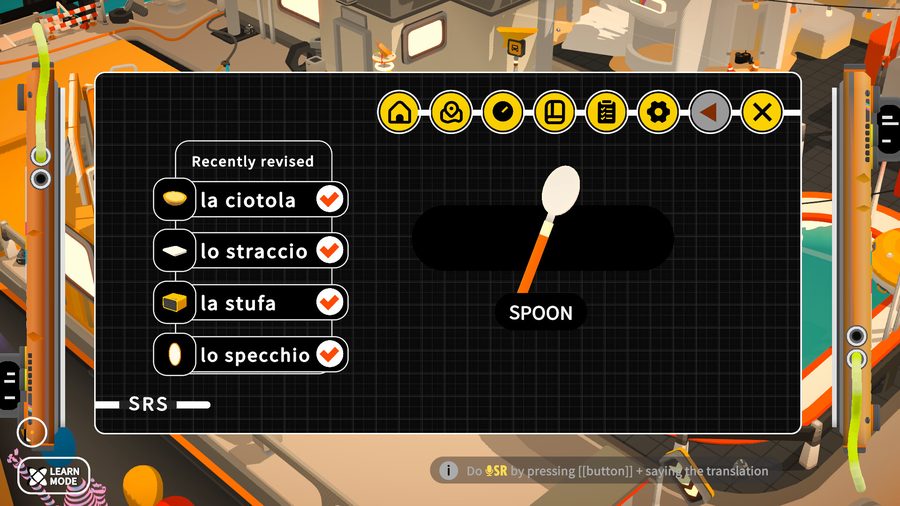
Screenshot from the Noun Town Steam store page, showing the spaced repetition review screen
The US Foreign Service Institute places French in Category I, its easiest tier for native English speakers, estimating around 600 to 750 class hours to reach professional working proficiency. That is a fraction of the time needed for a language like Mandarin or Arabic, which is one reason French rewards steady, engaged practice so heavily. You are not fighting the language itself nearly as much as you are fighting your own consistency, so a rough hour count you can watch climb is genuinely motivating.
If you have started French before and lost momentum, a game is worth trying specifically because it removes the "chore" feeling that makes most people quit apps within a few weeks. If you thrive on structure and checklists, a structured course may still suit part of your routine.
A lot of learners do not pick one over the other. They use a game for sessions where they want to properly sit down and absorb vocabulary, and a lighter app or set of flashcards for quick daily maintenance in between, an app for the five minutes on a train, a game for the twenty minutes on the sofa.
Curious what learning French in a 3D game world actually looks like? There is a free demo on Steam.
Try Noun Town on SteamYes. A small number of games are built specifically around teaching French vocabulary, pronunciation and listening, rather than simply being set in a French-speaking location. Noun Town is one of them, teaching French vocabulary through a 3D world with native speaker audio and spaced repetition.
Fluency on its own is unlikely from a game alone. Games are strong at building vocabulary, listening comprehension and pronunciation confidence. Full fluency also requires speaking practice with real people, structured grammar study and enough time immersed in the language, which most games are not designed to provide by themselves.
French is generally considered one of the more approachable languages for English speakers. The US Foreign Service Institute places French in Category I, its easiest tier, estimating around 600 to 750 class hours to reach professional working proficiency, largely because of shared vocabulary and a Latin alphabet.
Yes, French is one of the 12 languages available in Noun Town, alongside Spanish, Italian, German, Japanese, Korean, Mandarin Chinese, Russian, Greek and Egyptian Arabic. Vocabulary is taught in a 3D open world with native speaker audio, spaced repetition and speech recognition practice.
There is a free demo on Steam, available on PC and Mac. The full game is a one-time purchase of $19.99 with no subscription and nothing paywalled once you own it, a deliberate choice after the team got frustrated with ads and paywalled tiers in mobile language apps and heard the same complaint from thousands of learners.