
Photo: Norbert Nagel / Wikimedia Commons (CC BY-SA 3.0)
Yes, there are real video games built specifically to teach German, not just games set in Germany with German scenery in the background. A handful of titles teach actual vocabulary, pronunciation and listening skills through gameplay rather than flashcards. Noun Town is one of them, covering German alongside 11 other languages through a 3D open world with native speaker audio and spaced repetition. Whether a game is the right tool for you specifically depends on what part of German you find hardest, so it is worth being honest about what games are good at and what they are not.
German has a reputation for being harder than French or Spanish, and that reputation is not entirely undeserved. The vocabulary itself is not the main obstacle. Plenty of German words are close cousins of English ones, since both languages share Germanic roots, so "Haus" for house or "Wasser" for water feel familiar almost immediately.
The real difficulty sits in the grammar. German nouns carry one of three genders, der, die or das, and that gender is not always predictable from the word itself. On top of that, German uses four grammatical cases, nominative, accusative, dative and genitive, which change the form of articles and adjectives depending on a noun's role in the sentence. None of that is optional if you want to speak or write correctly.
Pronunciation and listening comprehension sit somewhere in the middle. German spelling is fairly consistent and phonetic once you learn the rules, but spoken German moves quickly and compound words can stretch to a dozen syllables, which makes listening practice genuinely useful early on.
There is no single best way to learn German. Different methods solve different pieces of the puzzle, and most people end up combining more than one. Here is roughly how the common approaches stack up against each other.
| Approach | Strongest at | Weakest at | Typical cost |
|---|---|---|---|
| Vocabulary game Best for retention | Vocabulary, listening, pronunciation, sticking with it | Explicit grammar rules, writing practice | $19.99 one-time (Noun Town) |
| Lesson-based app | Daily habit building, bite-sized review | Depth of vocabulary context, long sessions | Free to $96+ per year |
| Textbook or structured course Best for grammar | Grammar rules, sentence structure, writing | Engagement, staying motivated alone | $20 to $150+ |
| Immersion or exchange | Real conversation confidence, natural rhythm | Structure, tracking progress, availability | Free to very expensive (travel) |
None of these four wins on every axis, which is exactly why the "which one is best" question rarely has a single answer. It usually comes down to which weakness you can tolerate and which strength you actually need right now.
Inside Noun Town, German vocabulary is attached to a 3D open world rather than delivered through a list of flashcards. A word like "Apfel" is learned because you encounter an apple on a market stall, hear it spoken by a native German speaker, and interact with it directly, not because a card told you to memorise it. That contextual link between the object, the sound and the meaning is what makes the word easier to recall later.
Underneath the gameplay sits a spaced repetition system, which schedules review of each word right before you are statistically likely to forget it. This is the same principle apps like Anki use, just wrapped inside gameplay instead of a bare review screen. Speech recognition lets you practise saying German words out loud and get feedback, which is one of the more useful features for a language where pronunciation genuinely differs from English.
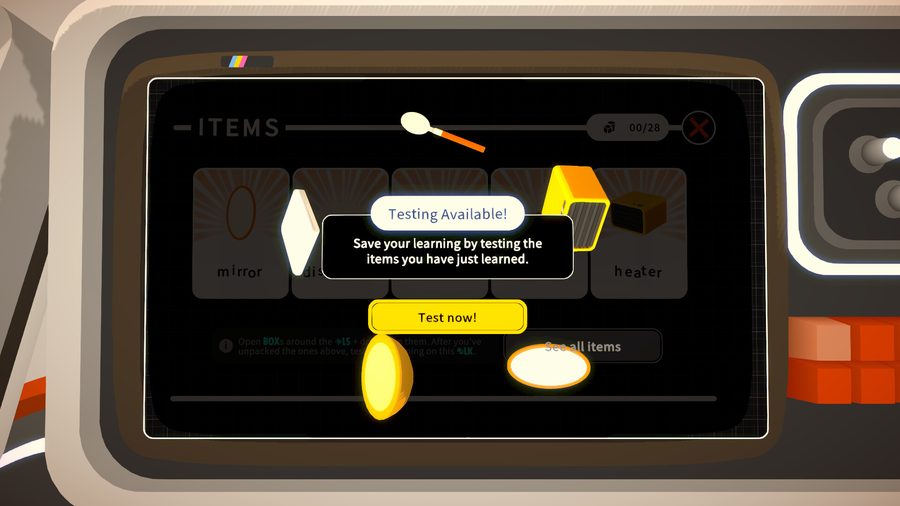
Screenshot from the Noun Town Steam store page, showing the spaced repetition testing prompt
None of this replaces a grammar lesson. What it does is make the vocabulary side of German, which is where a lot of learners lose steam first, feel far less like homework. That matters more than it sounds, because the single biggest predictor of whether someone reaches conversational German is not raw aptitude, it is whether they kept going for long enough.
Nobody should expect a vocabulary game, ours included, to fully teach the German case system on its own. Games teach grammar implicitly, through repeated correct examples in context, which does work over time but is slower than seeing the rule written out plainly.
If your goal includes a formal qualification, organisations like the Goethe-Institut run recognised German exams mapped to the Common European Framework of Reference for Languages (CEFR), and preparing for one of those exams means dedicating separate time to grammar drills and writing practice that a game will not cover for you.
The practical approach most learners land on is treating a game as the vocabulary and listening engine, and pairing it with a short grammar resource, whether that is a course, a textbook, or a tutor, specifically for the case system and word order. Trying to make either tool do the other's job usually just slows you down.
Noun Town is a one-time purchase of $19.99 covering all 12 supported languages, including German, with nothing locked behind a further paywall and no adverts interrupting a session. That decision was deliberate. The team used the big mobile language apps before building the game and got frustrated in the same way a lot of learners do, hitting a paywall a few lessons in or sitting through an ad mid-lesson. After hearing that same complaint from thousands of other learners, Noun Town was built the opposite way on purpose, one purchase, everything included.
The US Foreign Service Institute places German in Category II, its second easiest tier for native English speakers, estimating around 900 class hours to reach professional working proficiency. That is roughly 200 to 300 hours more than French or Spanish, mainly down to the case system and compound vocabulary, but still well short of the 2,200 hours FSI estimates for a Category IV language like Japanese or Arabic.
Noun Town has 590+ reviews on Steam with an 87% positive rating, and the series has been played by more than 200,000 people across its supported languages, with three awards won and shortlists for seven more. None of that guarantees results for any individual learner, but it does mean the approach has been tested at a fairly large scale.
Curious what learning German in a 3D game world actually looks like? There is a free demo on Steam.
Try Noun Town on SteamYes. A small number of games are built specifically to teach German vocabulary, pronunciation and listening, rather than simply being set in a German-speaking country. Noun Town is one of them, teaching German vocabulary through a 3D open world with native speaker audio and spaced repetition.
Not on its own. Games are strong at building vocabulary, listening comprehension and pronunciation confidence. Full fluency also requires practice with German's case system, regular conversation with real speakers and enough exposure over time, which a vocabulary game is not designed to cover by itself.
The US Foreign Service Institute places German in Category II, its second easiest tier, estimating around 900 class hours to reach professional working proficiency. That is more than French or Spanish but well short of languages like Japanese or Arabic, mainly because of German's four grammatical cases and compound word structure.
Yes, German is one of the 12 languages available in Noun Town, alongside Spanish, French, Italian, Japanese, Korean, Mandarin Chinese, Russian, Greek and Egyptian Arabic. Vocabulary is taught in a 3D open world with native speaker audio, spaced repetition and speech recognition practice.
Most learners build vocabulary fastest by combining repeated, contextual exposure with a spaced repetition system that resurfaces words right before they are likely to be forgotten. Games place vocabulary in a visual, spoken context, which tends to help words stick better than isolated flashcard drills alone.
Almost certainly, yes. German's case system, noun genders and word order rules benefit from direct explanation. A vocabulary game teaches grammar implicitly through repeated correct examples, which works over time but is slower than a rule laid out plainly in a course or textbook.
There is a free demo on Steam, available on PC and Mac. The full game is a one-time purchase of $19.99 with no subscription and nothing paywalled once you own it, a deliberate choice after the team got frustrated with ads and paywalled tiers in mobile language apps and heard the same complaint from thousands of learners.
Roughly 1,000 to 1,500 words cover most everyday conversation topics, including ordering food, asking directions and small talk. Comfortable general fluency is usually placed around 2,500 to 3,000 words, though the exact number depends heavily on which topics matter most to you.
Adults make up a large share of language game players. Many prefer games specifically because they remove the classroom feeling of a lesson app, and adults often have longer stretches of leisure time available for an immersive session than the short daily check-ins most apps are built around.