
Photo: Makoto Lab / Wikimedia Commons (CC BY 4.0)
Short answer: Yes. A handful of games are purpose-built to teach Japanese vocabulary, reading and listening rather than just featuring the language incidentally. They work by placing words in a visual, spoken context instead of a flashcard list, and several, including Noun Town, use furigana above kanji so beginners can read along without knowing the characters first. Games are strongest for vocabulary and listening. Grammar and conversation practice usually still need a dedicated resource alongside.
People searching this are usually one of two kinds of learner: someone who has bounced off Duolingo or a textbook and wants something that feels less like homework, or someone who already games a lot and is wondering if that time could double as study. The honest answer to both is that yes, this exists, and it works reasonably well for a specific part of learning Japanese, though not the whole picture.
Unlike a game that simply has Japanese text in it, like a JRPG, a purpose-built learning game is designed around teaching. In Noun Town, for example, you move through a 3D world where objects, characters and locations are labelled and spoken aloud by native speakers. Rather than being shown a word and asked to translate it in isolation, you encounter it attached to something concrete: an apple on a stall, a train platform sign, a greeting from a shopkeeper.
This matters for Japanese specifically because so much of the difficulty for English speakers is unfamiliarity with the writing system and the sound of the language, not just vocabulary size. Hearing a word spoken naturally while seeing it used in context does more for both of those problems than reading a romanised word off a flashcard.
Reading is where Japanese-teaching games differ most from each other. Some lean entirely on romaji, the Roman alphabet spelling of Japanese sounds, which is easy for beginners but does not build real reading ability in hiragana, katakana or kanji.
Noun Town used to display romaji throughout for exactly this reason, to lower the barrier for total beginners. Feedback on that was mixed: some players liked the ease of entry, but others felt it let them avoid learning the actual script, which held their reading back long term. In response, the game switched to furigana, small hiragana readings placed above kanji, instead of romaji. That change was received well across the board, since it keeps the real Japanese text front and centre while still giving beginners a way to sound words out.
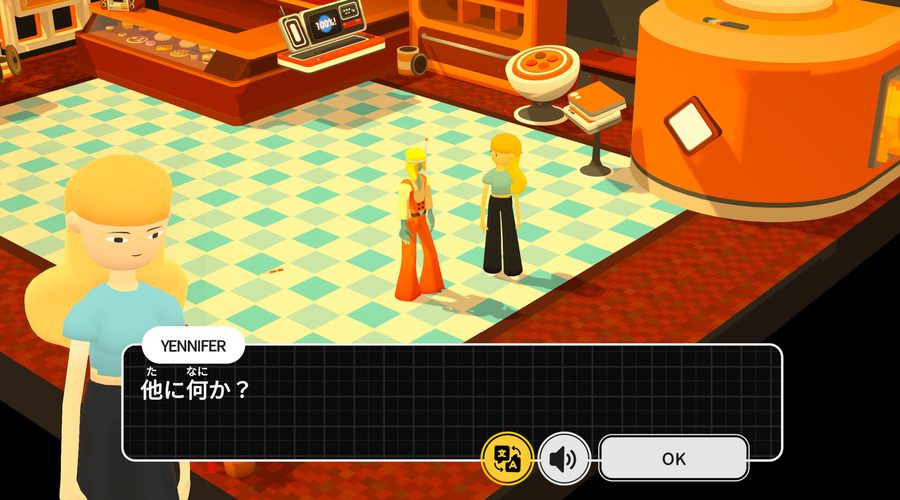
Screenshot from the Noun Town Steam store page, showing dialogue with furigana above kanji
Vocabulary and listening comprehension are where a well-made Japanese game earns its keep. Words tied to a visual object and native audio, then resurfaced through spaced repetition, tend to stick harder than the same words seen as text-only flashcards. Speech recognition features, where a game listens to you pronounce a word back, add a speaking practice element that a lot of apps skip entirely.
Where games are weaker is explicit grammar. Japanese grammar has structures, particles and verb conjugation patterns that are genuinely easier to learn through direct explanation than through incidental exposure alone. Kanji is a similar story: incidental exposure through a game helps you recognise characters you have already seen, but for systematically learning the two thousand or so characters used in everyday Japanese, a dedicated tool like a structured kanji curriculum does that job more directly than any game currently does.
Duolingo and similar apps are built around short daily exercises and a streak system that is genuinely good at keeping people opening the app regularly. What they are less good at is sustained attention within a single session, since most sessions are designed to be finished in a few minutes. A game session, by contrast, often runs much longer simply because the player wants to keep going, which means more total exposure to the language per sitting.
Textbooks and formal courses remain the strongest option for structured grammar, and organisations like the Japan Foundation publish well-regarded frameworks for how Japanese proficiency is typically staged. Most serious learners end up combining a couple of these tools rather than relying on just one, since vocabulary, grammar and conversation are genuinely different skills that no single format currently teaches equally well.
Steam is the best place to look for high quality Japanese language games. Unlike a general app store search, which mixes in flashcard apps, translation tools and games with almost no teaching behind them, Steam's store pages and user reviews make it far easier to tell a genuinely purpose-built learning game apart from something that just has Japanese text in it. Reviews from real players tend to call out fairly quickly whether the audio is native speaker recordings or synthesised, whether there is a free demo, and whether the teaching sticks past the first hour.
We built Noun Town as the deep, immersive part of a Japanese study routine rather than the whole thing. A typical setup we hear from players looks like a longer session in the game for vocabulary and listening, alongside a lighter tool or class for grammar. That combination plays to what each format is actually good at instead of asking one product to do everything.
On pricing, Noun Town is a one-time purchase at $19.99 covering all supported languages, including Japanese, with a free demo on Steam so you can try it before buying. There are no ads and nothing further to unlock afterward, a decision the team made after using the big mobile language apps themselves and getting frustrated by exactly that kind of interruption, a frustration thousands of other learners told us they shared.
A note from the author: Noun Town draws on the learning from my own PhD into language learning and computing, so the teaching methods behind the game are backed by research rather than guesswork. There are a lot of language learning RPGs and games out there, and while the entertainment value and motivation they offer is obvious, it is worth digging into the actual pedagogical basis of any of these programs before assuming play time is doing the job of real study.
Want to see how furigana and native audio work in practice? Try the free demo on Steam.
Try Noun Town on SteamYes. Several games are built specifically to teach Japanese vocabulary, reading and listening, rather than being general entertainment titles that happen to feature Japanese. Noun Town is one example, teaching words through a 3D world with native speaker audio and furigana above kanji.
Not from a game alone, and no honest product claims otherwise. Games are strong at building vocabulary, listening comprehension and reading recognition. Full fluency also needs sustained conversation practice, grammar study and exposure to native content well beyond what any single game covers.
Some do, though usually not as a dedicated system the way a tool like WaniKani teaches kanji directly. Noun Town, for example, does not teach kanji as its own curriculum, but players pick up kanji incidentally through repeated exposure, shown with furigana above the characters so the reading is always visible.
Yes, particularly for vocabulary tied to visual objects and everyday situations. Research on game-based and contextual learning suggests words encountered while doing something, rather than drilled as an isolated list, tend to be retained for longer.
Noun Town places Japanese vocabulary in a 3D open world, where words are attached to objects and spoken by native speakers, reinforced through spaced repetition and speech recognition practice. The game used to display romaji throughout, but switched to furigana above kanji after mixed feedback, a change that was received well across the board.
It depends on the game. Some are free with ads or limited free content, others are a one-time purchase. Noun Town is $19.99 as a one-time purchase with a free demo available on Steam, and has no ads or additional paywalled content once purchased.
They tend to be strong in different areas. Duolingo is well suited to short daily vocabulary drills and building a habit through streaks. A game like Noun Town tends to hold attention for longer sessions and ties words to a spoken, visual context, which many learners find helps retention, though neither replaces structured grammar study.
No, most games designed for learners assume no prior knowledge and build up reading support gradually, often through furigana readings placed above kanji, so a complete beginner can start immediately without first mastering the scripts separately.
Most learners notice basic vocabulary recognition within the first few sessions, since words are reinforced repeatedly through spaced repetition. Meaningful conversational ability takes considerably longer, generally many months of consistent practice, regardless of which tool is used.
Adults make up a large share of the audience for games like Noun Town. Many adult learners specifically choose a game format because it avoids the classroom feeling of textbooks and apps, and allows for longer, more immersive study sessions than typical app-based drills.