
Photo: Bgag / Wikimedia Commons (CC0)
Short answer: Yes. A short list of PC and Mac games teach Korean directly, rather than just being set somewhere in Korea. Noun Town is one of them, teaching Korean vocabulary through a 3D open world with native speaker audio, spaced repetition and speech recognition, available on Steam for $19.99 with a free demo.
Korean has had a real moment over the last several years, pulled along by music, television and film, and a lot of people who started as fans of Korean culture end up wanting to actually understand the words. That question usually starts with an app, and often stalls there.
The numbers back this up on our own side too. Korean is Noun Town's fastest growing language right now, with twice as many learners studying it today as when we first added it to the game. That kind of jump is a fairly direct reflection of how much interest in the language has grown recently, well beyond what we expected when Korean was just one of twelve tracks on the list.
Games are a smaller but growing category for Korean specifically. Not every game claiming to teach a language does much beyond putting subtitles on a screen, so it is worth knowing what separates a real teaching tool from a game that merely happens to be set in Seoul.
A game can be full of Korean signage and dialogue and still teach you almost nothing, the same way watching a foreign film with subtitles rarely builds vocabulary on its own. A genuine teaching game needs a specific structure behind the visuals.
Noun Town was designed around this list specifically. You move through a 3D open world, talk to characters, and Korean vocabulary attaches to things you actually encounter, a sign, an object on a market stall, a line spoken by an NPC.
Hangul, the Korean writing system, is unusual among East Asian scripts because it was deliberately designed to be learnable quickly. It is phonetic, meaning each character represents a sound rather than a whole word or idea, and linguists studying its structure have generally rated it as one of the more efficient writing systems in existence.
Games that show Korean text on screen alongside audio give you steady, passive exposure to Hangul even before you consciously study it, similar to how incidental exposure works for other scripts. It is not a substitute for a dedicated session learning the alphabet if reading is your priority, but it means the characters stop looking unfamiliar fairly quickly.
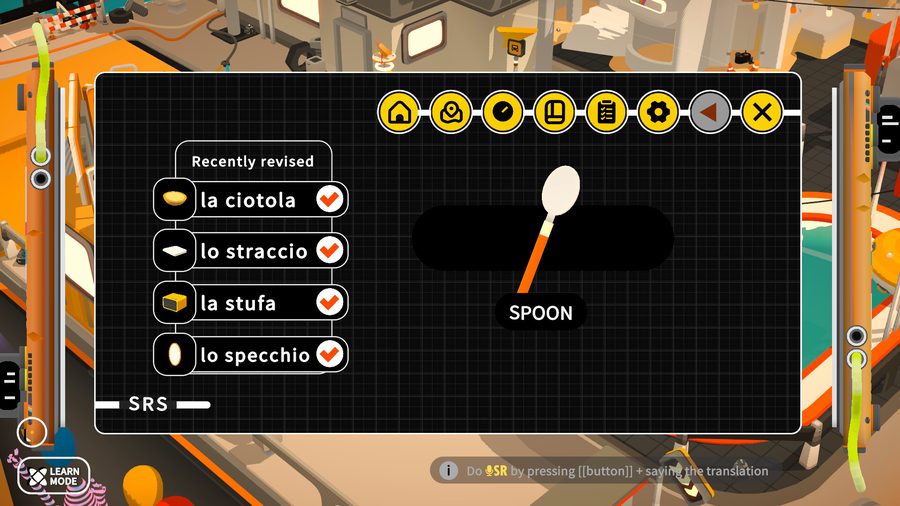
Screenshot from the Noun Town Steam store page, showing the spaced repetition review screen
Korean sentence structure and honorific speech levels, which change vocabulary depending on who you are speaking to, are the parts most learners find genuinely difficult, and no format solves that instantly. But the vocabulary layer underneath all of it benefits a lot from repeated, contextual exposure, which is exactly where games have an edge over flashcard-style apps.
Hearing a word multiple times in slightly different situations inside a game world tends to build a more durable memory of it than seeing the same word as an isolated card ten times in a row. This lines up with general findings on digital game-based learning, which has consistently shown contextual repetition outperforms rote memorisation for vocabulary retention.
Confirm recordings are by real Korean speakers, not text-to-speech
Test the teaching pace and style before committing to a purchase
Check it runs on your PC or Mac without extra hardware requirements
We built Noun Town as a single purchase with all languages, including Korean, included from day one, after finding the ad breaks and paywalled lesson tiers on major mobile apps frustrating during our own attempts to learn a language. Enough other learners told us the same thing that we decided a one-time payment with everything unlocked was worth building properly.
Games are strong for vocabulary, listening and pronunciation practice. They are weaker for teaching the full complexity of Korean honorifics and grammar in a structured way, which is where a course, textbook or tutor still earns its place. Resources like the National Institute of Korean Language or a structured beginner course can round out the grammar side that a game touches more lightly.
Treat a game as the tool that keeps you showing up and builds your working vocabulary fast, and treat a course or tutor as the tool that fills in the structural gaps once you are far enough in to notice them.
Curious what a Korean learning game actually looks like? There is a free demo on Steam.
Try Noun Town on SteamYes. A small number of PC and Mac games, including Noun Town, are built specifically to teach Korean vocabulary through a 3D world with native speaker audio, spaced repetition and speech recognition, rather than simply being set in Korea.
Some do to varying degrees. Hangul, the Korean writing system, is generally considered easier to learn than other Asian scripts because it is phonetic and was deliberately designed to be simple. Games that show Korean text alongside audio give you passive exposure to Hangul even if reading it is not the primary focus.
Korean is generally rated as more challenging for English speakers than languages like Spanish or French, partly due to sentence structure and honorific speech levels, though the Hangul alphabet itself is comparatively quick to pick up compared to other Asian writing systems.
Duolingo teaches through short structured lesson screens completed in a few minutes. A Korean learning game like Noun Town places vocabulary inside an explorable 3D environment, so words are learned through context and repeated exposure during longer, more engaged play sessions.
Noun Town runs on PC and Mac through Steam, with a free demo available. It is not a VR game and needs no special hardware beyond a standard computer.
Noun Town is a one-time purchase of $19.99 covering all 12 supported languages, including Korean, with no subscription fee and nothing else to unlock afterward.
Yes. Games like Noun Town are designed so complete beginners can start immediately, since vocabulary is introduced gradually through the environment rather than assuming any prior knowledge of Korean grammar or Hangul.
Games that include native speaker audio and speech recognition, such as Noun Town, let you hear correct pronunciation repeatedly and then practise saying words aloud, which is closer to real conversational practice than reading a phonetic guide.
Most players start recognising common words within the first few hours. A working vocabulary of a few hundred words typically builds up over several weeks of regular sessions, with spaced repetition bringing words back before they are forgotten.
It varies by title. Noun Town has a free demo on Steam and then a $19.99 one-time purchase for the full game, with no ads and no additional paywalled content once purchased.