
Photo: Madrid San Miguel Market / Wikimedia Commons (CC BY-SA 2.0)
Short answer: Yes. A small number of PC and Mac games are built specifically to teach Spanish, rather than simply being set in a Spanish-speaking world. Noun Town is one example, teaching both Spain Spanish and Mexican Spanish as separate tracks through a 3D environment, native speaker audio, spaced repetition and speech recognition, available on Steam for $19.99 with a free demo.
If you have typed this question into Google, you have probably already tried an app or two and found yourself wondering whether there is a more engaging way in. There is. A handful of games exist that treat Spanish vocabulary as the actual point of the design, not a theme painted over generic gameplay.
This is not the same as playing a Spanish-language version of a game built for something else, which teaches you almost nothing unless you already understand most of the dialogue. The games worth looking at here are ones designed around teaching, with the same rigour as an app but a completely different feel.
Plenty of games are set in Spain or Latin America without teaching a word of Spanish. A true learning game needs a few specific ingredients working together, not just a setting.
Noun Town was built around exactly this list. You explore a 3D open world, talk to characters, and pick up Spanish vocabulary the way you would notice it in a real place, a label on a shop, a word in a conversation, an object you interact with.
One detail that trips people up: Spanish is not one single language track in a good learning tool, since Spain Spanish and Mexican Spanish differ in pronunciation, some vocabulary and occasionally grammar. A handful of words are genuinely different words entirely, not just accents.
Noun Town treats these as two separate tracks, each with its own native speaker recordings, rather than defaulting to one variety and calling it "Spanish." If you are learning because you plan to travel to Mexico specifically, or you have family in Spain, that distinction actually matters for what you will hear when you get there.
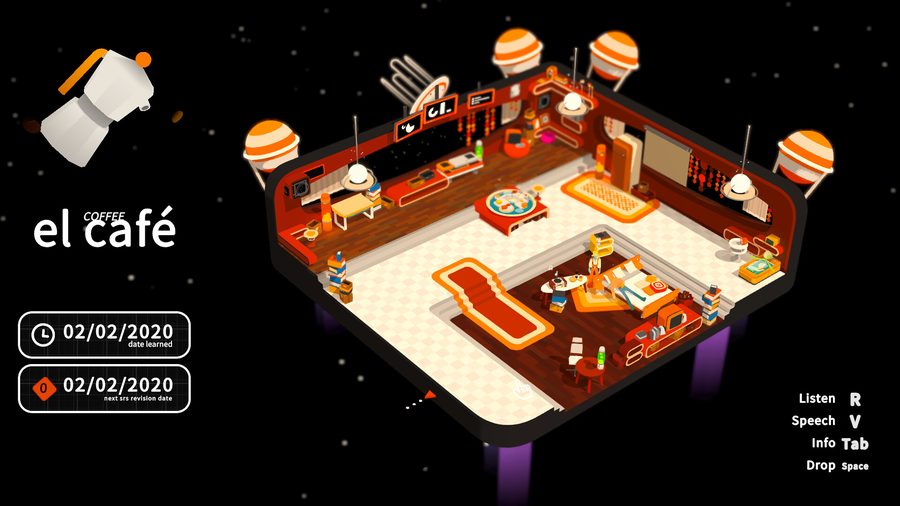
Screenshot from the Noun Town Steam store page, showing a Spanish vocabulary review card
It is also worth knowing that you will not just hear one voice over and over. Both Spanish tracks in Noun Town use multiple native speakers rather than a single recorded voice repeated across every word, so your ear gets used to some natural variation in accent and tone, closer to how you would actually hear Spanish spoken day to day. This matters more for the Mexican Spanish track in particular, since Latin American Spanish covers a wide range of regional accents, and hearing only one voice can leave learners caught out the first time they hear someone speak with a different one.
The honest comparison is not "games beat apps," it is that they solve slightly different problems well. Apps like Duolingo are built for short, frequent sessions and explicit grammar teaching. Games are built for longer, more absorbed sessions where vocabulary sticks because you are paying attention to something else at the time, not because you are being drilled.
| Feature | Typical Spanish app | Spanish learning game |
|---|---|---|
| Session length | 2-10 minutes | 20-60+ minutes |
| Grammar teaching | Explicit and structured | Light, mostly absorbed through use |
| Pricing model | Often free with subscription tiers | Usually one-time purchase |
| Vocabulary context | Isolated exercises | Tied to a world and situations |
Our own experience of building Noun Town came partly from frustration with the app side of this, specifically the ads and paywalled lesson tiers we ran into using the big mobile apps ourselves. When we heard thousands of other learners describe the same annoyance, we built the game as a one-time purchase with nothing locked away afterward.
The demo point matters more than people expect. Teaching styles vary a lot between games, and a five-minute demo tells you more about whether the pacing suits you than any amount of reading reviews.
Games are genuinely strong for vocabulary, listening and getting comfortable with pronunciation. They are weaker for extended grammar explanation and for conversational speaking practice with another human being, which eventually matters if your goal is real fluency rather than recognition.
Resources like the Instituto Cervantes or a structured course can fill that grammar gap well, and language exchange partners or tutors cover the live conversation piece a game cannot fully replicate. A game is an excellent entry point and an excellent vocabulary engine, not necessarily a complete solution on its own for every learner.
Curious what a Spanish learning game actually looks like? There is a free demo on Steam.
Try Noun Town on SteamYes. A handful of PC and Mac games are built specifically to teach vocabulary and listening skills, including Noun Town, which covers Spanish from Spain and Mexican Spanish separately across a 3D open world with native speaker audio.
Full fluency from a game alone is unlikely for most learners. Games are strong for vocabulary, pronunciation and listening comprehension. Fluency also requires speaking practice with real people and exposure to complex grammar that games typically introduce more lightly than a structured course.
Duolingo is a mobile app built around short daily lesson screens and streaks. A language learning game like Noun Town is a 3D world you explore, where Spanish words are attached to objects and conversations rather than presented as isolated flashcards inside a lesson menu.
Both are available as separate language tracks. Spain Spanish and Mexican Spanish use different native speaker recordings and, in places, different vocabulary, since the two varieties are not identical.
Noun Town is available on PC and Mac through Steam, with a free demo you can try before buying. It is not a VR title and does not require any headset or special hardware.
Noun Town is a one-time purchase of $19.99 that includes all 12 supported languages, including both Spanish variants, with no subscription and no additional paywalled content.
Yes, games like Noun Town are commonly used by complete beginners because vocabulary is introduced gradually through the environment and reinforced with spaced repetition, without requiring any prior knowledge of Spanish grammar.
Some do. Noun Town includes speech recognition so you can practise pronouncing Spanish words aloud and get feedback, rather than only reading and listening.
Most players notice they recognise common words within the first few hours of play. Building a working vocabulary of several hundred words typically takes a few weeks of regular sessions, helped by spaced repetition resurfacing words before they are forgotten.
It depends on the game. Noun Town specifically has no adverts and no content locked behind extra payment once purchased, a decision made after the developers experienced ad-heavy and paywalled mobile apps themselves and heard the same complaint from thousands of learners.