
Photo: InclusiveGameLab / Wikimedia Commons (CC BY-SA 4.0)
Short answer: A language app teaches through short structured lessons, usually translation drills or matching exercises. A language game teaches through an activity or world you engage with for its own sake, where vocabulary is a side effect of playing rather than the point of the screen. Apps tend to win on grammar structure and price flexibility. Games tend to win on retention and how long people actually stick with it. Most serious learners end up using both.
I have spent the last few years building a language learning game, so I should say upfront that I am not a neutral party here. But I have also spent a lot of that time using and testing the apps, so this is written from someone who has genuinely tried both sides, not someone selling one side.
The question I get asked most often, usually by people considering Noun Town, is some version of: why would I play a game instead of just using an app? It is a fair question, and the honest answer is more nuanced than "games are better."
Apps are built around lessons. You open Duolingo, Babbel or Memrise, and you are presented with a unit: a set of exercises, a progress bar, a completion screen. The structure exists to teach you something specific in a short window, usually five to fifteen minutes.
Games are built around a world or an activity. In Noun Town you are exploring a 3D open world, talking to characters, solving small puzzles. Nothing about the interface says "lesson 4 of 12." The vocabulary is attached to the environment: an apple on a market stall, a word spoken by a shopkeeper, a label on a door. You are not being taught in the traditional sense. You are picking things up.
This is not a cosmetic difference. It changes how the material gets encoded in your memory, and it changes how long people keep showing up.
When we started, the plan was closer to a standard app: flashcards, some quizzes, maybe a leaderboard. What changed our minds was watching how differently people behaved with a genuine game world versus a lesson screen. In an app, most people treat sessions as a chore to complete. In a well-made game, people lose track of time. That difference in attention is, we think, the entire ballgame for vocabulary retention.
None of this means apps are badly designed. Duolingo's streak system is a genuinely smart piece of behavioural engineering, and it gets people to open the product daily in a way most software never manages. We just think the depth of engagement matters more than the frequency of a five-minute check-in, at least for building real vocabulary.
One thing we decided early on, and have never revisited: Noun Town is never going to carry adverts, and none of the content is locked behind a paywall once you own the game. That was a conscious choice, not an accident. Before we built this, we used the big mobile apps ourselves and got frustrated in the same way a lot of people do, hitting a wall a few lessons in, then being asked to pay again for the next tier or sit through an ad to keep going. We also spoke to thousands of learners who told us the same thing in their own words. So we built the opposite of that on purpose: one purchase, everything included, no ads interrupting a lesson you were actually enjoying.
It would be dishonest to pretend games win everything, so here is where apps are genuinely stronger.
Vocabulary retention is the area where the evidence most clearly favours games, and specifically digital game-based learning that puts words into a meaningful, repeated context. Words tied to a visual object, a spoken sentence and an interactive moment tend to stick harder than the same words seen as an isolated flashcard, because more of your brain is involved in encoding them.
Games also tend to produce longer, more voluntary sessions. Nobody accidentally spends three hours doing app flashcards. People regularly lose an evening to a game world, and if that world happens to be teaching you Japanese vocabulary the whole time, that is three hours of exposure an app rarely gets from the same person.
The technique underneath most of this, in both apps and games that do it well, is spaced repetition, a scheduling method that resurfaces words right before you are likely to forget them. It works in either format. The difference is whether the review feels like a task or feels like a natural part of playing.
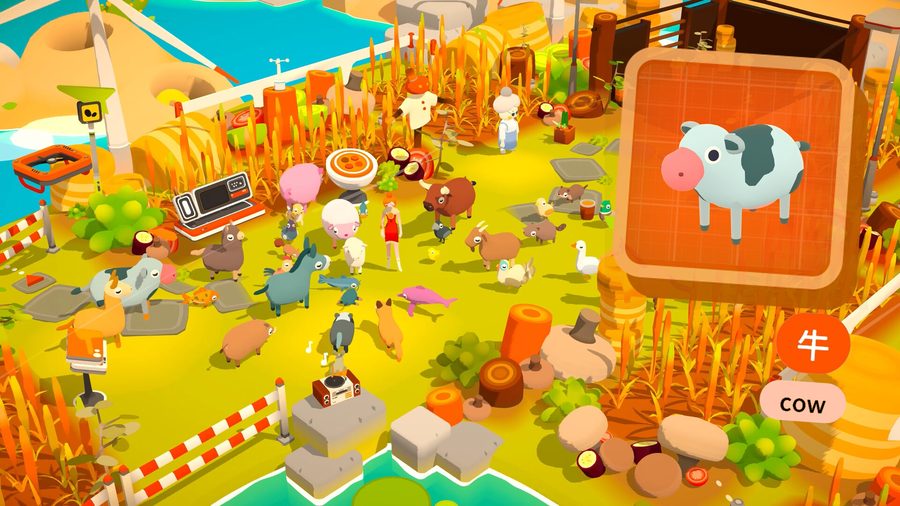
Screenshot from the Noun Town Steam store page
Price comparisons get muddled because apps use subscriptions and games usually do not. Here is roughly what a year looks like for each model.
Free app with ads, or a mid-tier subscription app over 12 months
One-time purchase for a game like Noun Town, covering all 12 supported languages for life
Premium subscription apps or private tutoring layered on top, per year
Over a single year the numbers can look similar. Over three or four years, the gap between a one-time purchase and a recurring subscription becomes hard to ignore.
Most learners we hear from, including plenty of Noun Town players, are not using our game exclusively. A common pattern looks like this: a game for the vocabulary sessions where they want to get lost in something, a lighter app or flashcard tool for quick daily maintenance, and occasionally a grammar resource or tutor for the structural side neither format handles particularly well on its own.
That is not a marketing answer designed to avoid picking a side. It reflects the fact that vocabulary, grammar and consistency are three different problems, and no single format currently solves all three equally well.
If your main obstacle has been sticking with a language long enough to see progress, a well-made game is worth trying, because engagement is the actual bottleneck for most people, not intelligence or aptitude. If your main obstacle is understanding how the grammar fits together, an app or a structured course will likely serve you better in the short term.
We built a game because we believe vocabulary retention and sustained attention matter more than most learners realise, and games are simply better positioned to deliver both. But we would rather you find whichever tool actually gets you speaking a new language than convince you ours is the only answer.
Curious what a language game actually looks like? There is a free demo on Steam.
Try Noun Town on SteamAn app is built around structured lessons, usually short exercises like translation drills or multiple choice questions. A game is built around a world or activity you engage with for its own sake, where vocabulary is picked up as a byproduct of playing rather than the direct point of every screen.
Yes, particularly for vocabulary and listening. Research into digital game-based learning consistently shows words encountered in an engaging, contextual setting are retained better than words drilled in isolation. Games are weaker on explicit grammar instruction, where structured apps and textbooks still have an edge.
For most learners, not entirely. Games are strong at vocabulary, pronunciation and sustained engagement. Apps are stronger at grammar scaffolding and quick daily reviews. Many learners get the best results combining a game for deeper sessions with an app or textbook for grammar.
It depends on the product, but a one-time purchase game like Noun Town at $19.99 is often cheaper over a year or two than a subscription app, which can run $70 to $150 annually. Some apps are free with ads, which is cheaper up front but comes with limits on features.
Either works as a starting point. If you tend to abandon apps after a few weeks, start with a game, since engagement is usually the deciding factor in whether beginners stick with a language at all. If you like structure and checklists, a lesson-based app may suit you better initially.
No. There are no adverts and nothing locked behind an additional paywall once you own the game. This was a deliberate decision after the team experienced the frustration of ad-supported and freemium mobile apps firsthand, and heard the same complaint from thousands of learners.
We used the major mobile language apps ourselves before building the game and found the ads and paywalled lesson tiers frustrating. After hearing the same frustration from thousands of other learners, we built Noun Town as a single one-time purchase with everything included instead.
They work for adults as well as children. Many adult learners specifically prefer games because they remove the classroom feeling of traditional apps, and adults often have more disposable time for a longer, immersive session than the short bursts apps are designed around.
Most people notice the difference in engagement within the first one or two sessions, since games tend to hold attention longer without extra effort. Differences in actual vocabulary retention usually become clearer after a few weeks of consistent use, once spaced repetition has had time to work.