
Photo: Leonhard Lenz / Wikimedia Commons (CC BY-SA 4.0)
Short answer: Yes, with one honest caveat. A video game can build your German vocabulary, listening and pronunciation remarkably well, and around 1,000 everyday words is realistic within three to four months of regular sessions. What a game will not do is explain the four-case grammar system, so serious learners pair a game with a grammar resource. The US Foreign Service Institute puts full professional proficiency in German at roughly 900 class hours, and the game's job is making a large share of those hours enjoyable.
Learning German with a video game sounds like something a procrastinating student invented to justify their Steam library. I build language games for a living, so you would expect me to say it works. But the honest version of the answer has real nuance in it, and German specifically is an interesting test case, because the language's famous difficulties and a game's particular strengths line up in an unusual way.
So let us take the question seriously. What can a game genuinely teach you about German, what will it never teach you, and what should you do about the gap?
The academic field studying this is called digital game-based learning, and its core finding has been replicated enough times to trust: vocabulary encountered inside a meaningful, interactive context is remembered better than vocabulary drilled from a list. The reasons are mundane rather than magical. A word met as a labelled object in a scene, spoken aloud, connected to an action you chose to take, gets encoded through more channels than a word glimpsed on a flashcard. More channels means more retrieval routes later.
The second piece of evidence is about behaviour rather than memory. Language learning fails, overwhelmingly, because people stop. Not because the method was wrong, because the sessions stopped happening. Games hold attention voluntarily for longer stretches than lesson software manages, and for a skill that the Foreign Service Institute prices at around 900 hours for German, the tool that keeps you showing up has a structural advantage over the tool that is theoretically optimal but abandoned in week three.
The third piece is spaced repetition, the scheduling technique that resurfaces a word just before you would forget it. It is the closest thing vocabulary learning has to a cheat code, and it works identically inside a game or outside one. The difference is purely emotional: in a game the review arrives as part of play, not as a debt of 40 due cards waiting to be paid.
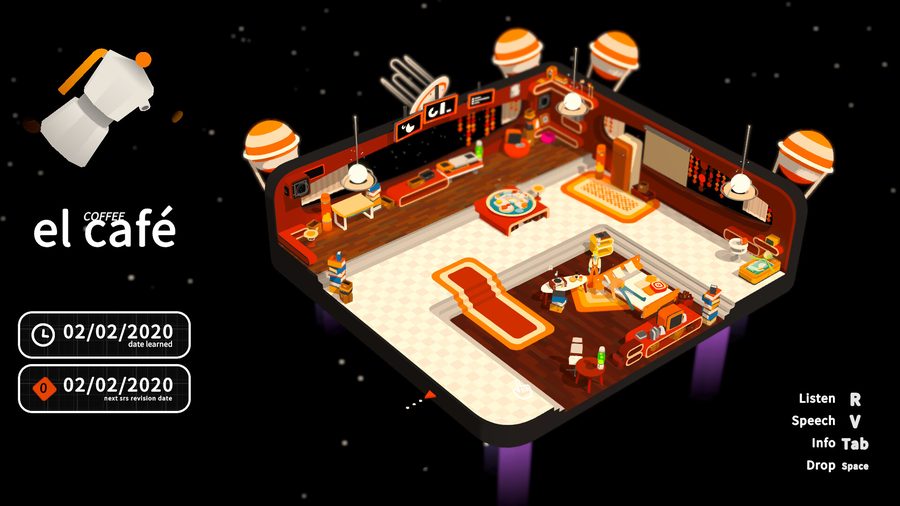
A vocabulary scene in Noun Town, showing the date a word was learned and its next spaced repetition review date. Screenshot from the Steam store page
Rather than bury the limits in a final paragraph, here is the whole picture at once.
That limits list matters more for German than for many languages. German grammar is front-loaded: nominative, accusative, dative and genitive cases change the little words around every noun, and no amount of ambient exposure teaches the system as fast as someone simply explaining the table. A grammar book costs less than lunch. Buy one, use the game for everything in the first box, and the two together cover the whole beginner problem.
Every German noun carries a gender, and the article that goes with it, der, die or das, follows no rule reliable enough to trust. Every German teacher gives the same advice: never learn a noun alone, always learn it with its article welded on. Students nod, then make flashcards that say "Tisch" anyway.
A game can enforce the weld. In the German module of Noun Town, the table in the café is "der Tisch" on first meeting, every review and every spoken repetition after that. You never encounter the naked noun, so the article becomes part of the word in your memory rather than a detail bolted on later. This one design decision quietly solves the most common bad habit in German self-study.
German also pays out early in a way learners rarely expect. English is a Germanic language, and the shared ancestry means thousands of near-free words: Haus, Wasser, Buch, Apfel, Finger, Winter. The German language has around 95 million native speakers and is the most spoken native language in the European Union, so those easy early wins open doors in six countries. Even the notorious compound nouns turn friendly once you have vocabulary: Handschuh, the hand shoe, is a glove. Once you know Hand and Schuh, the monster words start reading like Lego instructions.
Concrete beats abstract, so here is the plan we would give a friend starting German from zero today.
Play four sessions a week, 20 to 40 minutes each. Target is not word count, it is the habit itself. Let the spaced repetition system decide what you review. Expect roughly 100 to 150 words with articles attached by the end of the fortnight.
Keep the game sessions, and add a short grammar explanation after each one, working through cases at whatever pace feels sane. The vocabulary you already own makes the grammar examples meaningful instead of abstract, which is why this order works better than grammar-first.
Somewhere past 500 words, start supplementing with native material: German music, a familiar game switched into German, or the free level-graded resources from the Goethe-Institut. By day 90 a consistent learner sits near 1,000 words, comfortably within reach of the A2 milestones described in the CEFR framework for vocabulary and listening.
Notice what the plan does not contain: marathon weekends, 200-day streak obsessions, or any requirement to feel guilty. Regular modest sessions outperform heroic irregular ones, every time, because the repetition schedule needs you back before the forgetting curve wins.
Noun Town is $19.99 on Steam, once. That includes German and the other 11 supported languages, no subscription, no ads, and nothing locked behind a further payment. There is a free demo, and it runs on PC and Mac. Across the series it has passed 200,000 players, and the Steam rating sits at 87% positive from 590+ reviews.
The pricing is a philosophy as much as a price. Before building the game we used the big mobile apps ourselves, and the pattern of hitting an ad mid-lesson or discovering the next unit sat behind a higher subscription tier drove us up the wall. Thousands of learners told us the same story. So the game is deliberately the opposite arrangement: pay once, own everything, never see an ad. Whether you choose our game or not, we would suggest applying that standard to whatever you pick, because resenting your learning tool is a shortcut to quitting.
And quitting is the real enemy in German. The grammar tables get memorised eventually, the compound words unpack themselves, the genders settle in. Every difficulty yields to hours. The only unrecoverable failure is the one where the hours stop happening, which is precisely the failure a good game is built to prevent.
See whether game-based German suits you. The demo is free.
Try Noun Town on SteamYes, for vocabulary, listening and pronunciation. Research on game-based learning consistently shows words met in an interactive context are retained better than words drilled from lists. Games are weaker at explicit grammar, so most successful learners pair a game with a grammar resource.
The US Foreign Service Institute estimates around 900 class hours for an English speaker to reach professional working proficiency in German. A useful everyday vocabulary of about 1,000 words is achievable in three to four months of regular game sessions.
It is middling. English is a Germanic language, so thousands of words are near-identical cognates like Haus, Wasser and Buch. The difficulty comes from grammar: three noun genders, four cases and famously long compound words. Vocabulary is the easy half, which is the half games handle best.
Noun Town is our recommendation for beginners. Its German module teaches nouns with the correct der, die or das article attached, uses native speaker audio throughout, and reviews words through spaced repetition. It costs $19.99 once on Steam for PC and Mac, with a free demo.
A well-designed one does. Learning each noun together with its article from the first exposure is exactly what German teachers recommend, and a game can enforce that pairing on every single encounter, which is harder to do with self-made flashcards.
Not well, and it is better to be honest about that. Games build pattern recognition through exposure, but the German case system benefits from explicit explanation. A grammar book or a structured course alongside your game sessions covers this gap cheaply.
Around 1,000 well-chosen words covers most everyday conversations, and roughly 2,000 to 3,000 puts you in comfortable B1 territory for daily life. Frequency matters more than volume: the most common thousand words appear constantly in real speech.
Noun Town is $19.99 as a one-time purchase with no subscription, no ads and no locked content, and all 12 supported languages are included. Subscription apps typically cost $70 to $150 per year by comparison, and a free Noun Town demo is available on Steam.
Switching a familiar game's language to German is excellent practice once you know a few hundred words, but brutal as a first step because commercial games never slow down for learners. Build a base vocabulary with a dedicated learning game first, then graduate to native-language gaming.