
Photo: Dietmar Rabich / Wikimedia Commons (CC BY-SA 4.0)
Short answer: Dedicated Italian-only games are genuinely rare on Steam. Most people learning Italian through gaming are either using a broader language learning game that includes Italian, like Noun Town, or picking up incidental vocabulary from games set in Italy that were never designed to teach anything. Both have a place, but it is worth knowing which one you are actually getting before you expect results from it.
Search "learn Italian game" and you will find plenty of results, but pull back the marketing on most of them and the picture gets thinner fast. There is no shortage of games with Italian settings, gorgeous ones, some genuinely steeped in the language and culture. What there is a shortage of is a game built from the ground up as a structured Italian course, the way a textbook or dedicated app would be.
This post is a straightforward look at what is actually out there for Italian on Steam, split into what teaches you Italian on purpose and what just happens to expose you to it.
If you are hoping for a long list of games built purely to teach Italian, the list is short. Most language learning games take a multi-language approach instead, building one system and applying it across a set of commonly requested languages, Spanish, French, German, Italian and a handful of others, rather than building a separate product for each one from scratch.
That is partly a commercial reality. Italian has fewer learners globally than Spanish or Mandarin, so it rarely justifies a standalone game on its own. It is usually included as one option within a broader product instead, which is exactly how Noun Town treats it, alongside Japanese, Korean, Chinese, Spanish, French, German, Russian, Greek, Egyptian Arabic and English.
It helps to separate these two categories clearly, because they get lumped together a lot in casual searches.
Neither is wrong to use. The mistake is expecting the first category to function like the second. Playing a game with Italian dialogue for thirty hours will expose you to the sound of the language and maybe a handful of recurring phrases, but it will not build a structured vocabulary the way a dedicated learning system will, because building that vocabulary was never the goal of the game in the first place.
Noun Town's Italian content works the same way its other 11 languages do: a 3D open world where vocabulary is attached to objects, characters and situations rather than presented as an isolated lesson. You explore, talk to people, and the words come with native speaker audio, so pronunciation is learned by ear from real speech rather than approximated from text alone.
Underneath that sits a spaced repetition system, resurfacing words shortly before you are likely to forget them, and speech recognition, so you can attempt to say a word back and get a sense of how close you are. It is not trying to be a grammar course. It is trying to make the vocabulary side of learning Italian feel like something you want to keep doing rather than something you have to force yourself through. If you want more detail on how the whole system works across languages, the language learning game landing page goes into the mechanics properly.
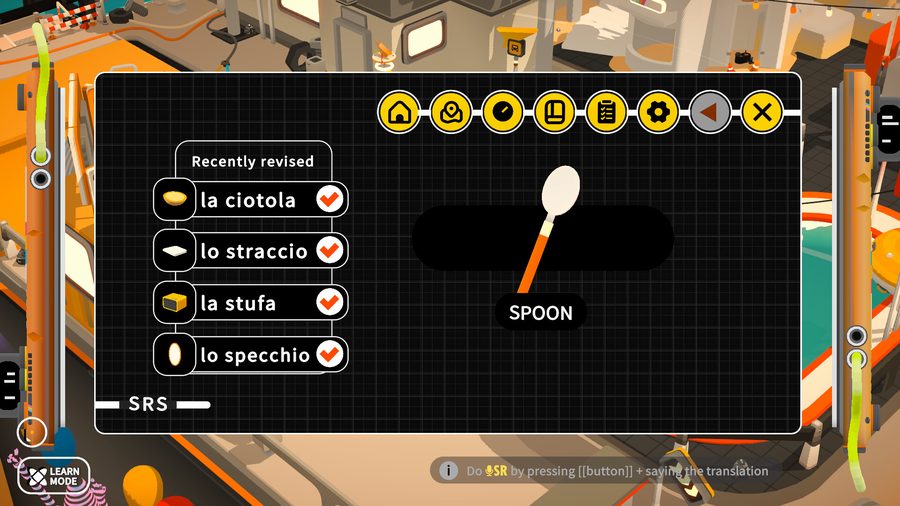
Screenshot from the Noun Town Steam store page, showing an Italian vocabulary review screen
A note from the developers: Italian gets particular care in Noun Town for a simple reason, half the team is Italian, so there is a genuine personal attachment to getting this language right, not just a business case for including it.
If you are choosing between languages and Italian is one option, it is worth knowing it sits among the friendlier ones for English speakers. The US Foreign Service Institute places Italian in its easiest category alongside Spanish and French, estimating around 600 to 750 hours to reach professional working proficiency, roughly a third of what it estimates for a language like Mandarin or Arabic.
Shared Latin roots with English vocabulary help, and Italian pronunciation is fairly consistent once you learn the rules, unlike English where the same letters can sound completely different depending on the word. None of that makes Italian effortless, but it does mean the early plateau that discourages a lot of beginners tends to arrive later than it does with harder languages.
The most sensible path for most people is not choosing one category over the other, it is using them together deliberately.
This is not a complicated system. It is closer to how people naturally end up learning a language they are enthusiastic about anyway, just with a bit more intention behind which parts are doing which job.
Subscription apps covering Italian commonly run $70 to $150 a year. Noun Town is a one-time purchase of $19.99 that includes Italian and all 11 other supported languages, with no adverts and nothing locked behind an extra paywall once you own it. That was a deliberate decision by the team, made after using ad-supported and freemium mobile apps themselves and hearing the same complaint from thousands of other learners. There is a free demo on Steam too, so you can try the Italian content before deciding whether it is for you.
Want to see what learning Italian in a 3D world feels like? There is a free demo on Steam.
Try Noun Town on SteamThere are very few games built specifically and only around teaching Italian. What exists mostly falls into two categories: broader language learning games that include Italian as one of several supported languages, and games set in Italy or featuring Italian characters that offer incidental exposure without a structured teaching system behind them.
You can pick up some vocabulary and a feel for pronunciation from games set in Italy or featuring Italian voice acting, but this is incidental exposure rather than structured teaching. It works best as a supplement alongside a dedicated learning resource, not as a replacement for one, since there is no spaced repetition or deliberate vocabulary progression built in.
Italian is generally considered one of the more approachable languages for English speakers. The US Foreign Service Institute places it in its easiest category alongside Spanish and French, estimating around 600 to 750 hours of study to reach professional working proficiency, thanks to shared Latin vocabulary roots and fairly consistent pronunciation rules.
Look for a game that pairs native speaker audio with vocabulary encountered in context, ideally with a spaced repetition system that resurfaces words before you forget them. Noun Town approaches Italian this way, through a 3D open world rather than isolated flashcard screens, alongside 11 other supported languages.
Yes, Noun Town uses native speaker audio throughout its Italian content, attached to vocabulary encountered inside its 3D open world, along with speech recognition so you can practise saying words back yourself.
Noun Town is a one-time purchase of $19.99 covering all 12 supported languages including Italian, with no ads and nothing paywalled once you own it, compared to many subscription apps charging $70 to $150 a year. The tradeoff is that Noun Town does not offer explicit grammar lessons the way a structured app or course might, leaning instead on contextual vocabulary exposure.
Several well-known games are either set in Italy or feature significant Italian dialogue and voice acting, including entries in long-running historical and adventure series. These can be a fun, low-pressure way to hear the language spoken naturally, though they are not designed to teach vocabulary systematically the way a dedicated language learning game is.
No prior Italian is needed. Games designed for language learning, including Noun Town, are built to start from zero, introducing vocabulary gradually inside the game world rather than assuming existing knowledge.