Quick verdict: Noun Town is a 3D open world language learning game on Steam. It teaches vocabulary in 12 languages through spatial context, native speaker audio, spaced repetition, and speech recognition. 590+ Steam reviews, 87% positive. $19.99 one-time, free demo available. It is excellent for vocabulary and genuinely fun to play. It does not cover grammar or offer a mobile version. For learners who want vocabulary that sticks rather than translation drills, it delivers.
Noun Town — available on Steam for PC and Mac
Noun Town is made by our studio, Ratcliffe and Ratcliffe Ltd. That means this review comes with an obvious conflict of interest, and we want to acknowledge that clearly. We have tried to write honestly about what the game does well and where it does not serve every learner. If you want a completely independent take, Steam reviews are the best place to look: there are over 590 of them, mostly from people who had no reason to be kind.
The short version is this. Noun Town works. The reception from players has been strong. But it is a specific tool with specific strengths, and whether it is the right tool depends entirely on what you are trying to do.
Noun Town is a 3D open world game built specifically for vocabulary learning. You pick a target language from the 12 available, load into the town, and start exploring. The environment is designed so that every object, character, and location teaches you something. Walk into a kitchen and you learn kitchen vocabulary. Explore a market and you learn the names of foods, colours, and quantities. Everything comes with native speaker audio played in real time.
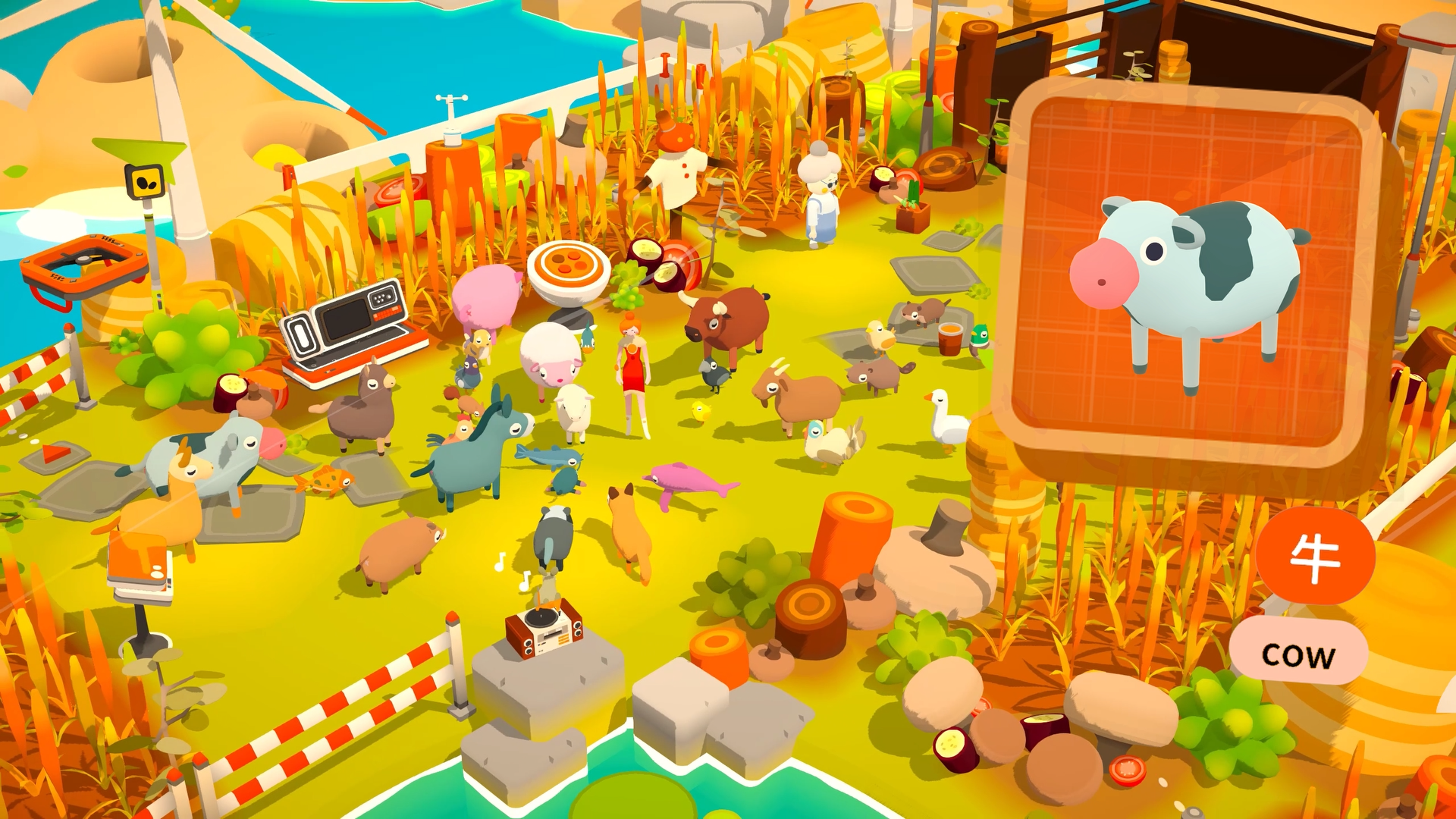
Words are attached to objects and locations in the game world
The core method is what learning researchers call spatial encoding: attaching language to physical locations and objects rather than learning words in abstract lists. The idea is that your brain encodes information more durably when it is connected to a place, an image, or an experience. It is the same principle behind the memory palace technique, which has been used for memorisation since ancient Greece.
On top of the spatial approach, the game uses a spaced repetition system (SRS) to manage review. Words come back at intervals calibrated to how well you are retaining them: if you recall a word easily, it returns later; if you struggle with it, it comes back sooner. Spaced repetition is one of the best-evidenced techniques in cognitive science for long-term memory retention.
Speech recognition is woven into the gameplay. Characters ask you questions in your target language and you answer out loud. The game evaluates your pronunciation and gives you feedback. This makes speaking practice part of the session rather than a separate activity you have to remember to do.
Vocabulary retention is where the game earns its reviews. Most language apps teach words through translation pairs: you see "cat" and type "gato." Noun Town teaches words by showing you a cat, having a character say its name in your target language, and then bringing that word back across different parts of the game. By the time a word is firmly established in your memory, you have encountered it in multiple contexts, not just once on a flashcard.
The research behind contextual vocabulary acquisition is solid. A 2022 paper in Computers and Education found that words encountered in game environments were retained at significantly higher rates over a 30-day period than the same words encountered in reading exercises or translation drills. The authors attributed this to deeper processing: when your attention is engaged with a task, new vocabulary gets encoded more thoroughly.
The native speaker audio quality is consistently good. Every language in the game uses real recorded speech, not synthesised voices. Hearing words spoken correctly from the start builds natural pronunciation habits that are very hard to unlearn later.
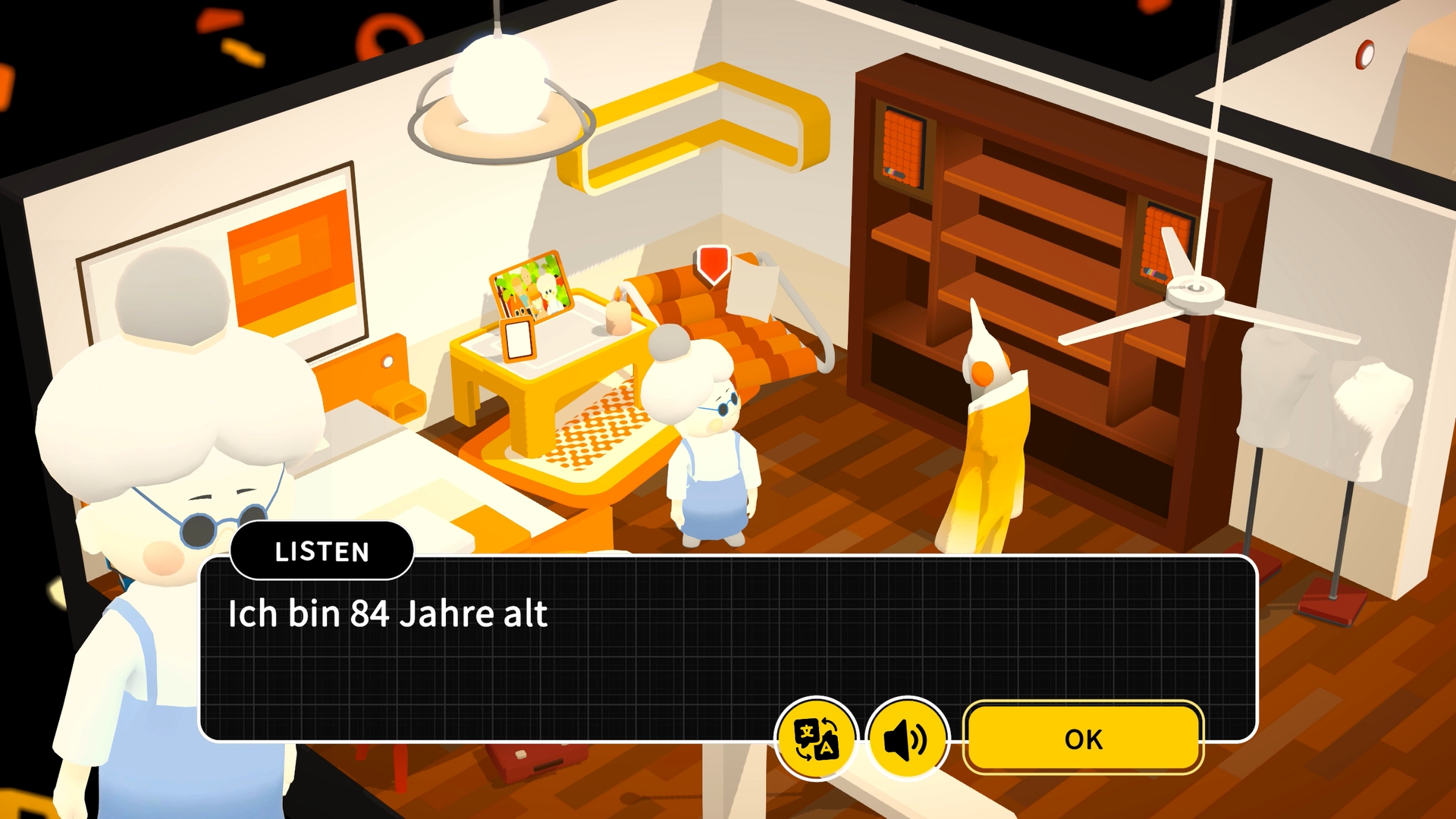
Speech recognition lets you respond to characters in your target language
Session length also tends to run longer than with apps. Duolingo lessons are designed to be five minutes. Noun Town sessions often run an hour or more, not because the game forces it, but because it holds your attention. That adds up quickly over weeks of regular play.
Noun Town is a vocabulary tool. It is not a grammar course, and it does not try to be.
If you need explicit instruction in verb conjugations, sentence structure, noun genders, or tense use, the game will not provide it. You will pick up patterns through repeated exposure, the way you learn grammar through immersion generally, but there are no lessons explaining why a sentence is constructed the way it is. For early-stage learners who want structural guidance, something like Babbel or a structured grammar textbook runs alongside Noun Town well.
There is no mobile version. The game runs on PC and Mac via Steam. If you want to practise on your phone during a commute, Noun Town is not the right tool for that time slot.
Conversation practice is also limited by the game's format. Speech recognition lets you respond to in-game characters, but it is not the same as a real conversation with a native speaker. For speaking confidence and natural conversational flow, a human tutor or language exchange partner is still the best option.
All 12 languages are included in the single $19.99 purchase. You can switch between them freely. The languages are Japanese, Korean, Chinese (Mandarin), Spanish (Spain), Spanish (Mexico), French, German, Italian, Russian, Greek, Egyptian Arabic, and English.
The coverage is interesting because it includes several languages that most apps handle poorly or not at all. Greek and Egyptian Arabic, for instance, are underserved by the major app platforms. Noun Town's Egyptian Arabic module covers the dialect most widely understood across the Arab world, which is a more practical choice for most learners than Modern Standard Arabic. Russian and Greek both use non-Latin scripts, and the game handles this properly rather than relying on romanisation.
Having multiple languages in a single purchase is also useful if your plans change, or if you are curious about a language you have not committed to yet. The free demo gives you a genuine sample before you decide.
Noun Town is most often compared to Duolingo, Anki, and Rosetta Stone. Each comparison reveals something different about what the game does.
Against Duolingo, Noun Town has a stronger vocabulary approach but covers less ground overall. Duolingo handles grammar basics, has a mobile app, and is free. For most learners targeting the 12 languages Noun Town supports, the best approach is both: Duolingo for daily habit and grammar exposure, Noun Town for deep vocabulary sessions.
Against Anki, which is also based on spaced repetition, the difference is engagement. Anki is a blank canvas: highly effective for disciplined learners, but most people find it difficult to sustain long-term. Noun Town delivers the same underlying technique in a format that is much easier to show up for consistently.
Against Rosetta Stone, which also uses immersive contextual learning, Noun Town is significantly cheaper. Rosetta Stone costs around $179 per year for a single language; Noun Town is $19.99 for all 12, forever. The pedagogical approaches are similar in some respects, though Noun Town's SRS integration is more explicit and the game format adds a motivation layer that Rosetta Stone does not have.
For a full comparison with Duolingo specifically, see our Noun Town vs Duolingo article.
The game is best suited to beginners and people who are new to a language. If you are starting from zero in Japanese, Italian, or any of the other 12 languages, Noun Town gives you a strong vocabulary foundation in a format that is much easier to stick with than flashcard apps or textbooks. The core vocabulary it teaches covers the words you encounter most often, which is exactly what a new learner needs.
If you are already at an intermediate or advanced level, you will probably find that most of the vocabulary covered is already familiar. The game is not designed to push you into advanced or nuanced word territory. That said, some intermediate learners do find it useful as a revision tool, particularly for languages where they have grammar knowledge but patchy retention of common nouns. Encountering familiar words in a new spatial context can reinforce them in a way that passive review does not.
In terms of who gets the most out of it: people who play games regularly, or at least do not find a game environment off-putting. People who have tried apps before and found motivation hard to sustain. And anyone who cares more about vocabulary that genuinely sticks than about ticking off daily lessons.
It suits adults and older teenagers particularly well. Younger children can use it, but the open world format works better for learners who have some capacity for self-directed exploration.
If you are a complete beginner who needs grammar scaffolding before vocabulary makes sense, starting with something more structured for the first few weeks before adding Noun Town is a reasonable approach. The Noun Town language learning game works best as a vocabulary layer on top of, or alongside, some basic grammar awareness.
With over 590 reviews on Steam and an 87% positive rating, the player reception is strong. Reading through the reviews gives a consistent picture: people are surprised that a game format actually works for language learning, they mention the vocabulary retention specifically, and they appreciate the quality of the native speaker audio. The negative reviews cluster around two things: the lack of a mobile version, and the desire for more explicit grammar content. Both are fair criticisms.
The game has won 3 awards and been shortlisted for 7 others from games education and language learning bodies. That kind of recognition from people who evaluate this category professionally adds weight to what the Steam reviews reflect from players.
Research into game-based language learning consistently supports the approach. The Cambridge English research team has published work on digital game-based vocabulary learning showing statistically significant advantages in retention over conventional methods. The Computers and Education journal has a growing body of peer-reviewed studies on the same topic, most pointing in the same direction: games produce better long-term vocabulary retention when the design is built around real learning principles rather than just engagement mechanics. Noun Town is built around both.
Try the free demo on Steam and see for yourself.
Try Noun Town on SteamFor learners targeting any of the 12 supported languages who enjoy games, yes. At $19.99 as a one-time purchase covering all 12 languages with no subscription, it is significantly cheaper than comparable apps over a year. With 590+ Steam reviews at 87% positive, the reception from real players is strong.
Yes, specifically for vocabulary. Words are taught in a 3D spatial context with native speaker audio, and a built-in spaced repetition system schedules review based on your retention. Research into game-based vocabulary learning consistently shows stronger long-term recall than translation drills. The game does not replace grammar instruction or speaking practice, but for building a vocabulary foundation it is effective.
12 languages: Japanese, Korean, Chinese (Mandarin), Spanish (Spain and Mexico), French, German, Italian, Russian, Greek, Egyptian Arabic, and English. All 12 are included in the $19.99 purchase price.
Yes, there is a free demo on Steam that lets you try the game before buying. The full game is $19.99 as a one-time purchase with no subscription or in-app purchases.
Noun Town is best suited to beginners and new starters who want to build a vocabulary foundation in one of the 12 supported languages. It works well for people who enjoy games or find traditional apps hard to stick with. If you are already at an intermediate or advanced level, you will likely know most of the vocabulary already, though some learners use it as a revision tool. It is available on PC and Mac only. It is not suited to learners who need explicit grammar instruction or mobile-first access.