Short answer: Clozemaster is a fill-in-the-blank sentence app covering somewhere between 50 and 60-plus languages, priced around $8 to $13 a month or roughly $60 to $80 a year for Pro. Noun Town is a single $19.99 Steam purchase covering 12 languages, teaching new vocabulary inside a 3D world before ever quizzing you on it. Clozemaster wins on raw sentence volume and language breadth. Noun Town wins on introducing words in context first, cost, and not needing an existing vocabulary to get started.
Clozemaster works on a simple, slightly unusual premise: take real sentences written by real people, blank out one word, and ask the learner to fill it back in. It's a format borrowed from the linguistic concept of a cloze test, and Clozemaster has built an entire app around running that test at speed, over and over, across thousands of sentences. We should say upfront that we built Noun Town, so this isn't an unbiased review, but we've also used Clozemaster ourselves and think it does its one job genuinely well.
Open Clozemaster and you're shown a sentence in your target language with a word missing, either as a multiple choice pick or a typed answer depending on the mode. Guess correctly and you move to the next sentence. Guess wrong and the correct word is revealed along with a translation. Repeat that thousands of times and, in theory, you build vocabulary and sentence-pattern recognition simultaneously, since every exercise is a full sentence rather than an isolated word.
The free version gives you a taste of this. A Clozemaster Pro subscription unlocks unlimited sentences, Cloze-Reading and Cloze-Listening modes, better text-to-speech audio, and offline access. Pricing has been reported inconsistently across sources and regions, roughly $8 to $13 a month or $60 to $80 a year, with a lifetime tier that has shown up priced as high as $199 in some markets. Language coverage is Clozemaster's other headline strength. Depending on the source, it supports somewhere between 50 and over 60 languages, a list that dwarfs almost every competitor because generating cloze sentences from an existing text corpus scales far more easily than building a fully voiced learning environment for each one.
Noun Town takes the opposite order of operations. Rather than testing you on a word you may never have seen, it introduces the word first, attached to something visible and spoken aloud by a native speaker inside a 3D open world on PC or Mac. A market stall teaches food words. A conversation with a character in the world introduces a few new verbs in a spoken sentence, not a blanked-out one. Only after that introduction does a spaced repetition system bring the word back for review, timed to land right before you'd naturally forget it. More on how the whole system works is on the Noun Town language learning game page.
Speech recognition lets you practise saying words aloud too, something Clozemaster's Cloze-Listening mode approaches from the reading and listening side rather than speaking. Noun Town covers 12 languages: Japanese, Korean, Mandarin Chinese, Spanish (Spain and Mexico), French, German, Italian, Russian, Greek, Egyptian Arabic and English, a much shorter list than Clozemaster's, but each one is built with full native-speaker audio and a hand-made 3D environment rather than a text corpus alone. It's a single $19.99 purchase on Steam, and a free demo is available first.
| Category | Clozemaster | Noun Town |
|---|---|---|
| Format | App, phone, tablet and web | Winner 3D game, PC and Mac |
| Teaching order | Tests words before you may know them | Winner Introduces words in context first |
| Language coverage | Winner 50 to 60-plus languages | 12 languages, fully voiced |
| Sentence volume | Winner Thousands of corpus sentences per language | Curated in-world vocabulary and dialogue |
| Speaking practice | Cloze-Listening mode only | Winner Built-in speech recognition |
| Pricing model | Subscription, roughly $60 to $80/year Pro | Winner One-time $19.99, lifetime access |
| Best suited to | Learners with an existing base vocabulary | Winner Beginners needing context first |
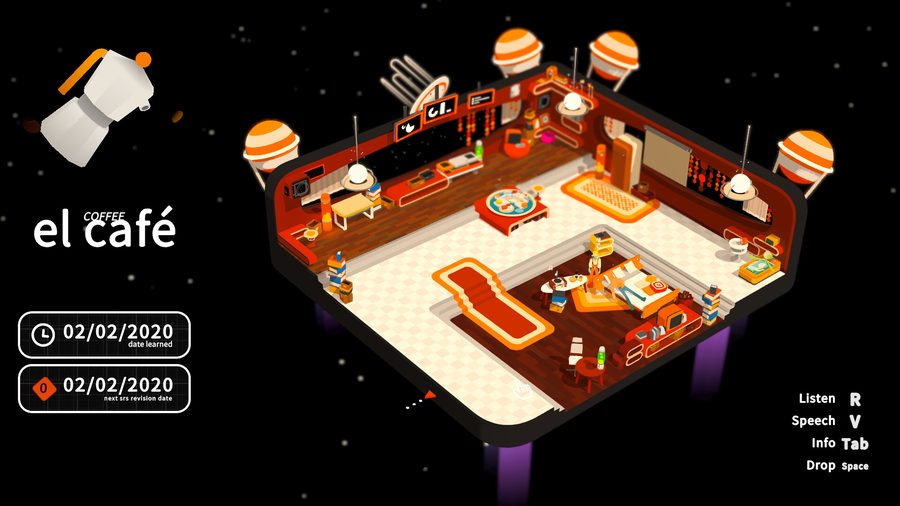
Screenshot from the Noun Town Steam store page, showing a vocabulary scene and its spaced repetition review schedule
Mostly, but with a catch worth being honest about. Clozemaster's own guidance and most independent reviews agree that it works best once you already have a foundation of common words and basic sentence structure to draw on. Guessing a missing word from context is a genuinely useful skill, but it's much harder, and much less motivating, with an almost empty vocabulary. That's the gap Noun Town is built to fill first. Learn the word in context inside the game, then a tool built for high-volume sentence drilling becomes far more useful afterward rather than being your very first exposure to the language.
Quite a few learners end up running both in sequence rather than picking one forever: Noun Town, or something like it, to build an initial vocabulary through spoken context, then Clozemaster to expand and stress-test that vocabulary against thousands of real sentences once there's actually something there to test.
Clozemaster is a well-built tool for exactly what it sets out to do, and we don't think that's up for debate. Where it falls short for a lot of learners is the starting point, being tested on a word before you've properly met it is a rough on-ramp if you're new to a language. Noun Town was built to solve that first step: introduce vocabulary somewhere real, let it stick through spaced repetition, and only then move on to harder sentence-level recall. If you're already past the beginner stage and want volume, Clozemaster is genuinely worth adding to your routine. If you're just starting out, we'd argue you want the context first.
See how words are introduced in context with the free demo on Steam.
Try Noun Town on SteamClozemaster is a vocabulary app built around fill-in-the-blank sentences pulled from a large text corpus. Noun Town is a 3D game on PC and Mac where words are learned by exploring a world and hearing them spoken in context by a native speaker. Clozemaster tests words you may not have met yet. Noun Town introduces a word before it ever asks you to recall it.
A cloze test presents a sentence with one word removed, and asks the learner to supply the missing word from context. Clozemaster runs almost entirely on this format, drawing sentences from a large multilingual corpus and turning each one into a fill-in-the-blank exercise, either as multiple choice or typed recall.
For learners who specifically want a huge volume of sentence-level practice across thousands of example sentences, not entirely. Clozemaster's strength is breadth and repetition at speed. Noun Town's strength is teaching new vocabulary in a spoken, visual context first, then reviewing it. A number of learners use a game to build the base vocabulary and something like Clozemaster afterward to drill it at volume.
Noun Town is a one-time purchase of $19.99 covering all 12 supported languages for life. Clozemaster Pro pricing has varied across reports, generally landing somewhere between $8 and $13 a month, or roughly $60 to $80 a year, with a lifetime option that has been priced as high as $199 in some regions. Noun Town's flat one-time cost is lower than a single year of Clozemaster Pro in most pricing tiers.
No. Noun Town has no adverts and no subscription of any kind. You pay once on Steam and every one of the 12 supported languages is included from that point on, with nothing held back behind a further paywall.
Not directly. Clozemaster doesn't explain grammar rules the way a textbook or a structured app does. The idea is that grammar gets absorbed implicitly by seeing correct sentence structures repeatedly across thousands of examples, which works for some learners better than for others.
No. Clozemaster runs on iOS, Android and the web, built for quick rounds of sentences anywhere. Noun Town is a PC and Mac game played through Steam, built for sitting down at a desktop or laptop rather than short mobile bursts.
Noun Town supports 12 languages: Japanese, Korean, Mandarin Chinese, Spanish (Spain and Mexico), French, German, Italian, Russian, Greek, Egyptian Arabic and English. Clozemaster covers a much larger list, with providers reporting anywhere from around 50 to over 60 languages, since its sentence-corpus approach scales more easily to less commonly taught languages than a fully voiced 3D game does.
It can be a steep start. Clozemaster works best once you already know a base of common words and basic sentence structure, since guessing a missing word from context is much harder with an empty vocabulary to draw on. Most reviews and the app's own guidance suggest pairing it with a beginner-focused resource rather than starting cold.
For a true beginner with little to no vocabulary yet, Noun Town's approach of introducing a word in context before testing it is generally the gentler starting point. Clozemaster tends to suit learners who already have some vocabulary and want high-volume sentence practice to solidify and expand it quickly.
Further reading: the cloze test Wikipedia page explains the linguistic technique Clozemaster is built around. Background on the review method used by Noun Town is on the spaced repetition page. The input hypothesis page covers the theory behind learning through comprehensible context, relevant to both approaches. The Common European Framework of Reference for Languages from the Council of Europe is a useful independent reference for what different proficiency levels actually require.
← Back to blog