LingoDeer is a subscription app built around explicit grammar teaching, particularly well regarded for Japanese, Korean and Mandarin. Noun Town is a one-time purchase game on PC and Mac where vocabulary is picked up through a 3D world rather than a lesson screen. LingoDeer's subscription runs around $95.99 a year at the standard rate. Noun Town costs $19.99 once, covers all 12 of its supported languages, and never asks for another payment.
Short answer: LingoDeer costs roughly $14.99 a month, $95.99 a year, or a discounted lifetime plan around $199.99, and covers 11 languages with strong Japanese, Korean and Chinese support. Noun Town is a single $19.99 Steam purchase covering 12 languages including Greek and Egyptian Arabic, with a free demo and no subscription. LingoDeer wins on structured grammar teaching. Noun Town wins on cost, session length and vocabulary retention through spoken context.
We built Noun Town, so we're not writing this as a neutral third party. We've also spent real time inside LingoDeer while working out what our own approach should and shouldn't borrow, particularly around Japanese and Korean, so this isn't a guess from the outside.
LingoDeer organises each language into topic-based units, and every unit is broken into two to five short micro-lessons. Before the exercises start, most units open with a "Learning Tip" screen that explains a grammar point directly: verb conjugation, particle use, sentence structure, whatever the unit needs. This is the part LingoDeer is best known for. Rather than expecting you to notice a grammar pattern through repetition, it tells you the rule up front and then gives you exercises to practise it.
Some language tracks also include a short story at the end of a unit, usually a brief captioned video with a reading comprehension section and a speaking exercise where you record yourself retelling the story. Recordings can be shared to a leaderboard for likes from other users, which adds a light social layer without going as far as a full correction community.
LingoDeer covers 11 languages: French, Italian, Vietnamese, Japanese, English, Spanish, Portuguese, Korean, Mandarin Chinese, Russian and German. It's particularly well known within Japanese and Korean learner communities, partly because the app started out focused on Asian languages before expanding into European ones. An unlimited free trial is available, though it only unlocks the alphabet lessons, the first unit of each course, level tests, flashcards and review exercises. Everything past that sits behind a subscription of $14.99 a month, $39.99 a quarter, or $95.99 a year, with a discounted lifetime plan sometimes offered around $199.99.
Noun Town skips the lesson-screen format entirely. You play a 3D open world on PC or Mac, and nouns attach themselves to the objects and characters you actually encounter, a market stall teaches food words, a shopkeeper's dialogue introduces a handful of verbs, all spoken aloud by a native speaker. Full detail on how the system fits together is on the Noun Town language learning game page.
A spaced repetition system resurfaces words right before you're likely to forget them, and built-in speech recognition lets you practise saying words aloud with feedback on pronunciation, which is closer to LingoDeer's story-recording exercise than to a flashcard app, just happening continuously rather than at the end of a unit. Grammar is not taught as a separate system. Instead it's absorbed the way a second language often is in real life, through repeated exposure to natural sentence patterns rather than an explained rule.
Noun Town covers 12 languages: Japanese, Korean, Mandarin Chinese, Spanish (Spain and Mexico), French, German, Italian, Russian, Greek, Egyptian Arabic and English. It's a single $19.99 purchase on Steam, with a free demo available before buying.
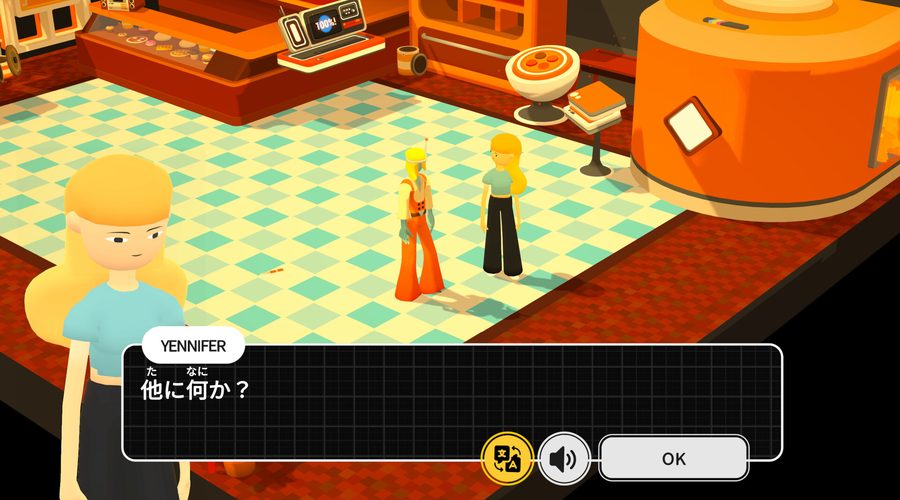
Screenshot from the Noun Town Steam store page, showing furigana-assisted Japanese dialogue in the game world
LingoDeer's reputation among Japanese and Korean learners is well earned. It explains honorifics, particles and verb conjugation directly, which is genuinely useful for scripts and grammar systems that don't map cleanly onto English. Noun Town takes a different route with Japanese specifically. It doesn't teach kanji as a dedicated system, since tools built purely for kanji study do that job better. Instead kanji gets picked up incidentally through repeated exposure, with furigana shown above kanji characters rather than the romaji the game used in earlier versions. Player feedback on romaji was mixed, some found it easier to start with, others felt it discouraged learning the actual script, so the switch to furigana was made and has been received well across the board since.
For Korean, Noun Town leans on the same spoken-context approach rather than explaining Hangul's writing rules directly. If you specifically want grammar and honorifics spelled out before you use them, LingoDeer's structured units do that more directly than Noun Town's exposure-based method.
You want grammar rules explained up front, you're targeting Japanese, Korean or Chinese specifically, or you'd rather study in short sessions on your phone during a commute.
You'd rather absorb grammar through context than memorise rules, you're on PC or Mac, and you don't want another recurring subscription added to your monthly spend.
Cost is one of the more concrete differences between the two. A single year of LingoDeer at $95.99 already costs more than four times what Noun Town charges once, total, forever. Two years in, the gap gets harder to ignore. That said, LingoDeer's lifetime plan, when it's on offer around $199.99, narrows things considerably if you know you'll stick with the app long term and specifically want its grammar-first teaching style.
There's also a session-length difference worth naming honestly. LingoDeer is designed for short, focused ten-minute-ish sessions, which suits people fitting language study around a commute or a lunch break. Noun Town tends to pull people into longer sessions without them planning to, since exploring a game world doesn't have a natural stopping point the way a finished lesson does. Neither pattern is objectively better, it depends on the shape of the time you actually have.
If grammar explanations are what's been missing from your study routine, especially for a language like Japanese or Korean where the rules genuinely don't resemble English, LingoDeer's structured approach is hard to beat and we'd say so even though we compete with it. If you've tried apps like that before and found yourself opening them less and less each week, the problem usually wasn't the grammar content, it was staying engaged long enough to use it. That's the gap we built Noun Town to fill, and it's also exactly why we didn't build our own version of LingoDeer's grammar-tip screens. We wanted to solve a different part of the problem, not recreate what already works well elsewhere.
Try the vocabulary system yourself with the free demo on Steam.
Try Noun Town on SteamLingoDeer is a mobile app that teaches grammar explicitly through structured units, each with tips, examples and short stories. Noun Town is a 3D game on PC and Mac where vocabulary is learned by exploring a world and hearing native speaker audio, with grammar picked up through repeated exposure rather than direct explanation.
Yes, LingoDeer is generally considered one of the stronger apps for Japanese and Korean specifically, since it was originally built by a team focused on Asian languages and explains scripts, particles and honorifics in more depth than most general language apps. It still relies on lesson-style screens rather than an immersive setting.
For learners who rely heavily on LingoDeer's grammar explanations and structured units, probably not on its own. Noun Town is strongest at vocabulary retention, listening and speaking practice through built-in speech recognition. LingoDeer is stronger at explicit grammar teaching, particularly for Japanese and Korean. Many learners use a game for vocabulary and a grammar-focused app alongside it.
Noun Town is a one-time purchase of $19.99 covering all 12 supported languages for life. LingoDeer's subscription runs about $14.99 a month, $39.99 a quarter, or $95.99 a year, with a discounted lifetime plan sometimes available around $199.99. Even against LingoDeer's own lifetime option, Noun Town costs roughly a tenth as much.
No. Noun Town has no adverts and no subscription of any kind. You pay once on Steam and every one of the 12 supported languages is included from that point on, with nothing held back behind a further paywall.
Yes, and this is arguably its biggest strength. Each unit opens with a short "Learning Tip" that explains a grammar point or piece of syntax before the exercises begin, which suits learners who want rules spelled out rather than absorbed gradually through context.
No. LingoDeer runs on iOS and Android, built for short sessions on a phone. Noun Town is a PC and Mac game played through Steam, designed for sitting down at a desktop or laptop rather than quick mobile study breaks.
Noun Town supports 12 languages: Japanese, Korean, Mandarin Chinese, Spanish (Spain and Mexico), French, German, Italian, Russian, Greek, Egyptian Arabic and English. LingoDeer covers 11: French, Italian, Vietnamese, Japanese, English, Spanish, Portuguese, Korean, Mandarin Chinese, Russian and German. LingoDeer has Vietnamese and Portuguese, which Noun Town does not, while Noun Town covers Greek and Egyptian Arabic, which LingoDeer does not.
It depends on what tends to stall your progress. If you want grammar rules explained clearly from the first lesson, LingoDeer's structured approach is the more traditional starting point. If you've tried grammar-first apps before and lost momentum a few weeks in, a game built around exploration may hold your attention for longer stretches.
Yes, LingoDeer offers an unlimited free trial that includes alphabet lessons, the first unit of each course, level tests, flashcards and review exercises. Everything beyond that first unit sits behind the paid subscription. Noun Town also offers a free demo on Steam before you decide to buy.
Further reading: the honorific speech in Japanese Wikipedia page explains the grammar system LingoDeer spends significant time teaching directly. Background on how vocabulary is learned through repeated exposure is covered on the spaced repetition page, and more general context on how a second language is acquired is on the language acquisition page. The U.S. Foreign Service Institute's language difficulty rankings are a useful reference for how long grammar-heavy languages like Japanese and Korean typically take to learn.
← Back to blog