Lingopie and Noun Town both promise to make language learning feel less like homework, but they get there from opposite directions. Lingopie hands you real TV shows and films with clickable dual subtitles, so you learn by watching content that already exists for its own entertainment value. Noun Town builds a 3D world from scratch, where vocabulary is attached to objects, characters and spoken dialogue you encounter while exploring. One repurposes existing media. The other is purpose-built around teaching from the ground up, and that difference shapes who gets the most out of each one.
Short answer: Lingopie teaches through authentic TV shows and movies with interactive subtitles, priced around $13.99 a month or roughly half that on an annual plan. Noun Town teaches through a 3D vocabulary game with native audio and speech recognition, priced once at $19.99 on Steam. Lingopie suits learners who already have some vocabulary and want listening immersion. Noun Town suits learners who want to build that core vocabulary first, in context, before moving on to authentic media.
Lingopie's library runs to thousands of shows and movies across its supported languages. You pick something that interests you, turn on the dual subtitle track, and click any word in either language for an instant translation and definition. Words you look up get saved and turned into flashcards automatically, and a Grammar Coach feature explains trickier phrases in context as they come up. The whole experience is built around content you'd plausibly watch anyway, just with a translation layer stitched underneath it.
Noun Town starts from the vocabulary itself rather than from existing media. You move through a 3D open world, interacting with objects and characters, and every item has a native speaker audio clip attached to it. A spaced repetition system resurfaces words right as you're likely to forget them, and real-time speech recognition checks your pronunciation when you try saying a word back. There's no show to follow or plot to keep up with, just a world built specifically to put new words in front of you in a meaningful setting.
The trade-off is roughly this: Lingopie gives you exposure to language exactly as native speakers actually use it, slang, speed and all, which is valuable but can be a steep climb if your vocabulary is still small. Linguist Stephen Krashen's input hypothesis argues that learners pick up language best from material that's just slightly above their current level, which is where authentic shows can struggle for true beginners and work brilliantly once someone has a working vocabulary already. Noun Town gives you a gentler, more structured on-ramp to that same end goal, built around words rather than scripts, which is friendlier early on but doesn't expose you to unscripted, natural speech in the same way a real show does.
Lingopie works on the web, through iOS and Android apps, and through smart TV apps, with your progress synced across all of them. That makes it easy to pick up a show on your phone during a break and finish the episode on a TV later, which is a genuinely convenient setup for anyone who already has a habit of watching shows in the evening.
Noun Town runs as a native Steam application on PC and Mac, so it's tied to a single kind of session, sitting down at a computer rather than switching between a phone and a TV. In exchange, you get the kind of interactive, hands-on engagement a show can't offer, speech recognition, exploration, and objects you can interact with directly rather than just watch.
If your evenings already involve a TV show or a streaming habit, Lingopie slots into time you're already spending. If you'd rather carve out a dedicated study session, Noun Town makes better use of that block of time, since it's built around active participation rather than passive viewing with occasional clicks.
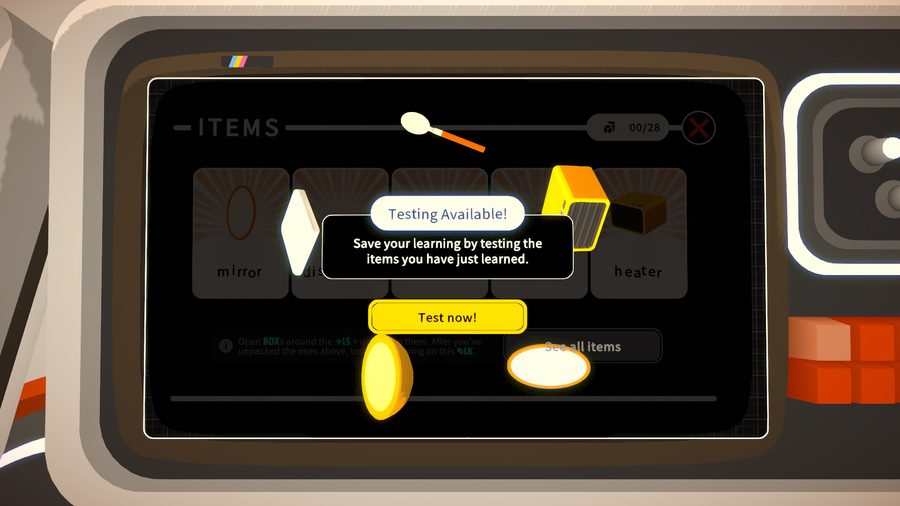
Screenshot from the Noun Town Steam store page, showing the vocabulary testing prompt
Lingopie's monthly plan runs around $13.99. An annual plan brings that down to roughly half the monthly rate, and a lifetime plan is also available for learners who want to pay once and stop thinking about billing, similar in spirit to how Noun Town is priced from the outset. There's a 7-day free trial, though it requires a payment method upfront and there's no ongoing free tier once the trial ends.
Noun Town costs $19.99 as a single purchase on Steam, with all 12 supported languages included in that price. There's no subscription, no ads, and nothing locked behind a further paywall once you own it. A free demo is available with no time limit and no payment details required, so you can try before committing anything.
On languages, Lingopie covers 9: Spanish, French, German, Italian, Russian, Portuguese, Japanese, Korean and English. Noun Town covers 12: those same core languages minus Portuguese, plus Mandarin Chinese, Greek and Egyptian Arabic, and a separate Spain/Mexico split for Spanish learners who want a specific regional accent. Portuguese learners have a clear reason to pick Lingopie here, since it's outside Noun Town's current lineup entirely.
| Feature | Noun Town | Lingopie |
|---|---|---|
| Teaching format | 3D game world, vocabulary-first Winner | Real TV shows with clickable subtitles |
| Speech recognition | Yes, real-time Winner | No |
| Authentic native content | Scripted in-game dialogue | Real shows and movies Winner |
| Platform | PC, Mac (Steam) | Web, iOS, Android, smart TV Winner |
| Language coverage | 12 languages Winner | 9 languages |
| Price | $19.99 one-time Winner | ~$13.99/month or annual/lifetime plans |
| Free trial | Free demo, no card required Winner | 7-day trial, card required |
Noun Town fits beginners and lower-intermediate learners, roughly A1 to A2 on the Common European Framework of Reference for Languages, who want to build a solid vocabulary base in context before tackling unscripted native content, and anyone who wants pronunciation feedback rather than guessing on their own. It's also the simpler financial decision, since there's one price and nothing recurring to track. The Noun Town language learning game is worth trying through its free Steam demo if that sounds like your situation.
Lingopie fits learners who already have a working vocabulary and want to level up their listening comprehension with content they'd genuinely enjoy watching regardless of the language-learning angle. It's also the stronger pick for Portuguese specifically, since Noun Town doesn't currently support that language at all.
A reasonable number of learners end up doing both in sequence rather than picking one forever: building core vocabulary with something structured first, then moving to authentic shows once enough words are recognisable that following along feels rewarding rather than frustrating.
These two aren't really chasing the same learner at the same stage. Lingopie is a strong tool once you have enough of a foundation to make watching real content productive rather than overwhelming. Noun Town is built for building that foundation in the first place, with structure, repetition and feedback a show alone can't give you.
If you're earlier in your learning journey, Noun Town's $19.99 one-time price and vocabulary-first design make it the easier starting point. If you're already past the basics and want to sound more natural, Lingopie's library of real shows is hard to beat, as long as the ongoing subscription cost fits your budget.
Want to build your vocabulary foundation first? There's a free demo on Steam.
Try Noun Town on SteamLingopie teaches through real TV shows and movies with interactive dual subtitles you can click for instant translations. Noun Town teaches through a 3D game world where vocabulary is attached to objects and characters, with native speaker audio, spaced repetition and speech recognition built in.
Lingopie's monthly plan runs around $13.99, with an annual plan priced at roughly half that per month and a lifetime option also available. Noun Town costs $19.99 as a single one-time purchase on Steam, covering all 12 supported languages with no recurring charge.
Lingopie offers a 7-day free trial that requires a payment method upfront, with no permanent free tier after that. Noun Town has a free demo on Steam that can be tried with no time limit and no payment details required before deciding to buy.
Lingopie is available on the web, as mobile apps for iOS and Android, and through smart TV apps, with progress synced across devices. Noun Town runs as a native application on PC and Mac through Steam.
Lingopie supports 9 languages, including Spanish, French, German, Italian, Russian, Portuguese, Japanese and Korean. Noun Town supports 12 languages: Japanese, Korean, Mandarin Chinese, Spanish (Spain and Mexico), French, German, Italian, Russian, Greek, Egyptian Arabic and English.
Yes, for listening comprehension and picking up natural speech patterns, watching authentic content with interactive subtitles is a well regarded immersion technique. It tends to be less effective on its own for building up a base of several hundred core vocabulary words quickly, which is where a more structured, repetition-driven approach often helps alongside it.
No. Noun Town has no adverts and nothing locked behind a paywall once you own the game. This was a deliberate decision after the team used the major mobile language apps themselves, found the ads and paywalled lesson tiers frustrating, and heard the same complaint from thousands of other learners.
Yes. Many learners pair a structured vocabulary-building tool with authentic media once they have a working base of words, since watching real shows becomes far more rewarding when you already recognise a meaningful chunk of what's being said.
Noun Town is cheaper over any period beyond about six weeks, since its $19.99 price is paid once. Lingopie's monthly plan adds up to roughly $168 across a year, and even its discounted annual plan typically costs more than four times Noun Town's one-time fee.
It works best once you already have some vocabulary and grammar foundation, since following a real TV show with limited words known can feel overwhelming even with clickable subtitles. Complete beginners often get more out of a method that introduces core vocabulary directly before moving on to authentic, unscripted content.