
Photo: Rob Bye / Wikimedia Commons (CC0)
LingQ is a reading and listening app that lets you import real content such as news articles, podcasts, and YouTube videos, then click on any word you don't know to save it for later review. Noun Town is a one time $19.99 Steam game that teaches vocabulary by attaching words directly to objects and characters inside a 3D world, spoken aloud by native speakers. The short answer: LingQ works best once you already know several hundred words in a language, since it depends on you coping with long stretches of unfamiliar text. Noun Town is built for someone starting with nothing at all.
Short answer: LingQ costs $14.99 a month, or around $10 a month if you pay for a year upfront, and covers more than 50 languages with a free tier capped at 20 saved words. Noun Town is a single $19.99 Steam purchase covering 12 languages, with a free demo and no ongoing fees. For a true beginner with no existing vocabulary, Noun Town's spatial, audio-led system is the easier place to start. LingQ becomes genuinely useful once you already have a base of 500 to 1,000 words and want more reading and listening practice.
LingQ was built around a simple idea: you learn a language fastest by reading and listening to things you're actually interested in, not by working through a fixed textbook. You import content, anything from a news article to a Netflix transcript to an audiobook, and the app highlights every word in a different colour depending on whether you know it, are learning it, or have never seen it before. Tap an unknown word and a translation pops up. Save it, and it becomes what LingQ calls a "LingQ", which then gets folded into a spaced repetition review queue alongside multiple choice, fill in the blank, and dictation exercises.
The library is large. LingQ's own figures put it at more than 50,000 lessons with transcripts across over 50 languages, and a browser extension lets you pull in almost anything else you find online. A free plan exists, but it's tightly capped: 20 saved words in total, five imported lessons, and one audio playlist. Reading and listening to the existing library is unlimited even on the free tier, but you'll hit the saving limit within your first sitting if you're actively building vocabulary. Past that, Premium runs $14.99 a month or roughly $10 a month paid annually, and Premium Plus, which adds extra AI-assisted features, runs $29.99 a month.
LingQ was created by Steve Kaufmann, a well known polyglot, and the whole system leans on a learning theory usually called comprehensible input, the idea that you acquire a language mainly by understanding messages that are slightly above your current level, rather than by memorising grammar rules in isolation.
Noun Town skips text altogether as a starting point. You play a 3D open world on PC or Mac, and nouns are taught by attaching them to the objects and characters you actually walk past. A bakery teaches bread and pastry words, a market stall teaches food vocabulary, a conversation with a shopkeeper introduces a handful of verbs, all spoken aloud by a native speaker rather than written first. The full breakdown of how the system fits together is on the Noun Town language learning game page.
A built in spaced repetition system brings words back right before you're likely to forget them, and speech recognition lets you practise saying the word aloud and get feedback on your pronunciation, rather than only recognising it when you see it. Nothing in the game is explained through grammar tables or conjugation charts. Instead, patterns get picked up gradually through repeated exposure, the way a lot of real world language learning actually works.
Noun Town covers 12 languages: Japanese, Korean, Mandarin Chinese, Spanish (Spain and Mexico), French, German, Italian, Russian, Greek, Egyptian Arabic, and English. It's a single $19.99 purchase on Steam, with a free demo available before you commit to anything. There's no advertising and nothing locked behind a second payment once you own it, a decision the team made partly because they'd found the ad breaks and paywalled lesson tiers in the big mobile apps frustrating themselves, and heard the same complaint from a lot of other learners too.
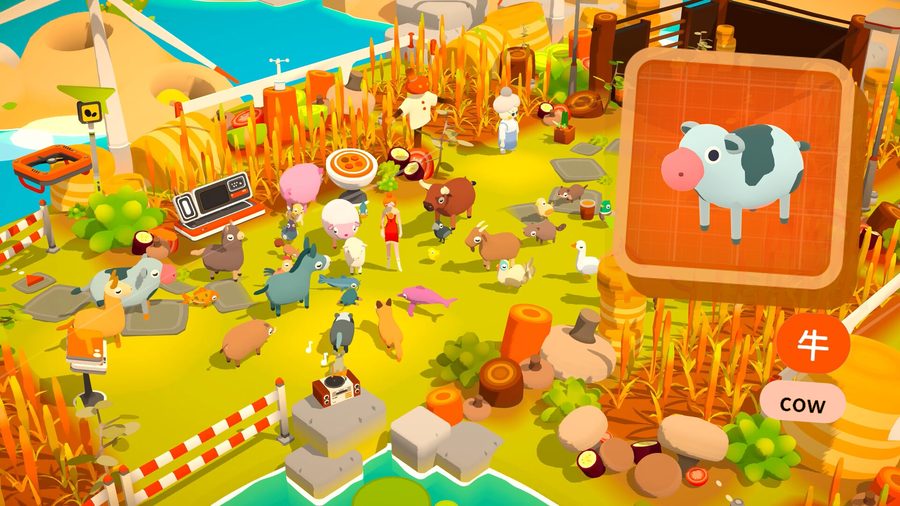
Screenshot from the Noun Town Steam store page, showing vocabulary taught through everyday objects in context
Comprehensible input works when the input is, in fact, comprehensible. That's the catch for a complete beginner on LingQ. If you open a mini-story or a news article in a language you don't know at all, you're looking at a wall of unfamiliar words with no spatial or visual anchor to hang them on, just colour coded highlighting and a dictionary pop-up. You can work through it, plenty of people do, but it takes real patience to sit with that much ambiguity before anything starts to click.
LingQ's own free tier reflects this gap a little. Capping new accounts at 20 saved words makes sense for someone who already knows the basics and is adding vocabulary from real content, but it's a strange limit for someone trying to build their very first 20 words in a language, which usually takes more than one sitting of reading real text. Most reviewers of the app agree it gets dramatically better once you're past roughly the first 500 to 1,000 words. Before that point, it tends to feel like being handed a newspaper in a language you've never studied and told to figure it out.
None of this makes LingQ a bad tool. It's one of the more respected options for intermediate and advanced learners who want more reading and listening volume. It just isn't designed to be anyone's very first lesson.
Noun Town's whole design starts from the opposite assumption, that you know nothing yet. Every word shows up attached to the thing it means, so there's no moment where you're staring at unfamiliar text with no way in. Hearing a native speaker say a word for "bakery" while standing in a virtual bakery does the same job a flashcard tries to do, just with more context built in for free.
A few things make this specifically beginner friendly:
The trade off is the one you'd expect. Once you're past the first few hundred words and want to read a real newspaper article or follow an unscripted podcast, Noun Town's curated world eventually runs out of new ground to cover, and that's exactly the point where a tool like LingQ starts to make more sense.
| Category | LingQ | Noun Town |
|---|---|---|
| Price | $14.99/month (~$10/month annually) | $19.99 one time WIN |
| Free tier | 20 saved words, 5 lessons | Full free demo WIN |
| Best for complete beginners | Not really designed for it | Built for it WIN |
| Languages | 50+ languages WIN | 12 languages |
| Real world content | Import articles, video, podcasts WIN | Curated game world only |
| Spoken audio from day one | Only on imported audio content | Every word, native speaker WIN |
| Speech practice | Not a core feature | Built in speech recognition WIN |
| Platforms | Web, iOS, Android WIN | PC, Mac (Steam) |
If you're starting a language with zero existing vocabulary, Noun Town is the easier on-ramp. You won't be staring at text you can't parse, and the spatial, audio-first format does a lot of the beginner groundwork that LingQ assumes you've already done.
If you already know some of the basics, maybe a semester of classes, a different app, or time spent living somewhere, and you want more volume of real reading and listening practice, LingQ's library and import feature genuinely shine. Pulling in a show you already love and reading along is a different kind of practice than any game can offer.
A fair number of learners end up using both at different stages: Noun Town to get the first few hundred words and some comfort with pronunciation, then LingQ once there's enough of a base to make real content worth the effort.
We'd rather be straightforward about where Noun Town fits than pretend it does everything. If your goal is eventually reading novels or following podcasts in your target language, you will outgrow any game at some point, and LingQ's approach to real content is a genuinely good next step. What we built Noun Town to solve is the part that comes before that, the problem of not knowing a single word yet, which is exactly where tools built around real world text struggle the most.
Try the vocabulary system built for absolute beginners, free on Steam.
Try Noun Town on SteamLingQ is a reading and listening app built around importing real content and clicking unknown words to save and review them. Noun Town is a 3D game on PC and Mac where vocabulary is taught by attaching words to objects and characters in a game world, with native speaker audio throughout. LingQ relies on text from day one. Noun Town does not require you to read anything to learn a word.
Not especially. LingQ works on a comprehensible input model, which depends on the material being mostly understandable already. A true beginner facing a page of unfamiliar text with no visual or spatial anchor tends to find it overwhelming. Most reviewers agree LingQ becomes genuinely useful once you already know 500 to 1,000 words.
LingQ Premium costs $14.99 a month, or about $10 a month if you pay $119.99 upfront for a year. Premium Plus, which adds extra features, costs $29.99 a month. A free tier exists but is capped at 20 saved words, five imported lessons, and one audio playlist.
Noun Town is a one time purchase of $19.99 on Steam, covering all 12 supported languages for life with no subscription. A free demo is available before you buy.
For an absolute beginner, yes, at least for the first stretch of learning. Once you've built a base vocabulary and want to read real articles, books, or watch shows with the help of click-to-translate tools, LingQ's import feature does something Noun Town's curated game world isn't designed to do.
No. There are no adverts in Noun Town and nothing is held back behind a further paywall once you've bought it. The team built it this way partly because they found ad breaks and paywalled lesson tiers in other language apps frustrating as learners themselves.
LingQ supports more than 50 languages, with a single subscription covering all of them. Noun Town supports 12: Japanese, Korean, Mandarin Chinese, Spanish (Spain and Mexico), French, German, Italian, Russian, Greek, Egyptian Arabic, and English. LingQ has far broader language coverage, but Noun Town's beginner-focused method covers several languages, like Egyptian Arabic and Greek, that most comparable apps skip.
LingQ was created by Steve Kaufmann, a Canadian polyglot known for documenting his own language learning on YouTube. The app's design reflects his view that extensive reading and listening, not grammar drilling, is the fastest route to fluency.
Yes, though it's limited. The free plan caps you at 20 saved words in total, five imported lessons, and one audio playlist, though you can read and listen to the existing library without that cap. Noun Town also offers a free demo on Steam before purchase.
Yes, and it's a reasonably common pairing. Using Noun Town to build an initial few hundred words and get comfortable with pronunciation, then moving to LingQ once there's enough vocabulary to make real articles and videos worth reading, plays to what each tool is actually good at.
Further reading: LingQ's method leans heavily on what linguist Stephen Krashen called the input hypothesis, the idea that understandable input drives acquisition more than explicit grammar study. It's closely related to extensive reading as a teaching approach. Noun Town's review system is built on spaced repetition, and the Common European Framework of Reference for Languages is a useful standard for what counts as a true beginner level in the first place.
← Back to blog