
German numbers follow one rule that catches almost every beginner off guard. Starting at 21, the units digit comes before the tens digit, joined by und, meaning and, so 21 is einundzwanzig (literally one-and-twenty) and 45 is fünfundvierzig (five-and-forty). Numbers 0 to 12 are standalone words with no pattern to lean on yet, 13 to 19 add -zehn to the base number with two small spelling changes, and the tens from 20 to 90 use a -zig or -ßig ending. Once those three patterns click, counting in German becomes mostly predictable from there on, right up into the thousands.
Short answer: 0 to 12 are standalone words (null to zwölf), 13 to 19 add -zehn (dreizehn to neunzehn), and the tens from 20 to 90 use -zig or -ßig (zwanzig, dreißig, vierzig, fünfzig, sechzig, siebzig, achtzig, neunzig). From 21 onward the units digit comes before the tens, joined by und: 21 is einundzwanzig, 45 is fünfundvierzig. 100 is hundert.
| Number | German | Pronunciation |
|---|---|---|
| 0 | null | nool |
| 1 | eins | eyens |
| 2 | zwei | tsvai |
| 3 | drei | dry |
| 4 | vier | feer |
| 5 | fünf | fewnf |
| 6 | sechs | zex |
| 7 | sieben | ZEE-ben |
| 8 | acht | ahkt |
| 9 | neun | noyn |
| 10 | zehn | tsayn |
| 11 | elf | elf |
| 12 | zwölf | tsvolf |
| 13 | dreizehn | DRY-tsayn |
| 14 | vierzehn | FEER-tsayn |
| 15 | fünfzehn | FEWNF-tsayn |
| 16 | sechzehn | ZEX-tsayn |
| 17 | siebzehn | ZEEP-tsayn |
| 18 | achtzehn | AHKT-tsayn |
| 19 | neunzehn | NOYN-tsayn |
| 20 | zwanzig | TSVAHN-tsikh |
Zero through twelve are each their own word, with no pattern connecting them yet, much like English one through twelve, so this first block simply has to be memorised directly. Eins, zwei and drei will already feel familiar to most learners, since they show up constantly in everyday phrases, but the rest, vier through zwölf, need the same direct repetition English speakers give their own first twelve numbers.
Thirteen through nineteen is where the first real pattern appears, adding -zehn, the bound form of zehn (ten), onto the base number: dreizehn (13), vierzehn (14), fünfzehn (15), achtzehn (18) and neunzehn (19) all follow this directly. Two numbers trim a letter for pronunciation: sechzehn (16) drops the s from sechs, and siebzehn (17) drops the en from sieben. Both changes exist purely to keep the word easy to say, not because the numbers themselves are irregular.
Zwanzig (20) breaks from the -zehn pattern completely and uses its own ending, -zig, which becomes the standard ending for every multiple of ten from here to ninety, with one exception covered in the next section.
| Number | German | Pronunciation |
|---|---|---|
| 21 | einundzwanzig | eyen-oont-TSVAHN-tsikh |
| 22 | zweiundzwanzig | tsvy-oont-TSVAHN-tsikh |
| 30 | dreißig | DRY-sikh |
| 40 | vierzig | FEER-tsikh |
| 45 | fünfundvierzig | fewnf-oont-FEER-tsikh |
| 50 | fünfzig | FEWNF-tsikh |
| 60 | sechzig | ZEX-tsikh |
| 70 | siebzig | ZEEP-tsikh |
| 80 | achtzig | AHKT-tsikh |
| 90 | neunzig | NOYN-tsikh |
| 100 | hundert | HOON-dert |
From 21 onward, German reverses the order English speakers expect. Einundzwanzig is built from eins, und, zwanzig: literally one-and-twenty, and the same pattern repeats all the way to 99. Funfundvierzig is five-and-forty, not forty-five, and siebenundachtzig is seven-and-eighty, not eighty-seven. The units digit always comes first, the tens digit always comes last, and und sits between them every time.
This is not actually unusual by historical standards. English used to work the same way, which is why the old nursery rhyme line four and twenty blackbirds still makes sense: that phrase is a leftover from when English itself put the smaller number first, before the order flipped sometime in the late medieval period. German simply never made that switch.
Dreißig (30) is the one irregular ten. Every other multiple of ten from 40 to 90 uses the straightforward -zig ending, vierzig, fünfzig, sechzig and so on, but thirty uses -ßig with an eszett instead, for historical spelling reasons rather than any pronunciation difference you would notice as a learner. The Wikipedia entry on German orthography covers the eszett rule behind this spelling in more depth.
100 is hundert on its own, and most speakers say it without ein in front, hundert Euro, not einhundert Euro, though einhundert is not wrong, it just sounds slightly more formal or is used to avoid ambiguity in writing.
Eins is the word used when counting out loud or stating the number on its own: eins, zwei, drei. The moment that same number sits in front of a noun, it switches to ein, eine or einen depending on the noun's gender and grammatical role, something English has no real equivalent choice to make. Ein Mann (a or one man), eine Frau (a or one woman), ein Kind (a or one child) all use the same number, just shaped differently.
This single change causes more real confusion than anything else in this guide, mostly because English numbers never do this: one book and one house use the identical word one, while German must pick ein Buch (neuter) against eine Wohnung (feminine, an apartment).
Inside compound numbers, the ein at the end stays fixed and does not change for gender. Einundzwanzig Bücher (21 books) and einundzwanzig Wohnungen (21 apartments) both keep einundzwanzig exactly as written, even though Wohnung is feminine. The gender agreement rule only applies to the number one standing completely alone, not when it is the final piece of a larger compound number.
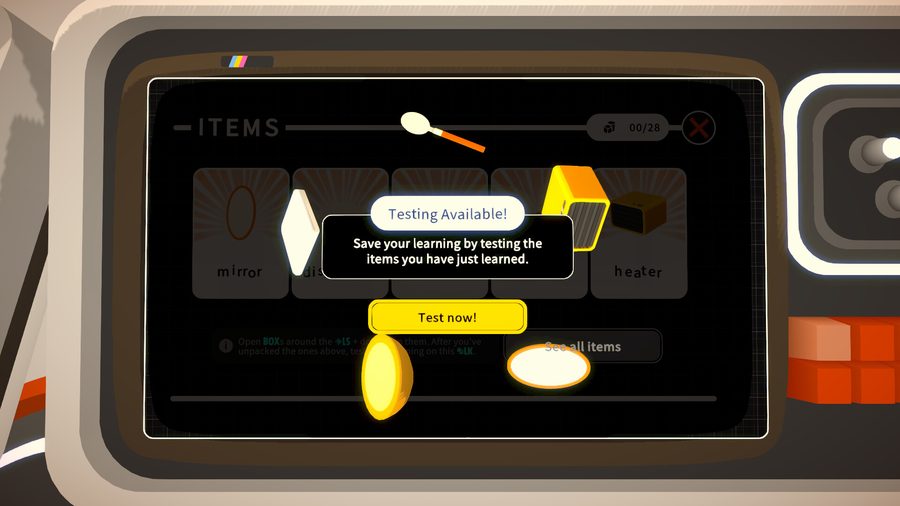
Screenshot from the Noun Town Steam store page, showing the in-game prompt to test newly learned words
Testing yourself on these numbers, rather than just rereading the tables above, is what actually makes the reversed order automatic. Noun Town prompts a quick test shortly after you learn a new word, like the screen shown above, which is exactly the kind of active recall that turns einundzwanzig from a rule you have been told into a number you no longer have to translate in your head.
Age uses the verb sein (to be), the same as English: Ich bin dreißig Jahre alt, I am thirty years old, follows a near word for word structure, unlike Spanish or French, which both build the same sentence around the verb to have instead.
Prices put the number directly before the currency: Das kostet zwanzig Euro, that costs twenty euros, with no gender shift needed since Euro does not change for ein the way a feminine noun would.
Phone numbers and other long strings of digits are usually read out two digits at a time rather than digit by digit, and zwei (two) is sometimes swapped for zwo in spoken German specifically to avoid it being misheard as drei (three) over a poor phone line, the same reason English speakers sometimes say niner instead of nine on a radio.
Treat this as three smaller blocks rather than one long list: zero through twenty first, since every later number is built from those words, then the tens from thirty to ninety, and finally the reversed order rule and the eins versus ein distinction, which apply no matter how high the number goes.
This is the kind of real-context repetition the Noun Town language learning game is built around, attaching numbers to actual 3D scenes, a price on a market stall, an age given by a character, a floor number on a building, with native speaker audio and spaced repetition bringing each one back for review automatically rather than leaving a flat list to memorise alone.
Want to learn these numbers and hundreds of other German words in context? Try the free demo on Steam.
Try Noun Town on Steam1 to 10 in German is eins, zwei, drei, vier, fünf, sechs, sieben, acht, neun, zehn. Each is its own standalone word with no connecting pattern yet, so this first set is usually memorised directly before moving on to the teens.
Elf (11) and zwölf (12) are irregular standalone words. From dreizehn (13) to neunzehn (19), each number adds -zehn to its base number, with sechzehn and siebzehn trimming a letter for easier pronunciation. Zwanzig (20) is its own word, not built from zwei.
German never shifted away from the older European word order that put the smaller number first, joined by und (and). Einundzwanzig for 21 literally reads one-and-twenty. English used to follow the same pattern, visible in the old phrase four and twenty, before switching to the current order sometime in the late medieval period.
Every other multiple of ten from 40 to 90 uses the regular -zig ending, but thirty historically took -ßig with an eszett instead. The difference is a spelling quirk from the language's history, not a pronunciation rule a learner needs to apply anywhere else.
Eins is used when counting or stating a number on its own. Ein, eine or einen is used the moment that number sits in front of a noun, and the ending changes depending on the noun's gender and grammatical role, similar to how English chooses between a and an, except German has far more forms to choose between.
100 is hundert, usually said without ein in front in everyday speech, hundert Euro, though einhundert is also correct. 1000 is tausend, following the same pattern, tausend Euro or eintausend Euro. Compound hundreds and thousands build the same way larger numbers do in English, just read as one continuous word.
Ich bin dreißig Jahre alt, I am thirty years old, uses sein (to be), the same verb English uses for age, which makes this one of the easier sentence patterns to pick up early.
Yes. Zwei (two) is sometimes replaced with zwo when reading out phone numbers or other long digit strings, purely to avoid it being confused with drei (three), especially over a poor connection. It is a spoken convenience rather than a different number.
Most learners can count confidently from 0 to 100 within a few focused sessions once the three patterns here, the -zehn teens, the -zig tens, and the reversed order from 21 onward, are explained clearly, though making the reversed order automatic in real conversation usually takes longer than recognising it on a page.
Yes, particularly for the reversed order rule and the eins versus ein distinction, since seeing ein Mann next to eine Frau in an actual scene makes the gender pattern click faster than memorising a grammar table. Repeated, spaced exposure to numbers in real contexts, prices, ages, floor numbers, reinforces both the word and when each form applies.
Further reading: the Wikipedia entry on German orthography covers the eszett rule behind dreißig in more depth. The Goethe-Institut, Germany's official cultural and language institute, runs German courses and exams worldwide. Duden is the standard reference dictionary of the German language, including the spelling rules behind numbers like dreißig. The Common European Framework of Reference for Languages, maintained by the Council of Europe, is the standard used across Europe to measure progress at each stage of learning a language like German.
← Back to blog