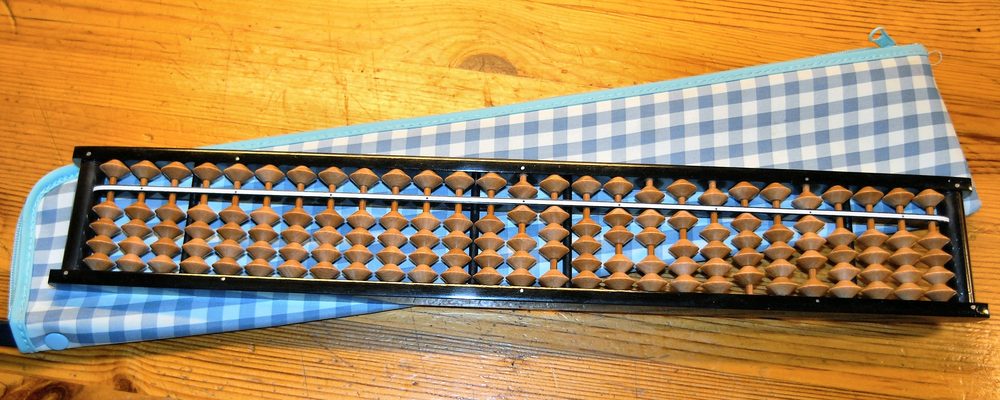
Photo: Fisle / Wikimedia Commons (CC BY-SA 3.0)
Japanese does not have one set of numbers, it has two, running side by side and doing different jobs. The native Japanese system (hitotsu, futatsu, mittsu) only stretches from one to ten, while the Sino-Japanese system (ichi, ni, san), borrowed from Chinese long ago, handles everything else, including dates, money, phone numbers and any number above ten. Once you reach 100, the word is hyaku, 1,000 is sen, and 10,000 is man. This guide covers both systems in full, explains exactly when each one is used, and walks through why numbers like four and seven get treated differently from the rest.
Short answer: Japanese uses native numbers (hitotsu, futatsu) only for informal counting from one to ten, and Sino-Japanese numbers (ichi, ni, san) for everything else, including all numbers above ten, dates, prices and phone numbers. 100 is hyaku, 1,000 is sen, and 10,000 is man.
The split exists because Japanese numbers come from two different sources. The native system is part of the language's own roots, used long before Japan adopted a writing system. The Sino-Japanese system arrived later, borrowed from Chinese numerals as Chinese characters spread into Japan centuries ago for government records, religious texts and scholarship.
Rather than one system fully replacing the other, the native system survived in a much smaller role, while Sino-Japanese became the default for almost everything involving numbers in modern Japanese. That is a genuinely different balance from a language like Korean, where both systems stay in heavy daily use side by side well past ten.
For a learner, this actually simplifies things compared to some other East Asian languages. There is really only one number system to learn properly, Sino-Japanese, with the native set being a smaller, limited addition mainly useful for counting objects informally and a handful of fixed expressions.
| Number | Japanese | Pronunciation |
|---|---|---|
| 1 | 一つ | hitotsu (hee-toh-tsoo) |
| 2 | 二つ | futatsu (foo-tah-tsoo) |
| 3 | 三つ | mittsu (meet-tsoo) |
| 4 | 四つ | yottsu (yoht-tsoo) |
| 5 | 五つ | itsutsu (ee-tsoo-tsoo) |
| 6 | 六つ | muttsu (moot-tsoo) |
| 7 | 七つ | nanatsu (nah-nah-tsoo) |
| 8 | 八つ | yattsu (yaht-tsoo) |
| 9 | 九つ | kokonotsu (koh-koh-noh-tsoo) |
| 10 | 十 | too (toh) |
These words are mostly used on their own, without a separate counter word attached, for a quick, generic way to count objects, such as picking up apples at a market or counting how many chairs are in a room. You will also hear hitori and futari, one person and two people, which are older native forms that survive specifically for counting people rather than the regular Sino-Japanese pattern.
Notice that ten breaks the pattern. Every number from one to nine ends in the counter -tsu, but ten is simply too, with no -tsu attached. That irregularity is worth memorising early, since learners often try to force a -tsu onto ten out of habit and end up with a word that is not actually used.
Beyond ten, the native system stops entirely. There is no native word for eleven or twelve, so as soon as a count passes ten, Japanese switches over to Sino-Japanese and stays there, which is a cleaner cutoff than learners sometimes expect.
| Number | Japanese | Pronunciation |
|---|---|---|
| 1 | 一 | ichi (ee-chee) |
| 2 | 二 | ni (nee) |
| 3 | 三 | san (sahn) |
| 4 | 四 | yon / shi (yohn / shee) |
| 5 | 五 | go (goh) |
| 6 | 六 | roku (roh-koo) |
| 7 | 七 | nana / shichi (nah-nah / shee-chee) |
| 8 | 八 | hachi (hah-chee) |
| 9 | 九 | kyuu (kyoo) |
| 10 | 十 | juu (joo) |
This system is far more mechanical once you have one through ten memorised. Eleven is juu-ichi, literally ten one, twelve is juu-ni, ten two, and so on up to nineteen. Twenty is ni-juu, two ten, twenty one is ni-juu-ichi, and this same building pattern carries all the way up to ninety nine without any surprises.
100 is hyaku, 1,000 is sen, and 10,000 is man. Japanese groups large numbers in units of ten thousand rather than thousands the way English does, so 100,000 is juu man, literally ten times ten thousand, not a new standalone word. That grouping continues upward, with 100 million being oku, and it is one of the more noticeable structural differences from English once numbers get large.
A few sound changes appear in the hundreds and thousands that are worth knowing rather than memorising as pure exceptions. 300 is sanbyaku, not sanhyaku, 600 is roppyaku, and 800 is happyaku. Similarly, 3,000 is sanzen, and 8,000 is hassen. These shifts happen for smoother pronunciation and follow consistent patterns once you have heard them a few times, rather than being random.
Zero itself has a few options. Rei is the formal or mathematical reading, zero is a widely used loanword from English, and maru, literally circle, shows up when reading digits aloud one at a time, such as in a phone number, similar to how English speakers sometimes say oh instead of zero.
Japanese nouns need a counter word attached to a number depending on what is being counted, and this is where numbers get genuinely tricky for English speakers, more than the number words themselves.
Telling time uses Sino-Japanese numbers for both the hour and the minute, with ji attached to the hour and fun or pun attached to the minute. Three o'clock is san-ji, and three fifteen is san-ji juugo-fun. A handful of hours are irregular, most notably four o'clock, which is yoji rather than the yonji you might expect from the pattern.
Money and dates also run on Sino-Japanese. Prices use the number directly followed by en, the word for yen, and the day of the month has its own set of irregular readings for the first ten days (tsuitachi for the 1st, futsuka for the 2nd, and so on) before settling into the regular Sino-Japanese pattern from the eleventh day onward.
Four is the clearest example of a number shaped by something other than pure grammar. Shi, one of its two readings, is a homophone of the word for death, and that overlap has led many Japanese speakers to avoid it in everyday contexts. It is common for hospitals and hotels to skip a fourth floor or room number four for exactly this reason, much like some Western buildings skip a thirteenth floor.
Yon, the other reading for four, carries none of that association and has become the default choice in ordinary speech, phone numbers and addresses. Both readings are grammatically correct Japanese, but a learner who defaults to yon will sound more natural day to day than one who defaults to shi.
Seven has a similar split, but for a more practical reason. Shichi can sound close to ichi, one, especially over a phone line or in a noisy room, so nana has become the preferred reading when clarity matters, particularly for phone numbers and spoken counting. Shichi has not disappeared, it still appears in fixed expressions and some date readings, but nana is the safer everyday default, the same way yon is for four.
The Sino-Japanese system rewards the same approach that works for most regular number systems: lock in one through ten solidly, then notice how everything above ten is simply built from those same ten building blocks rather than being new vocabulary to memorise from scratch.
This kind of context first approach is exactly what the Noun Town language learning game is built around, attaching numbers and their counters to real 3D scenes with native speaker audio, then bringing them back for review automatically through spaced repetition rather than leaving you to drill a flat list alone.
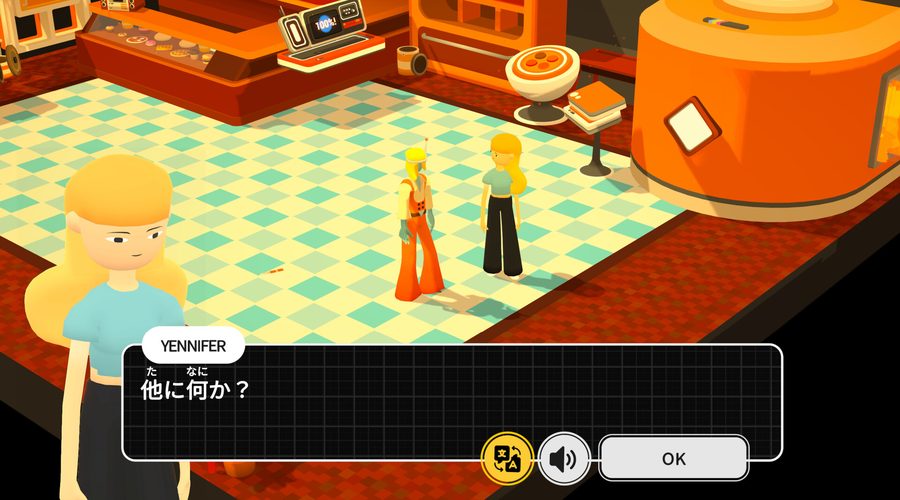
Screenshot from the Noun Town Steam store page, showing furigana-assisted Japanese dialogue
Noun Town does not teach kanji as a dedicated system on its own, since tools built specifically for that job already exist, but numbers and other kanji show up naturally throughout the game with furigana above them, the small reading guide shown above a kanji character, rather than romaji. That change came directly from player feedback, and it means you pick up the real written form of a number like hyaku over time instead of relying on a romanised stand in.
Want to learn Japanese numbers and hundreds of other words in context? Try the free demo on Steam.
Try Noun Town on SteamJapanese has a native Japanese system, with words like hitotsu, futatsu and mittsu, and a Sino-Japanese system borrowed from Chinese centuries ago, with words like ichi, ni and san. The Sino-Japanese system does almost all of the work in modern Japanese, including counting, dates, money and phone numbers, while the native system survives mainly for counting objects informally up to ten.
Using the Sino-Japanese system, which is what most learners need first, 1 to 10 is ichi, ni, san, yon, go, roku, nana, hachi, kyuu, juu. The native system also has its own set for counting objects, hitotsu, futatsu, mittsu, yottsu, itsutsu, muttsu, nanatsu, yattsu, kokonotsu, too, but it stops at ten and is not used for anything higher.
Four has two readings, shi and yon, and shi is avoided in many everyday situations because it sounds identical to the word for death. Hospitals and hotels sometimes skip the fourth floor or room number four for this reason, and yon is the reading most Japanese speakers reach for instead in ordinary speech.
Zero in Japanese is most commonly rei in formal or mathematical contexts, or the English loanword zero in everyday speech. Maru, which literally means circle, is also used when reading digits aloud one by one, such as in a phone number, similar to how English speakers sometimes say oh instead of zero.
Native Japanese numbers, hitotsu through too, only go up to 10. Once you pass ten, Japanese switches permanently to the Sino-Japanese system, so eleven is juuichi, not a native word, and everything above ten, including large numbers, dates and prices, stays in Sino-Japanese.
Japanese attaches a counter word to a number depending on the shape or category of what is being counted, such as hon for long thin objects, mai for flat objects, and nin for people. The number itself often changes slightly depending on the counter, which is one of the trickier parts of Japanese numbers for English speakers.
100 is hyaku, 1000 is sen, and 10,000 is man. Japanese groups large numbers in units of ten thousand rather than thousands, so 100,000 is juu man, ten times ten thousand, rather than a new standalone word, and this grouping continues all the way up to oku for 100 million.
Both the hour and the minute use Sino-Japanese numbers, with ji attached for the hour and fun or pun attached for the minute. Three o'clock is san-ji, and three fifteen is san-ji juugo-fun. A couple of hours have irregular readings, most notably four o'clock, which is yoji rather than the expected yonji.
Shichi can sound similar to ichi, one, when spoken quickly, which causes real confusion over the phone or in noisy settings. Nana avoids that overlap entirely, so it has become the preferred reading for phone numbers and spoken counting, while shichi still appears in fixed expressions and some dates.
Yes, particularly because Japanese numbers depend so heavily on context, which counter is attached, whether it is a date or a price, which a flat list cannot teach well. A game can attach each number to the actual scene it belongs to, reinforcing both the reading and the situation it is used in together.
Further reading: Japanese numerals on Wikipedia covers the full native and Sino-Japanese systems in more depth. The Wikipedia entry on Japanese counter words explains how counters attach to numbers beyond the examples here. The Japan Foundation is Japan's official body for promoting Japanese language and culture internationally, and the Wikipedia article on tetraphobia covers the wider cultural avoidance of the number four across East Asia.
← Back to blog