
Photo: Samson Ssemakadde / Wikimedia Commons (CC0)
A Steam achievement is a small badge a game awards you for reaching a specific milestone, such as finishing a level, trying a particular feature, or hitting a progress goal the developer built in. They cost nothing, unlock no extra content on their own, and exist purely to mark and show off progress. Steam displays them on the game's store page, showing what percentage of players have earned each one, and on your own profile, where friends can see what you have completed. Not every Steam game has them, since developers choose whether to add achievements through Steam's own toolkit, but most modern releases do.
Short answer: Steam achievements are optional in-game badges unlocked by hitting specific milestones. They are free, show up on your profile and the game's store page with a percentage showing how many players earned each one, and they exist to track and showcase progress, not to unlock extra content.
A Steam achievement is a small badge, usually with its own icon and a short description, that a game unlocks when you reach a specific milestone the developer decided was worth marking (see Wikipedia's overview of video game achievements for how the concept spread across platforms). That might be finishing the game's story, trying out a feature for the first time, or clearing some numeric target like playing for a set number of hours or collecting a set number of items.
Achievements are not a Steam wide feature that every game gets automatically. They come from Steamworks, the toolkit Valve gives developers to build their games for the platform, and adding achievements is entirely the developer's choice. Some games ship with dozens, others have none at all.
They do not cost anything to unlock and, on their own, do not hand you anything extra inside the game, no bonus levels, no in-game currency, no secret characters. The reward is the badge itself, plus whatever record of it Steam keeps on your profile.
Each achievement is tied to a specific trigger the developer coded into the game, so unlocking one happens automatically the moment you meet the condition, usually with a small pop-up notification in the corner of your screen.
None of this requires any setup from the player. If a game has achievements, they are simply there, tracking in the background, whether or not you ever look at the list.
For a lot of players, achievements turn a game into two games at once, the one the developer designed, and a side quest of chasing every badge it offers. Some communities even call this "achievement hunting," and dedicated players will specifically pick up games known for having a straightforward, fully completable achievement list. The practice falls under what researchers call gamification, applying game style reward structures to tasks that were not originally games at all.
Part of the appeal is simply visible progress. A percentage ticking upward is a concrete, external signal that effort is paying off, which is a large part of what makes any progress system satisfying, from a gym app's streak counter to a language app's level badges.
The low percentages shown next to harder achievements add a competitive element too. If only a small fraction of players have finished a game's toughest achievement, unlocking it says something about your own commitment to the game that playtime alone does not capture.
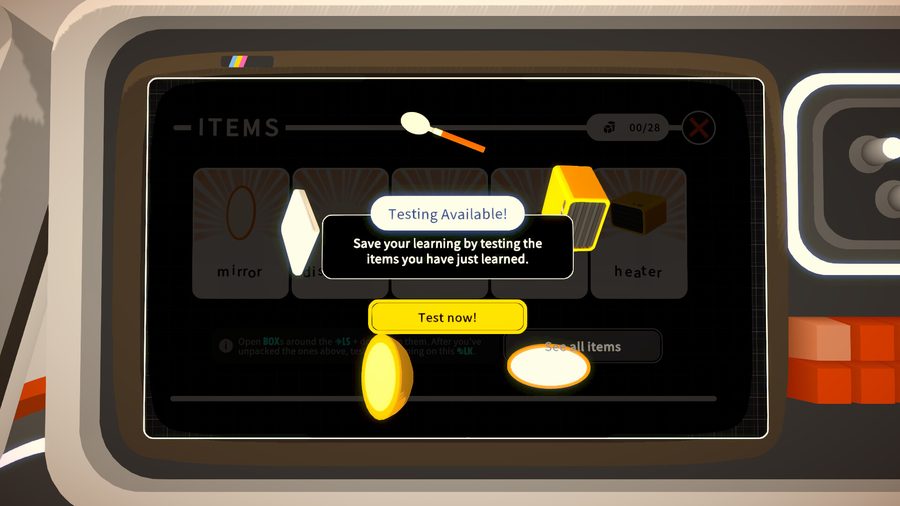
A screenshot from the Noun Town Steam page, showing the prompt to test what you've just learned
Research on motivation backs up at least part of why this works. People are more likely to stick with a difficult or repetitive task when progress toward it is visible and broken into smaller milestones, rather than left as one distant, undefined goal. A 2014 review in the journal American Psychologist on the cognitive and motivational benefits of video games (Granic, Lobel & Engels, 2014) found that structured progress systems, achievements among them, support the same sense of competence and mastery that self-determination theory identifies as central to intrinsic motivation.
That is a big part of the thinking behind building achievements into a language learning game like Noun Town, rather than only a conventional app. Learning several hundred words in a new language is a long, often invisible process, where it is easy to feel like nothing is sticking. Achievements tied to real learning milestones, a first completed review streak, a first batch of words retained, give that progress a shape you can actually see.
They are not a substitute for the learning itself, and nobody retains vocabulary purely because a badge popped up. What they do is make slow, cumulative progress feel less abstract, which is often the exact thing that keeps someone showing up for lesson twenty instead of stopping after lesson three.
Steam profiles track several different progress and collection systems, and it is easy to mix them up.
Of the three, achievements are the only one that actually reflects what you did inside the game rather than just how long you left it open.
The small pop-up that appears when you unlock an achievement is controlled through Steam's in-game settings, not the game itself. Open Steam, go to Settings, then In-Game, and look for the notification position and display options.
Turning the pop-up off does not turn achievements off. They keep unlocking and recording in the background exactly as before. The only thing that changes is whether a notification appears in the corner of the screen while you play.
Most players leave this on, since a quick, unobtrusive pop-up is part of what makes the moment of hitting a milestone feel immediate, but it is a genuinely personal preference, and it is good to know it can be changed if the interruptions do not suit you.
Want to see what there is to unlock for yourself?
Try Noun Town on SteamSteam achievements are small in-game badges, each with its own icon and description, unlocked when you meet a milestone the game's developer built in, like finishing a level or hitting a progress target.
No. Achievements come from Steamworks, Valve's developer toolkit, and adding them is optional. Some games have dozens, some have none.
No, they are entirely free and do not unlock bonus content on their own. The reward is the badge and the record of it on your profile.
Yes, your achievements show on your Steam profile, and your overall completion percentage for a game is visible there too, depending on your profile's privacy setting.
Achievements are milestone badges tied to specific actions. Trading cards are a separate collectible earned just by playing a game for a while, with no skill or progress requirement.
Achievement hunting gives players a visible, measurable extra goal beyond finishing the game itself, and lower unlock percentages on harder achievements add a competitive element.
Yes, like many Steam games, Noun Town includes achievements tied to real progress through the game, giving learning milestones a visible marker rather than leaving progress invisible.
Research on motivation suggests visible, broken down progress markers help people stick with long or repetitive tasks, though achievements support the habit rather than replacing the underlying effort.
Yes, under Steam's Settings, then In-Game, you can change or disable the pop-up. Achievements keep unlocking in the background either way.
No, playtime is just a running total of hours in a game with no unlock conditions, while achievements specifically reflect actions and milestones you completed.