
Steam runs four major seasonal sales a year, roughly in spring, summer, autumn, and winter, each lasting one to two weeks and discounting a large share of its catalogue, educational games included. Beyond those, smaller daily deals and individual publisher sales run constantly in between, so there's rarely a long stretch with nothing discounted at all. The most reliable way to actually catch a price drop on a specific title, rather than stumbling onto one by chance, is Steam's wishlist feature, which emails you automatically the moment a wishlisted game's price changes.
Short answer: Steam's four seasonal sales (Spring, Summer, Autumn, Winter) are the biggest and most predictable windows for discounts, with the Winter Sale in late December typically the largest. Discounts commonly range from 10 to 30 percent, sometimes deeper. Wishlisting a game is the simplest way to get notified the moment its price actually drops.
Steam's storefront runs on a predictable rhythm built around a handful of major seasonal events, supplemented by a constant churn of smaller promotions. The seasonal sales apply storewide, meaning thousands of titles across every genre get discounted at once, often alongside Steam-specific extras like trading cards, community events, or mini in-store games. Individual publishers and developers also run their own sales outside this calendar, sometimes to mark an anniversary, a new release, or simply a slow sales period.
None of this is centrally announced months in advance with fixed dates. Valve, the company behind Steam, typically confirms exact start and end dates only shortly before each sale begins, though the approximate season has stayed consistent for years.
These are the big, predictable windows, and they're the ones worth planning around if you're patient enough to wait for one.
Runs in March. Generally the smallest of the four in terms of discount depth, but still covers a wide slice of the catalogue.
Runs from late June into early July. One of the two biggest events of the year, often paired with community activities and broad participation from publishers.
Runs around November, often overlapping with the broader retail Black Friday period. Timing is the least fixed of the four and can shift from year to year.
Runs from roughly mid-December into early January. Usually the single biggest sale of the year, both in the number of discounted titles and typical discount depth, timed to catch holiday gift buying.
The four seasonal events aren't the only chances to save, and for a specific title they're sometimes not even the best one.
For a specific educational or language learning title, a publisher-specific sale can sometimes beat the discount offered during a general seasonal event, so it's worth checking both rather than assuming the big seasonal sales are always deepest.
Discount depth is set entirely by the publisher, not Steam itself, so there's no single universal number. That said, some patterns hold fairly consistently across the video game industry's pricing habits on digital storefronts.
Noun Town is priced at $19.99 as a one-time purchase, with no subscription and no paywalled lesson tiers to unlock separately. That pricing choice was deliberate: the team behind it had used the major mobile language apps themselves, found the ads and locked-away lesson tiers frustrating, and heard the same complaint from thousands of other learners before building Noun Town as a straightforward, single purchase instead.
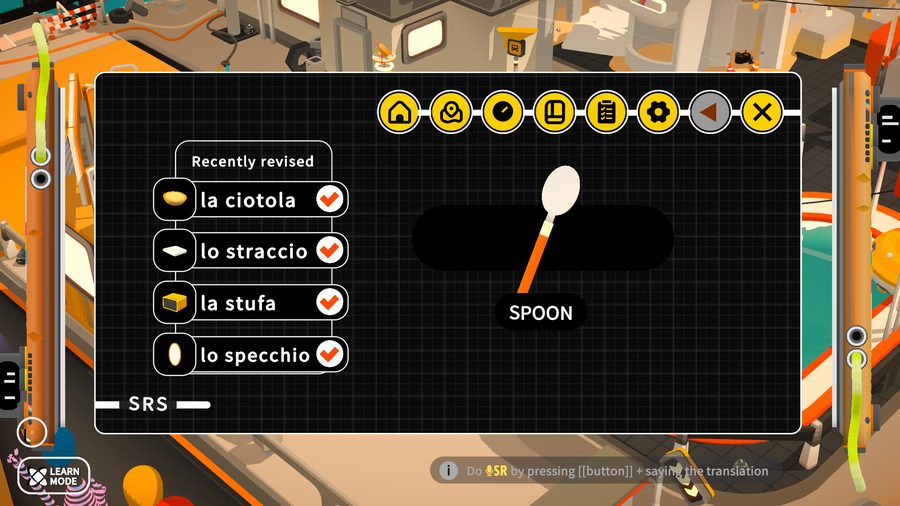
A screenshot from the Noun Town Steam page, showing the spaced repetition review screen
Manually checking a game's store page every week is a slow way to catch a price drop. Steam's wishlist feature exists specifically to solve this.
This is the single most effective habit for anyone trying to time a purchase around a sale rather than buying at full price out of impatience, or missing a discount entirely because they forgot to check during the right week.
Waiting for a discount makes sense when the purchase isn't urgent and the savings are meaningful, but it isn't a rule that applies evenly to every situation. Buying at full price can genuinely be the better choice when a game will see real use starting now, since the value of actually using something for an extra two or three months can outweigh a 20 percent discount, especially for a tool rather than a one-off entertainment purchase.
A language learning game is a reasonable example of this trade-off. Months spent waiting for a sale are months not spent building a vocabulary habit, and a free demo exists precisely so you can confirm a game is worth buying now rather than guessing. If budget is the only real constraint, wishlisting and waiting is the lower-risk option. If the constraint is just habit or hesitation, a free demo is usually a better next step than a calendar reminder.
Want to try before deciding whether to wait for a sale?
Try Noun Town on SteamSteam runs four major seasonal sales a year: a Spring Sale in March, a Summer Sale around late June to early July, an Autumn Sale around November, and a Winter Sale from mid-December into early January. Exact dates shift slightly year to year.
Four seasonal sales (Spring, Summer, Autumn, Winter), plus smaller recurring events like daily deals, flash sales, and individual publisher or franchise sales that run throughout the year.
It varies by publisher and title. Many games discount somewhere between 10 and 30 percent during a seasonal sale, while older titles or publisher-specific promotions can go much deeper, sometimes 50 to 75 percent.
Noun Town is priced at $19.99 as a one-time purchase with no subscription, and like most Steam titles it can appear in seasonal sales. Wishlisting it on Steam is the most reliable way to get notified if and when that happens.
Add the game to your Steam wishlist. Steam emails wishlist owners automatically when a wishlisted game's price drops, so you don't have to remember to check manually.
Yes. Daily deals are shorter, rotating discounts on a smaller number of titles that change every 24 to 48 hours, separate from the larger seasonal sales that run across the whole storefront for one to two weeks.
Sometimes. If you already know you want it and will use it now, waiting purely to save money can mean weeks or months without something you'd have gotten value from immediately. It's a genuine trade-off, not a simple rule.
Steam doesn't automatically refund the price difference, but its standard refund policy allows a refund within 14 days of purchase and under 2 hours of playtime for almost any reason, which can cover this situation if you act quickly.
Yes. A free demo lets you confirm a game is actually right for you before spending anything, so you're not just waiting for a discount on something you haven't tested.
Check Steam's own storefront or a wishlist notification for exact current dates, since they shift slightly each year. The reliable pattern is four seasonal windows spread roughly three months apart.