Photo: Astaroth (Wikimedia Commons user) / Wikimedia Commons (CC BY-SA 2.0)
Short answer: Steam has a growing but still small category of games actually built to teach a language, ranging from tiny single-language flashcard titles under $5 to full 3D experiences like Noun Town that cover 12 languages for $19.99. The best fit depends on how many languages you want, whether you want speech recognition, and how much game you actually want around the learning.
Type "language learning games PC" into Steam's search bar and you'll get a mixed bag: a few serious, well-built titles, a handful of small passion projects covering one language each, and some flashcard apps wearing a game skin. This list is an attempt to separate those categories honestly, including where our own game sits in the mix, since we obviously make one of these.
Before ranking anything, it's worth being specific about what separates a genuinely useful language learning game from a lesson app with a coat of paint on it.
With that in mind, here's how the current field on Steam breaks down.
The most complete option currently on Steam if you want breadth of languages in one purchase. Twelve languages, a full 3D open world split across eleven areas including a café, farm and food store, sixteen voiced NPCs, and speech recognition for actual conversation practice. Vocabulary is tied to spaced repetition so words resurface right before you'd naturally forget them, and there are 33 Steam achievements to work through. One-time purchase, $19.99, no ads, no subscription, and a free demo if you want to try before buying.
Best for: learners who want one game covering multiple languages, from complete beginner up through solid everyday vocabulary.
A 3D vocabulary game where you pick up and examine everyday household objects to learn their names, with over 400 nouns, adjectives and verbs available across 23 languages and native pronunciations for each. It's one of the broadest language selections on Steam, though the scope stays close to core vocabulary rather than full conversation practice.
Best for: learners who want to sample vocabulary in a wide range of languages, including less commonly taught ones, in short sessions.
A story-driven game built around the premise of being lost in a city where you don't speak the language, covering Chinese, French, German, Japanese, Russian, Spanish and more. The narrative framing gives vocabulary some situational context, closer to how you'd actually need it while travelling.
Best for: learners who like a light story hook alongside vocabulary practice, across a solid spread of languages.
A free title where you play an alien exploring Earth, learning one of 28 different languages through more than 1,000 words and 50-plus sentences. The huge language count and no-cost entry make it an easy way to test whether the game-based format suits you before spending anything on a paid title.
Best for: trying the game-based learning format for free, or picking up a language that smaller paid titles don't cover.
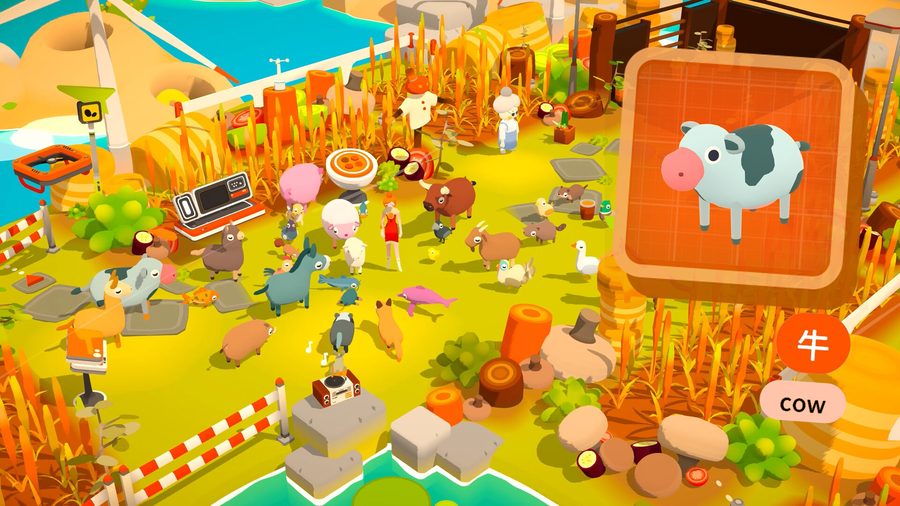
Screenshot from the Noun Town Steam store page, showing the farm area
This is probably the biggest fork in the road when picking between these titles. A handful of smaller games on Steam are built around a single language, and that narrow focus can be a genuine advantage, since everything in the game is tuned toward one language's specific quirks, whether that's tone, gendered nouns, or a particular writing system.
But most of the strongest options in this category, including our own language learning game, take the multi-language route. Noun Town covers 12 languages in one purchase, Influent stretches to 23, and Earthlingo goes as far as 28, all built on one game system rather than a separate title per language. That approach suits people who haven't settled on a language yet, or who want to try several before committing seriously to one. Neither approach is objectively better, it depends whether you already know exactly which language you're committing to.
Steam's language learning games don't follow one pricing model, but a few patterns show up repeatedly. Small single-mechanic titles, like script-focused flashcard games, tend to sit under $5. Mid-sized single-language games with more content and voice acting land in the $15 to $25 range. Almost none use a recurring subscription, which is arguably the single biggest structural difference between this whole category and mobile language apps.
That one-time pricing model was actually one of the deciding factors for us building Noun Town this way in the first place. We'd used subscription language apps ourselves, hit paywalls mid-lesson, sat through ads we didn't ask for, and heard the identical complaint from thousands of other learners when we started asking around. So the game charges once, at $19.99, and everything is included from day one, all 12 languages, no locked tiers, no ads breaking up a session.
It would be misleading to present any of these, ours included, as a total substitute for structured language study. Games are consistently strong at vocabulary acquisition, listening comprehension and pronunciation practice through speech recognition. They are consistently weaker at explaining grammar explicitly, the kind of rule-based instruction a textbook or a tutor delivers directly.
Organisations like the Council of Europe's CEFR framework break language proficiency into stages that include grammatical accuracy as a core component, not just vocabulary size. A game can get you a long way toward conversational comfort, but reaching the higher CEFR bands typically still involves some structured grammar study alongside it.
A few honest questions to ask yourself before buying any of these.
We think Noun Town is currently the strongest all-around option if you want a full 3D world, native speaker audio, spaced repetition and speech recognition all built around multiple languages in a single purchase. Influent and Earthlingo are worth a look if you want an even wider spread of languages and don't mind a lighter, more vocabulary-focused format, and Lingotopia is a solid pick if you want some story context wrapped around the words. There's no single right answer here, it comes down to how many languages you want and how much game you want around the learning.
Curious where Noun Town fits into your own list? Try the free demo on Steam.
Try Noun Town on SteamIt depends on your goals, but Noun Town is one of the most complete options currently on Steam, covering 12 languages with a full 3D world, native speaker audio, spaced repetition and speech recognition, all for a single one-time purchase.
Most full language learning games on Steam are paid, usually a one-time purchase in the $5 to $25 range, though many including Noun Town offer a free demo so you can try before buying.
Well-designed ones do, particularly for vocabulary and listening. Games that present words in context and repeat them at spaced intervals tend to produce better retention than passive study, and the engagement factor of a real game keeps people practising for longer than most apps manage.
Native speaker audio rather than synthetic voices, a spaced repetition system rather than one-off word presentation, a genuine game world rather than lessons dressed up visually, and clarity on pricing, whether it is one-time, subscription, or has ads.
Some do. Noun Town covers 12 languages within a single purchase, including Japanese, Korean, Mandarin, French, German, Italian, Spanish (Spain and Mexico), Russian, Greek and Egyptian Arabic. Many smaller language games on Steam focus on just one language.
Yes, most are designed with beginners in mind, teaching core everyday vocabulary through simple, repeated exposure. Experienced learners often get more value using the same games as a revision tool rather than as their primary source of new material.
Not entirely. Games are strong at vocabulary, listening and pronunciation practice through speech recognition, but weaker at explaining grammar rules explicitly, which is where a class, tutor or structured course still tends to add the most value.
Prices vary widely, from under $5 for small single-language titles to around $20 to $25 for more complete games with multiple languages, full voice acting and speech recognition. Almost none use a recurring subscription, which is one of their main advantages over app alternatives.
No. Noun Town is a one-time $19.99 purchase with no subscription and no ads at any point. This was a deliberate decision by the team after finding freemium and ad-supported mobile apps frustrating themselves, and hearing the same complaint from thousands of other learners.