
Photo: Levi Loot / Wikimedia Commons (CC BY-SA 4.0)
Short answer: Gaming cannot fully replace a language app for everyone, but it can for a specific group of learners: people whose real problem is staying engaged, not the method itself. Games tend to beat apps on vocabulary retention and time spent learning voluntarily, while apps still hold an edge on structured grammar and language breadth. Most people get the best results from combining the two rather than picking one exclusively.
Gaming as a replacement for a language app is a question I get asked a lot, given that I work on one. So it is worth being upfront: the honest answer is "sometimes, and it depends what you were actually struggling with in the first place."
A language app and a language game are not solving the same problem in the same way, even though they can end up teaching similar vocabulary. Understanding what each one is actually good at is more useful than picking a side.
Before answering, it helps to be specific about what replacing an app actually requires. It is not just "does the game teach words." Most reasonably designed language games teach vocabulary just fine. The real question is whether a game can also cover grammar explanation, review scheduling, pronunciation feedback and language breadth well enough that you would never need to open an app again.
Broken down that way, the answer becomes clearer: games can replace apps for some of those jobs and not others.
Vocabulary retention is the area with the clearest evidence in favour of games. Research into digital game-based learning consistently finds that words encountered in a meaningful, repeated context are retained better than the same words seen as isolated flashcards. A word tied to an object, a spoken sentence and an action you took to interact with it involves more of your memory than a word matched to a translation on a card.
Time spent is the other big factor. Nobody accidentally spends three hours doing app flashcards, but people regularly lose an evening to a game they enjoy. If that game happens to be teaching vocabulary the entire time, that is hours of exposure most apps never get from the same person, simply because apps are not designed to be played for their own sake.
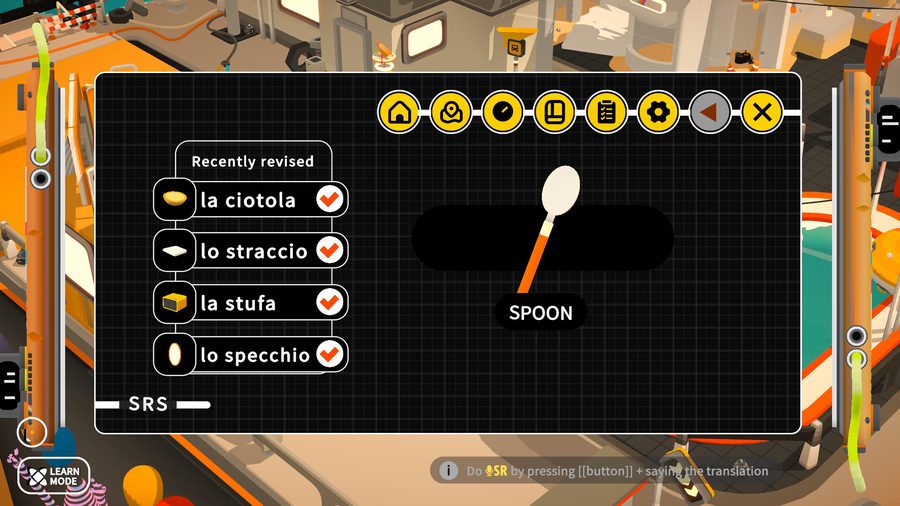
Screenshot from the Noun Town Steam store page, showing an in-game SRS vocabulary review
Games can also use the exact same scheduling technique apps rely on. Spaced repetition, the method of resurfacing a word right before you are likely to forget it, works whether it is presented as a flashcard deck or woven into gameplay. Noun Town runs an SRS system in the background as you explore, so reviews happen inside the game rather than as a separate task.
Grammar is the clearest gap. Apps can explain a rule directly, then build a set of exercises specifically to drill that rule. Most games, including well-designed ones, rely on players absorbing grammatical patterns through repeated exposure rather than being told the rule outright. That works, but it works more slowly for someone who wants to understand exactly why a sentence is structured a certain way.
One thing worth naming directly: we built Noun Town specifically because we, and thousands of people we spoke to, got frustrated with ads and paywalled lesson tiers in the major mobile apps. That is why it is a single 19.99 dollar purchase with no ads and nothing locked away afterwards. It does not mean the game replaces every function of an app for every learner, but it does mean you are not being nickel and dimed while you find out whether it works for you, since there is also a free demo on Steam.
The learners who report the fastest progress are rarely purists about method. A common pattern is a game for longer, more immersive sessions where vocabulary and listening get most of the attention, paired with a lighter app, flashcard tool, or grammar reference for quick daily maintenance and rule explanation. Neither format currently solves vocabulary, grammar and speaking practice equally well on its own, so combining strengths tends to beat picking a single tool and sticking rigidly to it.
If you are trying to decide whether to drop an app entirely, a reasonable test is to try a game as your primary tool for a month and see whether you keep opening it voluntarily. If you do, and grammar gaps start showing up, that is usually the point to add a lighter grammar resource back in rather than a full second subscription app.
Curious whether a game can hold your attention better than an app has? Try the free demo on Steam.
Try Noun Town on SteamFor most learners, not entirely. Games tend to be strong at vocabulary retention, listening and keeping people engaged over long sessions. Apps tend to be stronger at structured grammar instruction and quick daily reviews. Many learners who use a game as their main tool still lean on an app or reference book for grammar.
Games are generally better at vocabulary retention because words are learned in a spatial, contextual setting rather than as isolated flashcards. They also tend to produce longer, more voluntary study sessions, since people play games for their own sake rather than to complete a task.
Apps are stronger at explicit grammar instruction, since they can present a rule directly and build exercises around it step by step. They also tend to support far more languages, and many offer very short two to five minute sessions that fit into small gaps in the day.
Good ones do. Spaced repetition is a scheduling method that resurfaces vocabulary right before you are likely to forget it, and it works the same way whether it is presented inside a game world or a flashcard app. Noun Town uses spaced repetition to schedule word reviews as you explore.
Often yes, over time. A one-time purchase game like Noun Town costs 19.99 dollars and includes everything with no further payments. Subscription apps typically cost 70 to 150 dollars a year, so the gap widens the longer you use either product.
Apps are often treated as a chore to complete, which makes them easy to abandon once motivation dips. Games are played because they are enjoyable in themselves, so the language learning continues as a side effect of something people wanted to do anyway, which tends to sustain engagement longer.
Either can work. If someone has abandoned multiple apps in the past, a game is worth trying first, since sticking with it long enough to make progress is usually the bigger obstacle for beginners than the specific method used. If someone prefers a clear curriculum with checkboxes, an app may suit them better initially.
No. Noun Town has no adverts and nothing locked behind a further paywall once purchased. This was a deliberate decision after the team used major mobile language apps themselves, found the ads and paywalled tiers frustrating, and heard the same complaint from thousands of other learners.
Some language games include speech recognition features that let you practice pronunciation directly, which apps also offer in varying forms. Neither fully replaces speaking with another person, so learners aiming for conversational fluency typically still add a tutor or language exchange partner at some point.
A game can realistically replace an app for someone whose main obstacle is staying engaged long enough to make progress, since games tend to win on retention and voluntary time spent. It is less likely to fully replace an app for someone who specifically needs structured grammar teaching or a language outside what games typically cover.