Photo: Chabe01 / Wikimedia Commons (CC BY-SA 4.0)
The days of the week in Spanish are lunes (Monday), martes (Tuesday), miercoles (Wednesday), jueves (Thursday), viernes (Friday), sabado (Saturday) and domingo (Sunday). The Spanish week starts on Monday rather than Sunday, and none of the day names are capitalized unless they open a sentence, which trips up a lot of English speakers early on. Five of the seven names trace back to the Roman gods the days were originally named after, and the other two come from a completely different source, which is where things get interesting.
Short answer: Spanish has seven days of the week: lunes, martes, miercoles, jueves, viernes, sabado, domingo. Unlike English, none of them are capitalized in normal writing. Five come from the names of Roman gods (lunes from the Moon, martes from Mars, miercoles from Mercury, jueves from Jupiter, viernes from Venus), while sabado and domingo come from Hebrew and Latin religious terms instead.
Here they are in order, starting with Monday, along with a rough pronunciation guide. Spanish pronunciation is fairly consistent once you know the rules, so these should get most learners close enough to be understood.
| Spanish | Rough pronunciation | English |
|---|---|---|
| lunes | LOO-nes | Monday |
| martes | MAR-tes | Tuesday |
| miercoles | mee-AIR-coh-les | Wednesday |
| jueves | HWEH-ves | Thursday |
| viernes | vee-AIR-nes | Friday |
| sabado | SAH-bah-doh | Saturday |
| domingo | doh-MEEN-goh | Sunday |
Notice the week starts with lunes, not domingo. Most Spanish-speaking countries follow the Monday-first convention used across Europe and set out in the international ISO 8601 standard, rather than the Sunday-first layout still common on calendars in the United States. If you've ever looked at a Spanish calendar and felt like the weekend was in the wrong place, that's why.
One more detail worth knowing early: all seven days are grammatically masculine, so they always pair with el or los rather than la or las. That matters for the grammar patterns covered further down, and it holds true even for a word like miercoles that doesn't obviously sound masculine or feminine either way.
The Spanish week, like most of the Romance-language week, descends from the Roman planetary week, where each day was named after one of the seven classical celestial bodies visible to the naked eye: the Moon, Mars, Mercury, Jupiter, Venus, Saturn and the Sun. Latin called these dies Lunae, dies Martis, dies Mercurii, dies Iovis, dies Veneris, dies Saturni and dies Solis.
Five Spanish day names kept that pattern almost unchanged: lunes from Luna (the Moon), martes from Marte (Mars), miercoles from Mercurio (Mercury), jueves from Jupiter, and viernes from Venus. If that looks familiar, it's the same underlying system English uses, just with different substitutions. English swapped in Norse and Germanic gods instead of Roman ones for most weekdays: Tuesday from Tiw, Wednesday from Woden, Thursday from Thor and Friday from Frigg, while keeping Saturday, Sunday and Monday closer to their Roman roots.
The two Spanish outliers are sabado and domingo. Sabado, per the Real Academia Espanola, comes from the Latin sabbatum, itself borrowed from the Hebrew Shabbat, so it kept a religious name rather than the Roman dies Saturni. Domingo comes from the Latin dies Dominicus, meaning the Lord's day, which replaced dies Solis (the day of the Sun) under Christian influence. Portuguese followed the same pattern for both days, which is one of the clearer signs of how closely the two languages developed alongside each other.
The single most common mistake English speakers make with Spanish days of the week is capitalizing them out of habit. In Spanish, lunes, martes and the rest are written entirely in lowercase in the middle of a sentence, and they're only capitalized when a day name happens to be the very first word of a sentence, exactly the way any other lowercase noun would be.
The definite article does a lot of work that English handles with separate words. El lunes refers to one specific Monday, roughly equivalent to saying "on Monday." Los lunes, using the plural article, means Mondays in general or every Monday, describing something recurring rather than a single occasion. That distinction between el and los is the main grammatical thing to get comfortable with (if noun gender in general still feels shaky, our separate guide on Spanish noun gender covers it in more depth).
In print, Spanish calendars often abbreviate the days as L, M, X, J, V, S, D. The X for miercoles looks odd at first, but it exists specifically because M is already taken by martes, so using M for both Tuesday and Wednesday would be ambiguous on a printed calendar grid.
To talk about something happening on a specific day, use el plus the day name: el lunes tengo una clase means "on Monday I have a class," referring to this coming Monday or a particular Monday already established in the conversation. There's no separate Spanish word for "on" here the way English needs one; the article does that job on its own.
For something that happens repeatedly, switch to the plural article: los lunes tengo clase means "on Mondays I have class" or "every Monday I have class," describing a standing routine rather than a single event. This is the same el/los pattern from the grammar section above, just applied to full sentences.
A few other everyday combinations are worth learning alongside the days themselves: el proximo lunes (next Monday), el lunes pasado (last Monday), and de lunes a viernes (Monday to Friday, a common way to describe a work or school week). And when someone simply asks que dia es hoy? (what day is it today?), the answer drops the article entirely: hoy es lunes, not hoy es el lunes.
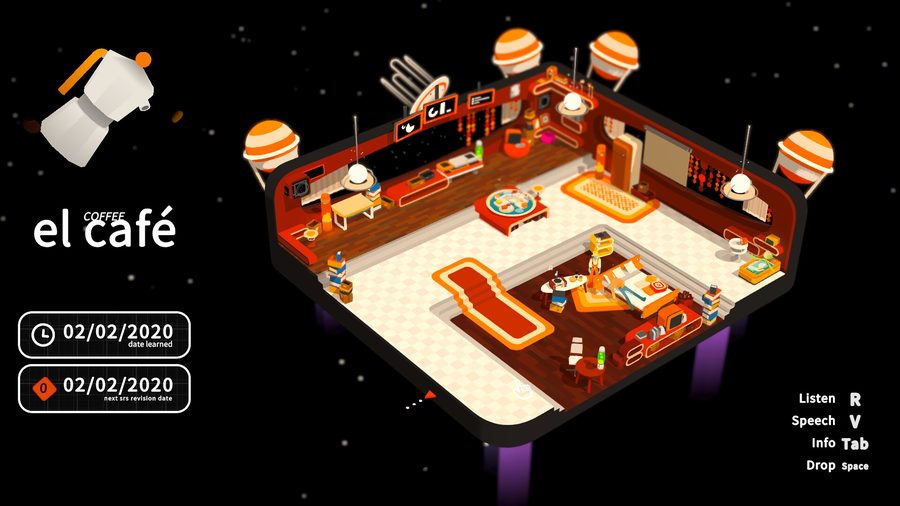
Screenshot from the Noun Town Steam store page, showing a review-scheduling scene
Seven words isn't a lot to memorize on its own, but the pattern behind five of them (Moon, Mars, Mercury, Jupiter, Venus) is a genuinely useful shortcut. If you already know a little Roman mythology or astronomy, you effectively already know most of the Spanish week, you just need to attach the Spanish spelling to knowledge you already have.
Formal study resources back this kind of contextual, meaning-first approach over rote memorization. The Instituto Cervantes, Spain's official body for promoting the Spanish language, places everyday vocabulary like days, dates and routines at the very start of its teaching materials, and the Council of Europe's CEFR framework lists exactly this kind of vocabulary under its A1 (beginner) descriptors, the first proficiency level most learners work through.
This is also the kind of vocabulary that sticks best when it's tied to something concrete rather than a bare word list, which is the whole idea behind our own language learning game. In Noun Town, words like the days of the week show up attached to a specific place and moment in a 3D world, with native speaker audio and spaced repetition bringing them back right before you'd naturally forget them, rather than asking you to drill a table like the one above on its own.
Screenshot from the Noun Town Steam store page, showing a review-scheduling scene
Want to pick up vocabulary like this without a flashcard deck?
Try Noun Town on SteamThe seven days of the week in Spanish are lunes (Monday), martes (Tuesday), miercoles (Wednesday), jueves (Thursday), viernes (Friday), sabado (Saturday) and domingo (Sunday).
No. Unlike English, Spanish does not capitalize the days of the week unless the word starts a sentence or appears in a title. Lunes, martes and the rest are written in lowercase in normal text.
The Spanish week starts on Monday (lunes), following the same convention used across most of Europe and in the ISO 8601 international standard, rather than the Sunday-first week common in the United States.
Sabado comes from the Latin sabbatum, which was borrowed from the Hebrew Shabbat. Spanish and Portuguese kept this Judeo-Christian name instead of the Roman god-based name most other Romance languages kept for that day.
Domingo comes from the Latin phrase dies Dominicus, meaning the Lord's day, reflecting Christian influence. This replaced the older Roman name dies Solis (the day of the Sun), which English kept as Sunday.
Use the definite article el before the day: el lunes means on Monday, referring to one specific day. Spanish does not use a separate word for "on" before a day the way English does.
Use the plural article los: los martes means on Tuesdays or every Tuesday, describing something that happens repeatedly rather than once.
Wednesday, miercoles, is commonly abbreviated as X in Spanish calendars, since M is already used for martes (Tuesday). The full seven-day abbreviation set often used in Spain is L, M, X, J, V, S, D.
All seven days of the week in Spanish are grammatically masculine, so they always pair with el or los, never la or las, regardless of how the word itself sounds.
The standard question is "Que dia es hoy?", meaning "What day is it today?". The answer drops the article entirely: "Hoy es lunes," not "Hoy es el lunes."