Foreign language credit on a homeschool transcript is a record showing a student has completed roughly a year's worth of study in one language, usually backed by 120 to 180 hours of instructional time and some way of demonstrating what the student can actually do with it. A video game can count toward that credit, and plenty of homeschool families already build one into their language plan, but the game by itself is not the credit. The credit comes from the hours you log, the samples of work you keep, and the grade you assign as the parent acting as the school.
Short answer: Yes, a video game can count as homeschool foreign language credit, but only as one piece of a documented course. Colleges and umbrella schools generally expect 120 to 180 logged hours per credit, evidence of what the student produced along the way, and a grade assigned by the parent or evaluator, not just time spent playing.
There is no single national standard for how a foreign language credit gets earned, which is both the flexibility and the headache of homeschooling. Most guidance, including from groups like the Home School Legal Defense Association, points back to the old Carnegie unit convention that public and private schools still lean on: roughly 120 to 180 hours of instructional time equals one full credit, with 60 to 90 hours for a half credit. Some states set their own homeschool statutes, and some umbrella or cover schools have their own rules on top of that, so it is worth checking both before finalising a plan.
What makes homeschooling different is that nobody outside the family is tracking those hours for you. A public school student earns a language credit just by showing up to class and passing the course. A homeschooled student earns it because the parent, acting as the school administrator, decided the hours were completed and the work met a reasonable standard. That is a legitimate and widely accepted approach, but it only holds up if there is a paper trail behind it.
Not on its own, and it is worth being honest about that upfront. A language learning game like Noun Town is genuinely effective at building vocabulary, training listening comprehension, and giving low pressure speaking practice through spaced repetition and native speaker audio. Those are real, substantial parts of learning a language. What a game cannot do by itself is produce the kind of documentation that makes a transcript credible: a course description, a grading rubric, and evidence beyond "the student played for X hours."
Think of the game as the engine and the documentation as the paperwork around it. Colleges reviewing a homeschool transcript are not usually skeptical of games specifically, they are skeptical of any credit that looks like it was awarded without much behind it, whether that is a game, a textbook nobody finished, or a subscription app used for a few weeks and then abandoned. The fix is the same regardless of the tool: show the work.
A few things stay outside what any game, including a good one, can reasonably cover. Formal grammar instruction, sustained writing practice, and spontaneous conversation with another person are the main gaps. Noun Town and similar tools are built around vocabulary acquisition through spatial, contextual learning, spaced repetition, and speech recognition for pronunciation, which is a strong foundation but not a complete language arts curriculum on its own.
Language credit also draws more scrutiny than some other homeschool subjects, simply because it is easier to inflate than, say, a maths credit with clear right and wrong answers. If college applications are on the horizon, it is worth adding at least one outside benchmark somewhere in the sequence, such as a CEFR aligned placement test, an AP language exam, or a community college placement exam. It does not need to happen every year, but having one on file for the final year of study gives an admissions reader something independent to point to.
The part of homeschool record keeping that families tend to find most tedious, logging what was actually learned and when, is close to automatic inside a well built language game. Noun Town tracks which words a student has learned, when they were last reviewed, and how they performed on recall, which turns into a ready made log rather than something you have to reconstruct from memory at report card time. The Noun Town language learning game covers 12 languages with native speaker audio and no ads or paywalled lessons once purchased, a deliberate choice after the team found the ad breaks and locked lesson tiers in most mobile apps made it hard to sit down and just study, a complaint we heard from a lot of other learners too.
For a homeschool family building a multi year language sequence, that consistency matters. A tool the student can return to for 20 minutes a day without hitting a paywall or being pulled into unrelated content is easier to turn into a reliable weekly log than something with variable access.
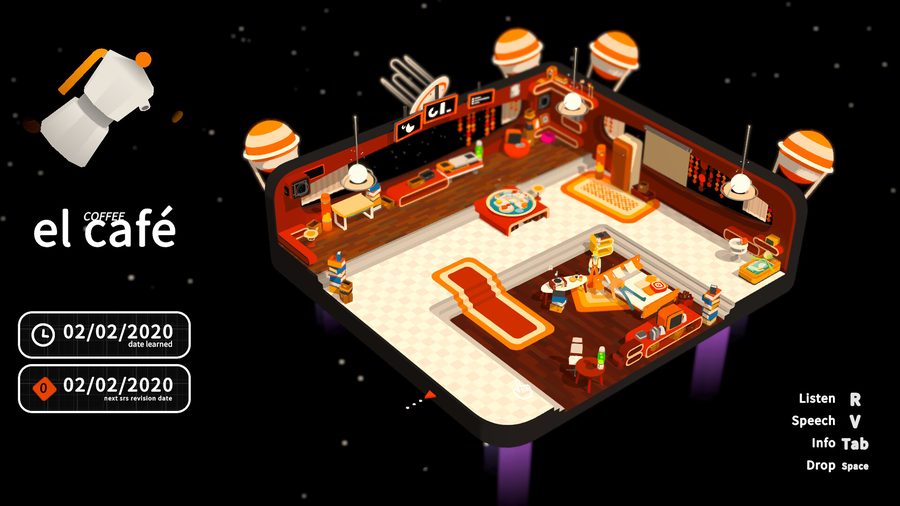
Screenshot from the Noun Town Steam store page, showing the kind of learned and review date tracking that doubles as a study log
Give your homeschool language credit a study log that actually keeps itself.
Try Noun Town on SteamYes, but not on its own. A game can supply real instructional hours and vocabulary progress, but a credit also needs documented hours, dated work samples, and a grade you assign as the parent or evaluator. Games work best as one part of a course, not the whole course.
Most homeschool guidance points to 120 to 180 hours for a full year credit, sometimes called a Carnegie unit, with 60 to 90 hours for a half credit. There is no single national rule, so it is worth checking your state's homeschool statute and any umbrella school policy you use.
Generally yes. Most colleges accept a parent issued transcript for homeschoolers, foreign language included, as long as it is backed by a clear course description and some form of evidence. Selective schools sometimes ask for an outside benchmark, such as a placement test or an AP or CLEP exam, particularly for a subject like language that is easy to inflate without one.
Noun Town works well as the vocabulary, listening and speaking foundation of a course, using spaced repetition and native speaker audio across 12 languages, but it is not a substitute for structured grammar instruction or writing practice. Most homeschool families pair it with a workbook or grammar guide to round out a full credit.
It is not required for every year, but it strengthens the transcript considerably, especially in the final year before college applications go out. A CEFR aligned placement test, an AP language exam, or a community college placement test all work and give an admissions officer something independent to point to.
A short paragraph naming the language, the materials and methods used, the total hours logged, and the skills covered, such as vocabulary size, listening comprehension, reading, and speaking. One or two sentences on how the grade was determined rounds it out.
Yes, and it is one of the more common approaches homeschool families use. The game covers vocabulary, listening and pronunciation efficiently, while a workbook or online grammar course covers sentence structure and writing, together adding up to a well rounded course rather than two disconnected activities.
It is not universally required, but its absence is one of the more common weak points colleges notice in homeschool language transcripts. Speech recognition tools inside a game, recorded conversation practice, or a few sessions with a tutor or conversation partner are enough to cover it without needing a full speaking curriculum.