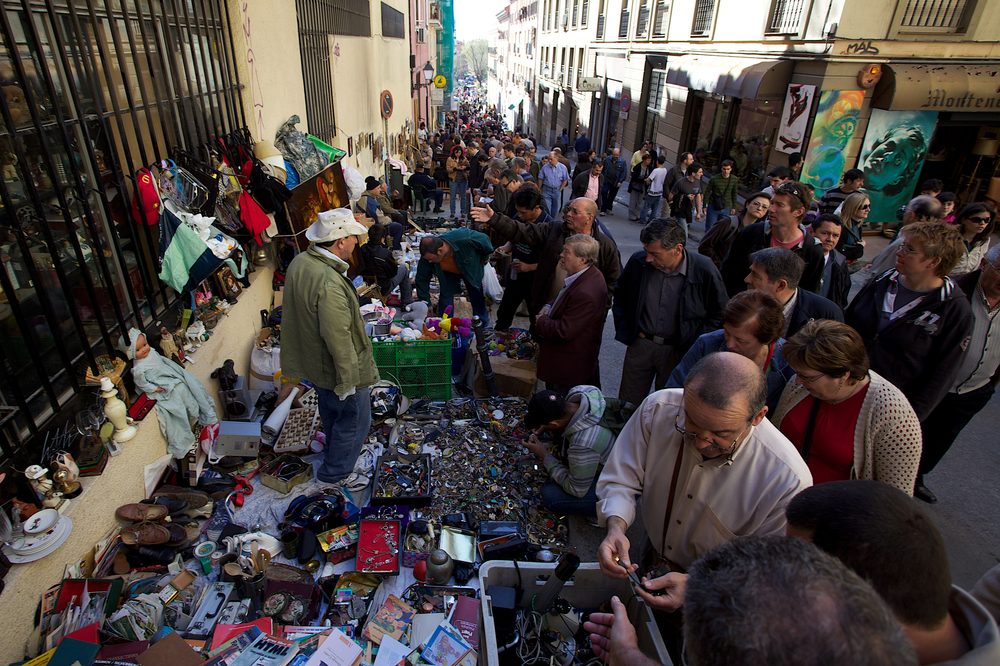
Photo: Duncan Rawlinson / Wikimedia Commons (CC BY 2.0)
Everyday objects in Spanish means the words for the things you use, carry or see around you daily: mochila (backpack), manta (blanket), toalla (towel), caja (box), cuchara (spoon), tijeras (scissors) and dozens more like them. These are some of the most commonly searched Spanish words there are, not because they show up often in textbooks, but because they're genuinely the words a beginner needs first. Below are more than 25 of them, grouped by where you'd actually use them, each with its article and a rough pronunciation.
Short answer: Everyday Spanish object words include la mochila (backpack), la manta (blanket), la toalla (towel), la caja (box), la cuchara (spoon), las tijeras (scissors) and el boligrafo (pen). Spanish nouns are either masculine (el) or feminine (la), and that article is worth learning alongside each word rather than as an afterthought.
These are general household items that show up across nearly every room, the kind of words that are useful from day one whether you're describing your own home or following instructions in someone else's.
| Spanish | Pronunciation | English |
|---|---|---|
| la manta | LAHN-tah (MAHN-tah) | blanket |
| la toalla | toh-AH-yah | towel |
| la caja | KAH-hah | box |
| la silla | SEE-yah | chair |
| la mesa | MEH-sah | table |
| la ventana | ven-TAH-nah | window |
| el estante | ess-TAHN-teh | shelf |
| la vela | VEH-lah | candle |
| el cubo | KOO-boh | bucket |
| el paraguas | pah-RAH-gwahs | umbrella |
Notice the mix of el and la here. There isn't one single rule that predicts gender perfectly, but a useful starting pattern is that most nouns ending in -a (manta, toalla, caja, silla, mesa, ventana, vela) are feminine, while el paraguas is a well-known exception despite ending in -s, not -o. More on that pattern in the grammar section below.
El cubo and el paraguas are also useful examples of words that don't translate one-to-one in every region. Some Latin American countries prefer a different word for bucket, and umbrella terminology varies too, but paraguas and cubo will be understood everywhere Spanish is spoken.
Kitchen vocabulary tends to come up early for anyone actually living in a Spanish-speaking country or household, since it covers the objects involved in cooking and eating together, one of the most repeated daily routines there is.
| Spanish | Pronunciation | English |
|---|---|---|
| la cuchara | koo-CHAH-rah | spoon |
| el cuchillo | koo-CHEE-yoh | knife |
| el tenedor | teh-neh-DOR | fork |
| el plato | PLAH-toh | plate |
| el tazon | tah-SOHN | bowl |
| la olla | OH-yah | pot |
| el microondas | mee-kroh-ON-dahs | microwave |
| las servilletas | ser-vee-YEH-tahs | napkins |
This set is a good example of why learning the article matters: cuchara, tenedor, cuchillo and plato are the four words you'd need for a single place setting, and in conversation people almost always say la cuchara or el tenedor rather than the bare noun, so practicing them that way from the start saves having to unlearn a habit later.
El microondas is also worth a second look, it's one of a small group of Spanish nouns that don't change form between singular and plural (el microondas, los microondas), which occasionally confuses learners expecting an -s ending to always signal a plural.
This group covers what's typically in, or attached to, a school or work bag, another cluster of words that get real, frequent use rather than sitting in a textbook unused.
| Spanish | Pronunciation | English |
|---|---|---|
| la mochila | moh-CHEE-lah | backpack |
| la carpeta | car-PEH-tah | folder |
| las tijeras | tee-HEH-rahs | scissors |
| el boligrafo | boh-LEE-grah-foh | pen |
| el lapiz | LAH-pees | pencil |
| el cuaderno | kwah-DER-noh | notebook |
Tijeras behaves the same way "scissors" does in English: it's almost always used in the plural, las tijeras, since a single pair is thought of as two blades rather than one object. El boligrafo is the standard word for pen across Spain and most of Latin America, though lapicero and pluma also turn up depending on the region, so don't be thrown off if a Spanish-speaking friend uses a different one.
La mochila deserves a special mention simply because of how often it's searched. It's one of the single most-looked-up object words on this topic, likely because it's genuinely one of the first nouns most courses and classrooms introduce.
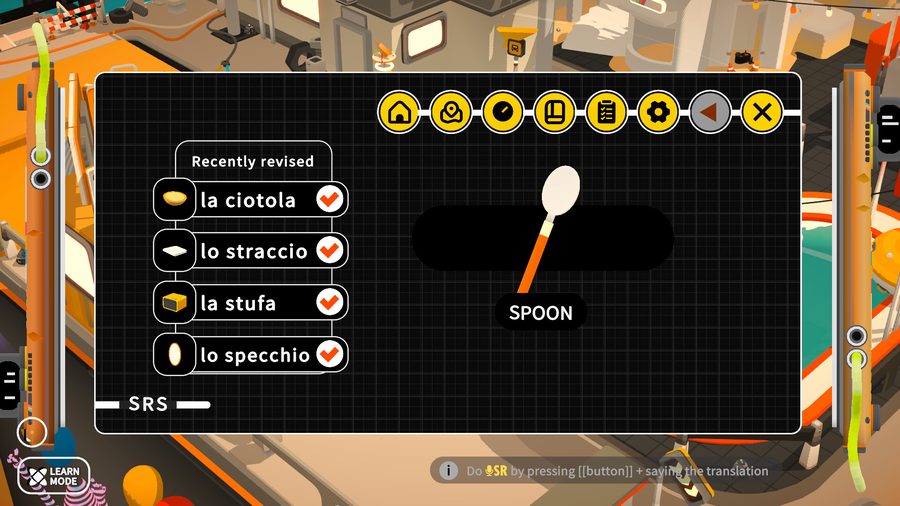
Screenshot from the Noun Town Steam store page, showing the spaced repetition review screen
Every Spanish noun, including every object on this page, is either masculine or feminine, and the article you use (el, la, un, una) has to match. A rough starting pattern, backed by the grammar reference on Spanish nouns, is that most words ending in -o are masculine and most ending in -a are feminine, which explains why la mochila, la manta and la cuchara are feminine while el cuchillo, el tenedor and el plato are masculine.
That pattern is a genuinely useful shortcut, but it isn't a rule without exceptions, el paraguas and el dia (day) both end in vowels that would suggest the "wrong" gender if you applied the -o/-a pattern too rigidly. Rather than memorizing exceptions as a separate list, most learners find it easier to just learn each noun together with its article from the very first time they see it, la mochila rather than just mochila, so the correct gender becomes automatic rather than something to work out on the fly.
If grammatical gender in Spanish still feels like guesswork in general rather than specific to these objects, our separate guide, Is It El or La? Spanish Noun Gender Made Simple, goes through the broader rules in more depth than makes sense to repeat here.
Object vocabulary is exactly the kind of material that official Spanish-teaching resources put right at the start of a beginner's course. The Instituto Cervantes, Spain's official institute for the Spanish language, and the Council of Europe's CEFR framework both place everyday object and household vocabulary under the earliest proficiency descriptors, on the reasoning that these are the words a learner will actually need immediately, in a real room, rather than in an abstract exercise.
That's also the reasoning behind our own language learning game. Rather than presenting mochila or cuchara as an entry on a flashcard deck, Noun Town places each object inside a 3D scene where it actually belongs, a backpack by a school desk, a spoon on a cafe table, paired with native speaker audio and spaced repetition that brings the word back right before it would normally be forgotten.
Whichever method you use, the two habits that make the biggest difference are learning the article alongside the noun from the start, and encountering each word in more than one context rather than a single flashcard, since that's what makes a word stick as usable vocabulary rather than something you can only recognize on a list.
Want to learn words like these in context instead of off a list?
Try Noun Town on SteamCommon everyday object words in Spanish include mochila (backpack), manta (blanket), toalla (towel), caja (box), cuchara (spoon) and tijeras (scissors), covering things used around the house, at school and in the kitchen.
Backpack is mochila in Spanish, a feminine noun, so it takes la: la mochila.
Blanket is manta in Spanish, a feminine noun: la manta.
Mochila is feminine, like most Spanish nouns ending in -a. It always pairs with la or una, never el or un.
Most nouns ending in -o are masculine (el) and most ending in -a are feminine (la), but there are common exceptions, so the safest approach is to learn each noun together with its article rather than guessing from the ending alone.
Spoon is cuchara in Spanish, a feminine noun: la cuchara.
Towel is toalla in Spanish, a feminine noun: la toalla.
Scissors is tijeras in Spanish, and like the English word it's normally used in the plural form, las tijeras, since a pair of scissors is thought of as two blades rather than one single object.
Pen is boligrafo in most of Spain and Latin America, a masculine noun: el boligrafo. Some regions also use lapicero or pluma for the same object.
Learning each word together with its article (la mochila rather than just mochila) and in a real context, such as a sentence or scene, is generally more effective than memorizing a bare word list, and spaced repetition helps the words move into long-term memory.