
Photo: Wikimedia Commons contributor (CC BY-SA 4.0)
Short answer: The dip in motivation usually happens because early beginner gains are dramatic and easy to notice, while intermediate progress is smaller and more spread out. You are still improving, just in ways that are harder to feel day to day. Tracking objective inputs, setting small specific goals, and switching to formats that give you visible feedback, like a game rather than a plain flashcard app, all help carry you through it.
There is a stretch in almost every language learner's journey where the excitement fades and the doubt creeps in. You are not a beginner anymore, so the easy wins have dried up. You are not advanced either, so fluency still feels far away. Nothing about your daily study session feels different from last month, and it is tempting to conclude that nothing is happening.
Something is happening. It just does not announce itself the way it did in week one.
In the first few weeks of learning a language, almost everything is a visible win. You learn to say hello, then order food, then string together a full sentence. Each of these feels like a leap because you are moving from zero to something.
Once the basics are in place, the gains get smaller and more specific. You understand one more word in a fast sentence. You catch a grammar pattern you had missed before. These are real improvements, but they do not feel like leaps, because you are refining an already functional skill rather than building it from scratch.
This slowdown is well recognised, sometimes described as an intermediate plateau, and it shows up across almost every skill that involves gradual mastery, not just languages. The rate of visible progress drops even though the underlying learning has not actually stopped.
Basic greetings, simple sentences, first real conversations. Every session feels like progress because the baseline was zero.
Vocabulary and grammar keep growing, but the improvements are smaller and spaced further apart. This is where most people report losing motivation.
Following a conversation without translating in your head, understanding a show without subtitles. Big, noticeable wins reappear once enough has accumulated underneath.
Vocabulary acquisition and grammar internalisation do not stop during the flat stretch, they just become less obvious. A useful way to think about it: early on you are filling in an empty shelf, so every new item is dramatic. Later you are reorganising and reinforcing a shelf that already looks reasonably full, and reorganising is quieter work.
Spaced repetition, the practice of reviewing words right before you are likely to forget them, is doing a lot of this invisible work. Vocabulary you learned months ago is being reinforced in the background even on days when you feel like you learned nothing new. This is part of why many learners are pleasantly surprised, months later, at how much they actually retained from the "flat" period.
Log words learned, minutes practised, or sessions completed. Objective numbers do not care whether you feel motivated today.
"Learn 50 words about food" beats "get better at Spanish." A specific target gives you a clear finish line.
Swap a flashcard session for a podcast, a game, or a conversation. New input format resets attention even on familiar material.
Reading or listening to something from month one, and finding it easy now, is one of the clearest signals that progress is real.
One thing that consistently helps learners we talk to is finding a format that gives visible feedback even when actual fluency gains are hard to feel. This is where games have a real advantage over plain lesson apps. A level completed, an area unlocked, a streak maintained, these are concrete signals your brain can register as progress, even during a stretch where the underlying language skill is improving more quietly than it did at the start.
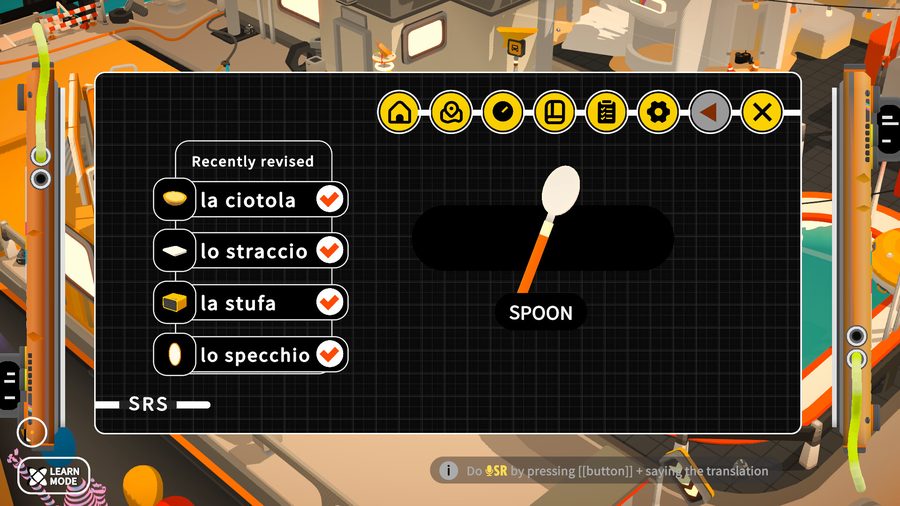
Screenshot from the Noun Town Steam store page, showing the spaced repetition review screen
Behavioural research on motivation, going back to work on operant conditioning and reward schedules, has long shown that visible, frequent feedback keeps people engaged with a task far longer than a reward that is distant or invisible. Fluency is a distant reward. A level-up screen is not.
Noun Town leans into this directly. Rather than a bare progress bar, the game shows you a growing 3D world, unlocked buildings, and a visible list of words you have reviewed and retained, so the plateau feels less like a wall and more like a slower stretch of a journey you can still see yourself moving through. You can try the core idea for yourself in the Noun Town language learning game, including in the free Steam demo before committing to anything.
We also kept the game free of ads and paywalled content once purchased, since nothing kills motivation during a plateau faster than a nag screen asking you to pay again just to keep the momentum you already had.
Sometimes it is not a normal plateau, it is burnout, and the honest fix is a short break rather than a new trick. Studying a language you resent every time you open the app is rarely productive. A week off, followed by a lighter, lower-pressure return, often works better than pushing through with gritted teeth.
Organisations like the British Council and language centres such as the Goethe-Institut both build deliberate variety and lighter review weeks into structured courses for this exact reason. Consistency matters more than intensity, and consistency is easier to sustain when you are not white-knuckling through every session.
Nearly everyone who sticks with a language through the flat stretch eventually hits a moment where something clicks, a conversation flows without translating in your head, a show makes sense without subtitles. That moment only happens because the quiet, unglamorous months before it were doing real work the whole time.
The goal during the dip is not to manufacture excitement that is not there. It is to keep showing up in small, trackable ways until the next visible milestone catches up with the invisible progress that has already happened.
Want a format that keeps the plateau feeling less flat? Try the free Noun Town demo on Steam.
Try Noun Town on SteamEarly progress is dramatic because you go from knowing nothing to recognising basic words quickly. Once you have the fundamentals, further gains are smaller and more spread out, like understanding a slightly harder sentence or catching one more word in fast speech, which are easy to miss day to day.
Yes, it is widely discussed in second language acquisition research and among learners generally, sometimes called an intermediate plateau. It reflects a genuine slowdown in the rate of new, noticeable gains rather than a stop in actual learning.
It varies a lot by person and study intensity, but many learners report a dip somewhere between three and nine months in, once the beginner phase of rapid, visible gains has passed and before advanced fluency milestones start showing up.
Track inputs rather than relying only on how fluent you feel. Word counts learned, minutes of listening practice completed, or a simple streak of sessions done are all objective measures that do not depend on your mood on a given day.
It can help significantly, because games are built around giving visible feedback, level progress, unlocked areas, streaks, exactly the kind of concrete signal that is otherwise missing during a plateau. That feedback can carry motivation through a stretch where raw language ability feels stagnant.
Sometimes, yes. If a method has stopped producing any noticeable engagement, switching to a different format, such as a game, podcast, or conversation practice, can reset your attention even if the underlying content difficulty is similar.
Yes, this is common and usually reflects attention shifting to harder material rather than actual loss of earlier knowledge. Spaced repetition review can help confirm that older vocabulary is still there, which often reassures learners more than they expect.
Many players tell us the open world format keeps sessions engaging even when they are reviewing familiar material, since exploring feels different from repeating drills. There are no ads or paywalled sections to interrupt a session, so nothing gets in the way of that engagement once you own the game.
Set small, specific, checkable goals, such as learning fifty new words in a category or finishing a short native-language video without subtitles, rather than vague goals like feeling fluent. Specific goals give you a clear finish line even when overall fluency is progressing slowly.