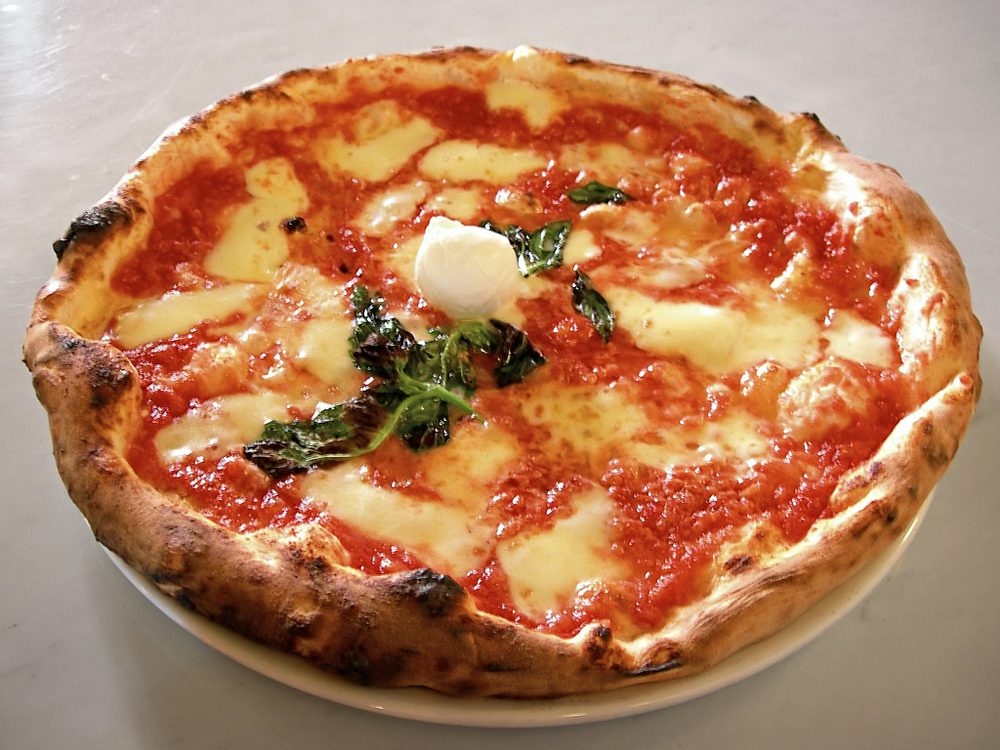
Photo: Valerio Capello / Wikimedia Commons (CC BY-SA 3.0)
Pizza is pronounced PEET-tsah, not PEE-zah, with a crisp double "ts" sound where English readers expect a soft z. Gnocchi is NYOK-kee, not guh-NOH-chee, because the letters "gn" always combine into one nasal "ny" sound. Bruschetta is broo-SKEH-tah, not broo-SHEH-tah, because "sch" in Italian is always a hard k sound, never "sh". Most Italian mispronunciations come down to a small number of letter combinations that look familiar to English speakers but represent completely different sounds. Learn those combinations once and you can read almost any Italian word correctly, including ones you have never seen before. Here is how to say pizza, gnocchi, bruschetta and 17 more Italian food words, along with the mistakes nearly everyone makes.
Short answer: Pizza is PEET-tsah, gnocchi is NYOK-kee, and bruschetta is broo-SKEH-tah, not broo-SHEH-tah. Italian has five vowel letters that represent seven distinct sounds, and once you learn how combinations like ch, sc, sch and gn are pronounced, the 20 food words below become far easier to get right on the first try.
English speakers usually guess Italian pronunciation from the spelling, using English rules, and Italian spelling was never designed with that in mind. The clearest example is "bruschetta". In English, "sch" often softens toward a "sh" sound in borrowed words, so people say "broo-SHEH-tah" with total confidence. In Italian, the rule runs the opposite way: "sch" before e or i is always hard, giving "sk", which is documented clearly in overviews of Italian orthography.
"Gnocchi" causes a different kind of confusion. English has no single letter or combination that makes the sound "gn" represents, a soft nasal "ny" produced with the tongue against the roof of the mouth, similar to the sound in the middle of "onion" or the Spanish letter ñ. Faced with an unfamiliar combination, English speakers often default to reading the g and n as two separate hard sounds, producing "guh-NOH-chee" instead of the correct single-sound "NYOK-kee".
The pattern behind both mistakes is the same. Italian reuses familiar Latin letters, but assigns some of them different jobs than English does, and those jobs are perfectly consistent once you know them. Unlike English, there is no long list of exceptions to memorise separately for every word.
A short list of rules explains almost every food word mispronunciation. Learn these eight patterns and menus stop being a guessing game.
c before e or i makes a soft "ch" sound, as in "ciao" or "cena"ch before e or i makes a hard "k" sound, as in "chianti" or "chilo"g before e or i makes a soft "j" sound, as in "gelato"gh before e or i makes a hard "g" sound, as in "spaghetti"sc before e or i makes a "sh" sound, as in "pesce" or "prosciutto"sch before e or i makes a hard "sk" sound, as in "bruschetta"gn makes a single "ny" sound, as in "gnocchi" or "lasagna"gli makes a soft "ly" sound, as in "tagliatelle" or "aglio"Notice that "c" and "sc" behave the same way as each other depending on the vowel that follows, and so do "ch" and "sch". Once that pattern clicks, an entire category of Italian words becomes predictable rather than something to memorise one word at a time.

Screenshot from the Noun Town Steam store page, showing a timed listening challenge
Here is a working phonetic guide for 20 common Italian food words. These are simplified for English speakers rather than formal transcriptions, but they will get you close enough to be understood and, more importantly, to hear the pattern once you start listening for it in real Italian speech.
| Word | Say it like | Note |
|---|---|---|
| Pizza | PEET-tsah | Doubled "zz" gives a crisp "ts", not a soft z |
| Gnocchi | NYOK-kee | "gn" is one nasal sound, never g then n |
| Bruschetta | broo-SKEH-tah | "sch" is always hard k, never "sh" |
| Prosciutto | proh-SHOO-toh | "sci" before u gives a soft "sh" |
| Parmigiano | par-mee-JAH-noh | "gi" before a is a soft "j" sound |
| Mozzarella | moht-sah-REL-lah | Doubled "zz" again makes a firm "ts" |
| Risotto | ree-ZOT-toh | Single "s" between vowels is often voiced, like an English z |
| Gelato | jeh-LAH-toh | Soft "j" sound, not a hard g |
| Espresso | ess-PRESS-oh | Never "expresso", there is no x sound |
| Cappuccino | kah-poo-CHEE-noh | "ci" before o is a soft "ch" sound |
| Minestrone | mee-neh-STROH-neh | Final "e" is always pronounced, never silent |
| Calzone | kahl-TSOH-neh | Single "z" often gives a "ts" sound here too |
| Bolognese | boh-loh-NYEH-zeh | "gn" plus a fully pronounced final "e" |
| Focaccia | foh-KAH-chah | "ccia" gives a soft "ch" sound before the final a |
| Tiramisu | tee-rah-mee-SOO | Stress falls on the final syllable |
| Ricotta | ree-KOH-tah | Doubled "tt" holds slightly longer than a single t |
| Pancetta | pan-CHEH-tah | "c" before e is soft "ch", not hard k |
| Ciabatta | chah-BAH-tah | "ci" before a is a soft "ch" sound |
| Arancini | ah-ran-CHEE-nee | "ci" before i is soft "ch", plural of arancino |
| Ravioli | rah-vee-OH-lee | Every vowel is short and clearly separated |
Most Italian food word mistakes fall into a small number of repeatable patterns, which is good news because it means fixing a handful of habits clears up most of the list at once.
Rules explain the theory, but pronunciation is a physical habit, and habits change through repetition, not through reading a table one more time. Listen to a native speaker say a word, repeat it immediately, and do that several times in a row before moving to the next word. This is a slower process than skimming a pronunciation guide, but it is the part that actually rewires how your mouth produces the sound.
A tool with speech recognition built in makes this much easier, since it tells you when your attempt is off rather than leaving you to guess. This is one of the reasons Noun Town's language learning game pairs every word with native speaker audio and a speak-back exercise rather than just showing the spelling, since reading a word correctly and saying it correctly are genuinely different skills that need separate practice, especially in a language like Italian where the spelling rules are consistent but unfamiliar to English speakers.
If you want to go further into the formal rules behind Italian pronunciation, the Accademia della Crusca, Italy's oldest linguistic academy and the leading authority on the Italian language, publishes detailed guidance in far more depth than a single article can cover. For most learners though, a short daily habit of listening and repeating will fix the bulk of these mistakes within a few weeks.
Want to practice Italian food words and hundreds more with native speaker audio?
Try Noun Town on SteamPizza is pronounced PEET-tsah, with a crisp, doubled "ts" sound in the middle, not the soft English z used in words like "pizzazz".
Gnocchi is pronounced NYOK-kee. The letters "gn" combine into a single "ny" sound, similar to the Spanish letter n with a tilde, so the word never starts with a hard g sound.
It is brusketta, broo-SKEH-tah. In Italian, the letter combination "sch" before e or i always makes a hard k sound, never "sh", so "brushetta" is a common English mispronunciation rather than a valid alternative.
In English, "ch" almost always makes the soft sound heard in "church". In Italian, "ch" only appears before e or i and always makes a hard k sound instead, as in "chianti" or "chilo". The soft English-style ch sound in Italian is actually written with a plain "c" before e or i, as in "ciao".
The Italian letter combination "gn" is a single nasal sound, close to the "ny" in the English word "canyon", and appears in common words like gnocchi and lasagna. It is never pronounced as a hard g followed by an n.
Italian has five vowel letters but seven distinct vowel sounds, since e and o each represent two different sounds depending on the word. Unlike English, every vowel is short and pure, with no diphthong gliding between sounds.
Italian spelling is highly consistent compared to English. Once you learn a small set of rules for combinations like c, ch, sc, sch, gn and gli, you can pronounce almost any Italian word correctly on sight, including ones you have never seen before.
Listen to native speaker audio rather than guessing from English spelling, repeat each word out loud multiple times, and ideally use a tool with speech recognition that can tell you when your version does not match. The letter rules explain the theory, but repetition against real audio is what actually fixes the habit.
For ordering food, native speakers will almost always understand you regardless. For learning Italian more broadly, it matters more than it seems, since the same letter combinations that trip people up on food words, like sc, sch and gn, appear constantly throughout the rest of the language.