
U.S. Navy photo / Wikimedia Commons (public domain)
Short answer: Not really, if you're judging it as an actual game. Duolingo is a lesson app with gamification layered on top, streaks, points, leagues, badges, rather than a game with a world or real interactive systems. Gamers who want genuine gameplay tend to get more out of language learning games built as actual 3D worlds, like Noun Town, which costs $19.99 as a one-time purchase versus Duolingo's ad-supported free tier or Super Duolingo subscription.
Duolingo gets called "gamified" so often that a lot of people assume it counts as a game outright. It is worth separating those two ideas, because they are not the same thing, and the difference matters a lot if you are someone who already spends real time in actual games.
I say this as someone who builds a language learning game for a living, so take the framing with that in mind. But the distinction between gamification and gameplay is a real one in game design circles, not something I'm inventing to make a point.
Gamification is the practice of taking a non-game activity, in this case language lessons, and adding game-like reward structures on top: streaks that punish missing a day, points for completing exercises, leaderboards against other users, badges for milestones. None of this changes what you are actually doing, which is still working through translation drills and multiple choice exercises. It just changes how the app frames your progress.
This is genuinely effective at building a daily habit. Streaks and rewards are a well-studied example of behaviour change design in consumer apps, and they get people opening the app far more consistently than a plain flashcard tool would. That is a real, useful achievement, not a criticism.
A real game, in the sense most gamers mean it, is built around interactive systems: choices that have consequences, a world you move through, mechanics you get better at over time. Digital game-based learning research draws this same distinction, treating gamified apps and genuine educational games as related but different categories with different effects on engagement and retention.
Underneath the streaks and leagues, a Duolingo lesson is still a sequence of exercises presented one after another. There is no world to explore, no character to talk to, no choice that changes what happens next beyond which answer you tap. For someone who plays actual games regularly, that structure can start to feel thin fairly quickly, points accumulating without much underneath them.
| Gamification (Duolingo-style) | Real game (Noun Town-style) | |
|---|---|---|
| Core loop | Lesson exercises with points on top | Explore a world, interact with objects and characters |
| Habit driver | Streaks, leagues, notifications | Wanting to keep playing for its own sake |
| Session feel | Task to complete App wins on speed | Activity you choose to spend time in |
| Pricing model | Free with ads, or subscription | One-time purchase Game wins long term |
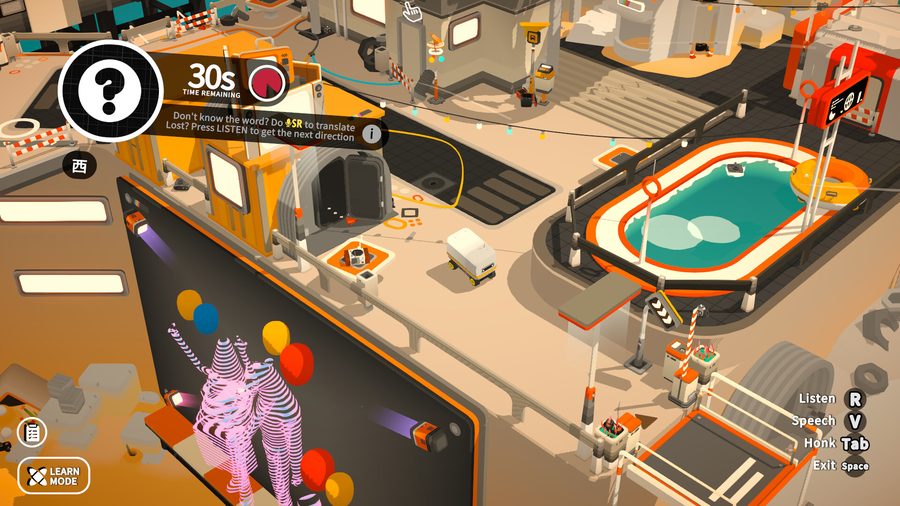
Screenshot from the Noun Town Steam store page, showing an interactive vocabulary challenge
Talk to people who identify as gamers about language apps and a pattern shows up quickly: they are not opposed to learning through play, they are opposed to thin play. The complaints are rarely about the vocabulary itself, they are about the format feeling more like a chore with a scoreboard attached than something they would choose to spend an evening in.
None of this means Duolingo is a bad product, it clearly works for a huge number of people, and its scale and language breadth are genuinely impressive. If your goal is a quick daily habit across a two-minute gap in your day, on a phone, across dozens of possible languages, its lesson format and streak system do exactly what they're designed to do.
It also remains a reasonable free starting point for anyone unsure whether they want to commit further to a language at all. The barrier to trying it is close to zero, which is not nothing.
Where it tends to fall short is specifically for people who already know they like games and are hoping the "gamified" label means they will get a game-like experience. That expectation gap is usually where the disappointment comes from, not from the underlying language content being bad.
Games built specifically as games, rather than lesson apps with rewards bolted on, put the interactive system first. In Noun Town, vocabulary is attached to a 3D open world you actually walk around in, with native speaker audio, spaced repetition scheduling and speech recognition built into how you play rather than added as a separate rewards layer. For someone who already spends leisure time gaming, that structure tends to feel far more natural than a lesson screen with a flame icon next to it.
The spaced repetition underneath still does the same scheduling job either format relies on, resurfacing words right before you're likely to forget them. The difference is whether that review happens inside something you were already enjoying, or as a separate task competing for your attention against an actual game you'd rather be playing.
Want to see what a language game built for actual gamers looks like? Try the free demo on Steam.
Try Noun Town on SteamNot in the sense most gamers mean. Duolingo uses gamification, points, streaks, leaderboards and badges layered onto lesson exercises, but it does not have a world, characters or the kind of interactive systems that define an actual game.
Gamification adds game-like rewards, points, streaks, badges, to an otherwise non-game activity to make it feel more motivating. A real game is built around interactive systems, a world or activity you engage with for its own sake, where any learning happens as a byproduct of play rather than the direct point of every screen.
Gamers who are used to real interactive systems, exploration, choice and consequence often find streak-and-points gamification thin, since the underlying activity is still a repetitive lesson format rather than something with genuine gameplay depth.
Yes. Games like Noun Town are built as actual 3D worlds you explore, with vocabulary attached to objects, characters and environments rather than delivered through a streak-based lesson screen, which tends to suit players who already spend time in game worlds.
Streaks are effective at getting people to open an app daily, which matters for habit formation. But daily opening is not the same as deep learning, and many long-streak users report their vocabulary and speaking ability lag behind how long they have technically used the app.
Duolingo offers a free tier supported by ads and limited hearts, plus a paid Super Duolingo subscription that removes ads and unlocks unlimited practice, typically priced as an annual subscription rather than a one-time purchase.
Look for a tool with an actual explorable world or interactive systems, not just point counters layered on drills. Speech recognition, spaced repetition tied to gameplay, and a one-time purchase instead of a subscription are also worth checking for.
Yes, and the strongest language learning games do both, using genuine interactive systems as the core experience while still layering progress tracking, achievements and spaced repetition on top for structure and motivation.
No. Noun Town has no adverts and no content locked behind an additional paywall once you own the game, a deliberate decision made after the team got frustrated with ad-supported and freemium mobile apps themselves.
It depends on why Duolingo isn't working for you. If you are bored rather than struggling with content, a genuine game is worth trying. If you specifically need structured grammar teaching, pairing a game with a grammar resource tends to work better than switching entirely.