
Photo: Humphrey Muleba / Wikimedia Commons (CC0)
Short answer: If you are tired of Duolingo's streaks, owl notifications and repetitive matching drills, a language learning game is worth trying instead. Games like Noun Town replace the lesson format with an explorable 3D world where you pick up vocabulary through native speaker audio, spoken practice and spaced repetition, without a daily streak to maintain or a mascot nudging you back in.
Duolingo is a genuinely clever piece of software. Millions of people have used it to get a foothold in a new language, and its habit-forming design is studied in product circles for good reason. But a lot of people, especially the ones who already spend their evenings gaming rather than doing app-based lessons, hit a wall with it after a few months. The streaks stop feeling motivating and start feeling like a chore. The lessons start to blur together.
If that sounds familiar, you are not the only one, and there is a different way to approach the same goal.
The pattern shows up often enough that it has a name in language learning communities: Duolingo fatigue. It tends to follow a similar shape.
None of this makes Duolingo a bad product. It makes it a specific kind of product, one built around short daily check-ins and habit loops, and that format simply does not suit everyone, particularly people whose relationship with screens is already built around actual games rather than productivity apps dressed up as one.
This is the part that surprises people who assume "language game" just means Duolingo with a coat of paint. Noun Town, which I work on, is a real 3D game distributed on Steam like any other PC or Mac title. There is no lesson counter. You walk around an open world, talk to characters, and pick up vocabulary attached to the things you see and do, an apple on a stall, a direction sign, a conversation with a shopkeeper.
Underneath the world is a spaced repetition system, the same underlying technique used in flashcard tools like Anki, which resurfaces words right before you are likely to forget them. You also get native speaker audio for every word, and speech recognition so you can practise actually saying things out loud, not just recognising them on a screen.
The difference is not that the technique is new. Spaced repetition and native audio exist in plenty of apps too. The difference is what it feels like to sit down with it. Nobody accidentally loses two hours to a flashcard app. People regularly lose two hours to a game, and if that game happens to be teaching Spanish the whole time, that is a lot more exposure than a five-minute streak check delivers.
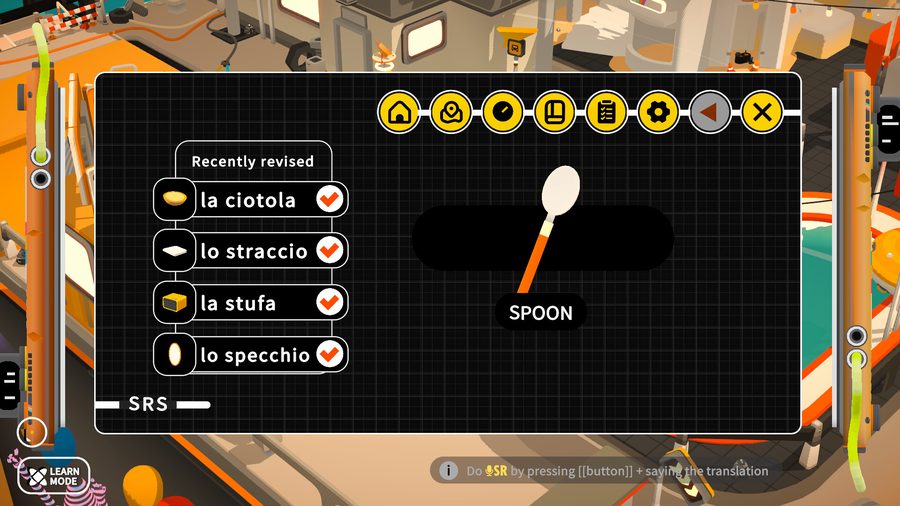
Screenshot from the Noun Town Steam store page
It is worth being specific about what changes when you swap a streak-based app for a spaced repetition game, because the two systems are trying to solve different problems.
Rewards showing up every single day, regardless of whether you actually needed to review anything that day. Missing one day can feel like failure, even if your memory of the material is fine.
Rewards reviewing a word right when you are about to forget it, whether that is tomorrow or in three weeks. Stepping away for a while simply means more words are waiting when you return, not a broken streak.
For a lot of recovering Duolingo users, this alone removes most of the anxiety that made the app feel like a task rather than a hobby.
Duolingo's free tier comes with ads and a limited hearts system. Removing both requires Duolingo Super, a recurring subscription that runs somewhere between $84 and $168 a year depending on plan and region. Over two or three years that adds up considerably.
Noun Town is a single purchase of $19.99 on Steam, covering all 12 supported languages for life, with no ads and nothing locked behind a further paywall. That was a deliberate decision, not an accident. Before building the game, the team used the big mobile language apps themselves and got frustrated by the same things a lot of players complain about, ads breaking up a lesson and content sitting behind another paywall just as things got interesting. After hearing the identical complaint from thousands of other learners, the game was built the other way around: one purchase, everything included.
There is also a free demo on Steam if you want to see whether the world and the vocabulary system suit you before spending anything.
A game is not automatically the right answer just because an app has burned you out. Here is a reasonable way to think about whether to switch.
If instead you specifically want a bite-sized daily habit and do not mind the streak pressure, Duolingo's format may still suit you better, and there is nothing wrong with that. This is about matching the tool to how you actually behave, not declaring one format universally superior. You can read more about how the game itself is built on the Noun Town language learning game page.
People who make the jump from an app to a game usually describe the same shift: sessions get longer without feeling longer, and the guilt of missing a day disappears because there is no counter tracking it. Whether that trade-off suits you depends entirely on what kept you coming back to Duolingo in the first place. If it was genuinely the habit loop, a game might not replace that feeling. If it was mostly inertia and the fear of losing a streak you no longer cared about, switching tends to feel like relief rather than loss.
Either way, the underlying goal is the same: getting enough consistent exposure to a language that it starts to stick. The format you choose should be whichever one you will actually keep opening.
See what a proper Duolingo alternative looks like with the free Steam demo.
Try Noun Town on SteamMost people quit within the first few months, and the usual reasons are repetition fatigue, the pressure of maintaining a streak, and lessons that feel disconnected from real conversation. Duolingo itself has published research showing a large share of new users stop using the app within weeks.
A game like Noun Town replaces the lesson-and-streak structure with an explorable 3D world where vocabulary appears in context, attached to objects, characters, and situations rather than isolated flashcards or matching drills.
It is built with that audience in mind. Noun Town runs on Steam like a normal PC and Mac game, with an open world to explore, native speaker audio, and speech recognition practice, rather than a mobile app interface adapted to look game-like.
No. Noun Town has no streak counter and no penalty for stepping away. Its spaced repetition system simply resurfaces words you have not reviewed in a while when you come back, rather than shaming you for missing days.
No. Noun Town has no adverts and no content locked behind a further paywall once purchased. The team built it this way deliberately after using ad-supported language apps themselves and finding the experience frustrating, a complaint they heard echoed by thousands of other learners.
Noun Town is a one-time purchase of $19.99 covering all 12 supported languages. Duolingo's ad-free subscription tier runs roughly $84 to $168 a year depending on the plan and region, so the cost gap widens the longer you use either product.
Noun Town currently supports Japanese, Korean, Mandarin Chinese, Spanish (Spain and Mexico), French, German, Italian, Russian, Greek, Egyptian Arabic and English, all included in the single purchase.
Yes. Noun Town has a free demo available on Steam, so you can explore the world and try the vocabulary system before deciding whether it fits how you like to learn.
Research into digital game-based learning suggests vocabulary encountered in a meaningful, interactive context is often retained at least as well as vocabulary drilled through flashcards, and games tend to produce longer voluntary sessions, which increases total exposure over time.
Noun Town is a PC and Mac title distributed through Steam, so it runs on Steam Deck as well as a standard desktop or laptop, giving gamers the option to review vocabulary away from a desk.